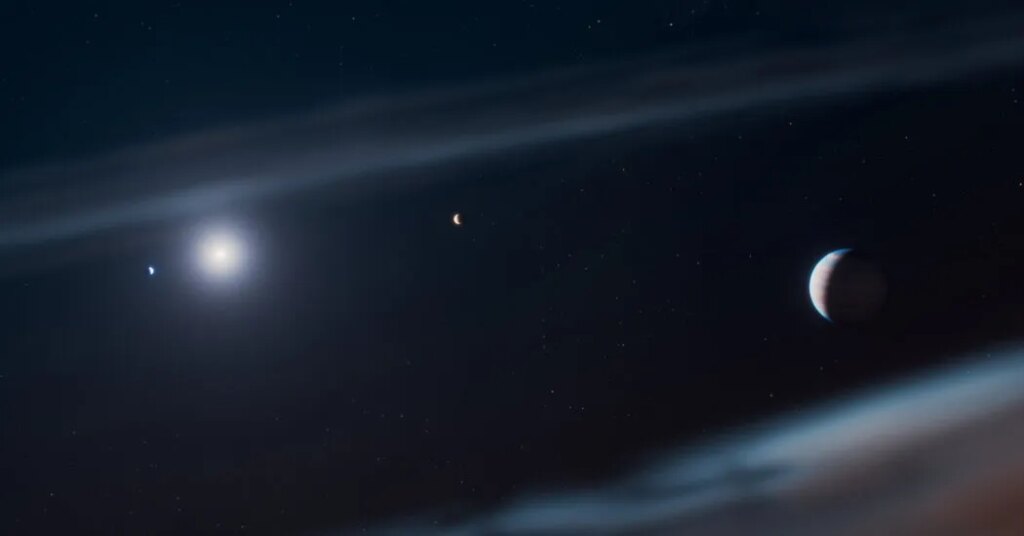
Radio waves streaming from an alien planet may offer a new tool in the hunt for life elsewhere in the universe.
Astronomers have spotted these waves coming from what seems to be an aurora at the poles of Beta Pictoris b, a planet that circles a star more than 63 light-years from Earth. The aurora is probably caused by a powerful magnetic field, according to the research team.
If so, it would be the first confirmed magnetic field on a planet outside our solar system, and it could be a precursor to finding more worlds that might host life. The findings, which have yet to be peer-reviewed, were posted online on Sept. 15.
“It is really exciting,” said Imke de Pater, a planetary scientist at the University of California, Berkeley, who was not involved in the paper. “Nobody has seen radio emission from a planet in this way.”
Earth’s magnetic field protects the planet’s atmosphere — and the conditions for life on the surface — from being blown away by radiation flowing off the sun. That’s partly why astronomers have been keen to find such fields on alien worlds.
“Habitability is probably one of the main reasons we’re interested in magnetospheres,” said Yvette Cendes, an astronomer at the University of Oregon who is an author of the paper.
Detecting magnetic fields on alien worlds is hard, but one trick is to look for radio emissions from the planets. A magnetic field will funnel electrons to a planet’s poles, producing auroras like the ones we see on the worlds of our solar system. When those electrons hit the poles, they can bounce back, releasing radio waves.
Kevin Ortiz Ceballos, a graduate student at the Harvard-Smithsonian Center for Astrophysics in Cambridge, Mass., and his colleagues started by looking for radio emissions from a variety of stars using the MeerKAT radio telescope. MeerKAT is an array of 64 antennas spread across Meerkat National Park in South Africa and is one of the most advanced radio telescopes in the world.
In 2025 and early 2026, the team spotted something on Beta Pictoris b. The planet was discovered in 2008 through direct imaging: Astronomers saw the faint blip of light from the planet by blocking the light of its much brighter host star. It is nearly twice the size of Jupiter and is about 12 times as massive.
Follow-up observations this May helped the team pinpoint radio emissions from Beta Pictoris b that seem to correspond to “very strong magnetic activity,” Mr. Ceballos said.
“We could actually distinguish the positions of the star and planet and figure out that the emission was coming from the planet,” Mr. Ceballos said. “We’re really pushing what this kind of telescope can do.”
The frequency of the radio waves reveals the potential magnetic field’s strength. Earth’s is about 0.5 gauss, which is a tiny fraction of the strength of a bar magnet. Jupiter’s is more intense at up to 14 gauss. Beta Pictoris b, by comparison, would have an “extraordinary” magnetic field strength of at least 1,250 gauss, Mr. Ceballos said.
Mary Knapp, a planetary scientist at M.I.T. who was not involved in the paper, called the finding a “pretty solid result.” We have seen hints of magnetic fields on exoplanets before, but until now there has been no direct detection. “I hope this is the start of more,” Dr. Knapp said.
Beta Pictoris b’s magnetic field would be similar in strength to those of large objects known as brown dwarfs, failed stars up to 80 times as massive as Jupiter. But exactly why it would be so strong is unclear. It could be related to the young age of the planet, barely 25 million years old, Mr. Ceballos said. Younger planets are hotter, and so have more energy to drive the dynamo that powers a magnetic field.
Or the field could be caused by something more speculative, like a moon orbiting the planet. In our solar system, Jupiter’s moon Io feeds its aurora by spewing charged particles from its myriad volcanoes into the planet’s atmosphere. However, no conclusive evidence for a moon has yet been found around Beta Pictoris b.
Aside from habitability, astronomers are excited about alien magnetic fields because they allow humans to study the interiors of distant planets in a unique way. We know these fields are normally driven by the spin of a planet’s core, so it’s likely that something similar is happening inside Beta Pictoris b. “You have a giant dynamo system creating this gigantic magnetic field,” Dr. Cendes said.
Astronomers want to examine smaller planets in the future for magnetic fields.
But rocky planets like Earth would have much weaker fields, and our planet’s atmosphere is “like a completely opaque wall” blocking their radio emission, Mr. Ceballos said. To find them, we would need to place radio telescopes in space or on the far side of the moon.
Until then, giant worlds — like Beta Pictoris b — will be easier to assess. “It’s been really beautiful to have studied this,” Mr. Ceballos said, “and finally measure the magnetic field of an exoplanet.”
The post Radio Waves Coming From an Alien Planet May Be a Cosmic First appeared first on New York Times.