Years ago, Kaia Wynne became enraptured by anime series such as “My Hero Academia.” Wynne, 21, began dressing up as characters from the show, such as the spiky-haired Kirishima, and sharing the look with online cosplay communities and at anime conventions where she met fellow fans.
But sometimes, when Wynne has posted TikTok videos about her anime cosplay, some commenters have repeatedly lobbed a word at her: LARPing, or being a LARPer. They said they doubted her anime credentials.
Live-action role play had long referred to a community of people who portray certain characters and create an immersive world together — à la the tabletop game Dungeons & Dragons. Now, the acronym has a snarky newfound incarnation. Instead of describing a niche subculture, LARPing has been deployed by Gen Z and Gen Alpha online to call someone out for being supposedly inauthentic, putting on airs or acting as an armchair expert.
You might upload an image of a sleek black Porsche that’s not yours, interspersed with clips of a penthouse suite you are just visiting in Miami: LARPing as a wealthy person. Showing up at study hall and not doing anything; becoming a bandwagon fan of a team or a musician; taking a photo in first class and then walking back to economy, where your actual seat is. LARPing has come to mean flexing a lifestyle that isn’t true to you.
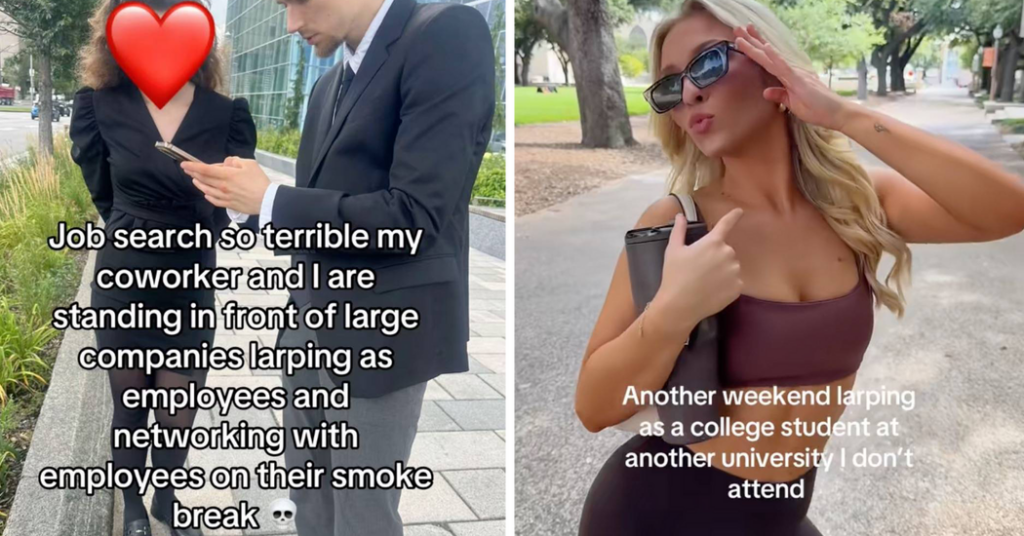
The term has circulated online for years but hit critical mass over the last few months. That’s when Macy Grisonichi, 19, first heard about it. “Now people are using it as their new vocabulary word,” she said. Grisonichi recently posted a video of herself roaming the University of Texas campus and LARPing as a student there; she attends a different Texas university.
Wynne suspects that the term has become “a replacement for ‘poser,’” a throwback taunt accusing someone of posturing. But Steven Dashiell, an assistant research professor at Morgan State University, senses a key distinction: “Being labeled a poser was something that could trigger a purity test, and in the sense of, ‘Are you really who you say you are?’” he said. “Whereas with LARPing, it is more: ‘I’ve already made up my mind that you aren’t who you say you are.’ It’s more of a condemnation, whereas poser can be challenged.”
No amount of earnestness or knowledge, it seems, can stop a fan from being accused of LARPing online. “When people are coming out and saying, ‘Oh, I just got into anime — I really like it,” Wynne said, “‘I’m kind of into K-pop now,’ everyone’s going to be like, ‘LARP — you weren’t there back then. Like, you’re a fake fan.’” In this new form, the acronym is deployed as a form of policing others’ behavior.
Longtime role players are perplexed by the word’s newfound online implications. “LARP” first appeared in print in the ’70s, around the time Dungeons & Dragons became a cultural phenomenon. As the popularity of role-playing games grew, some players began live role-playing games in locations like parks, dressing up as characters and acting out scenes and battles they imagined. In the early 1980s, a moral panic linked to D&D sent role players underground and stigmatized the activity.
“Some of the early stigma was around people supposedly not knowing the difference between fantasy and reality — so being too into what’s happening rather than faking it,” said Sarah Lynne Bowman, an associate professor of game design at Uppsala University.
But the role-play community has always had a symbiotic relationship with pop culture, and in recent years hobbies once labeled geeky have been recast in Marvel movies, while the tech industry pushed nerdiness mainstream. The tabletop game Mage: The Ascension is said to have heavily influenced “The Matrix.” The 2008 bro comedy “Role Models” also positively portrayed role players.
“We have this tech bro situation now where the people that traditionally would have been marginalized for these interests are now in positions of power,” Bowman said.
The word came to encompass performative behavior in recent years against the backdrop of A.I.-generated content, influencer culture and powerful algorithms that make it hard to discern what’s real online. “People want to know the authenticity of what it is they’re running into online, and are more vigilant about it, and we’re getting some outgrowth of words relating to those things,” said Jessi Grieser, an associate professor of linguistics at the University of Michigan.
In recent months, though, there has been an aspirational sheen to “LARP” videos, with dozens of TikTokers using it to manifest a better life for themselves.
In August, Anna Andriambeloson, 24, of Montreal, stopped in front of a banking company with a friend amid their job search: “larping as employees and networking with employees on their smoke break,” read the caption of a video they made.
“If you want to be in that space, then you need to act as if you belong in that space,” Andriambeloson said. In other words, LARP has morphed into a new shorthand: Fake it until you make it.
For Andriambeloson’s friend, it worked: She got a job referral.
The post How LARPing, a Gaming Term, Became a Word for Posers appeared first on New York Times.