Mohamed bin Zayed was worried about Iran—so worried, in fact, that he decided to gamble with his nation’s future. “We are living in a dangerous neighborhood,” the crown prince of Abu Dhabi and de facto leader of the United Arab Emirates told the top U.S. Air Force general in February 2007. Iran’s effort to acquire nuclear weapons, he said, must be delayed “by all means available.” But MBZ, as the crown prince is known, was acutely aware of what public opposition to the ambitions of its much larger neighbor—and $7 billion trading partner—could cost his tiny state. “I am putting my country at risk and placing myself in a dangerous spot,” he told General Michael Moseley. So he had an urgent request to make of the United States. He wanted a complete multilayered missile shield in place by the summer of 2009, to protect the Emirates against Iranian retribution.
American officials could scarcely conceal their glee. MBZ’s request was the payoff of a year-long campaign to enlist the UAE in their effort to curtail Iran’s nuclear program. They understood that unless the Emirates could defend itself against an Iranian missile barrage, this was unlikely to happen. For a decade, the American weapons manufacturer Raytheon had been trying, unsuccessfully, to persuade the Emiratis to invest in its Patriot air-defense system, but UAE officials were skeptical of its efficacy. However, by 2007, the United States had something new to offer—a system so technologically advanced that it didn’t fully exist yet.
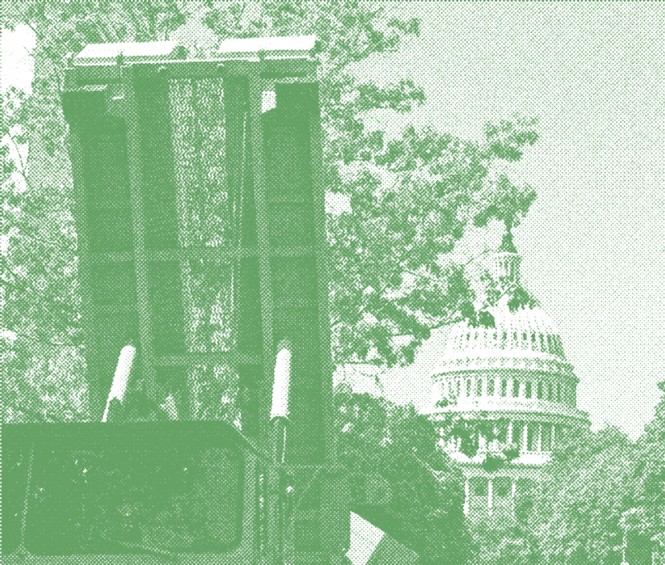
The dream of an anti-ballistic-missile shield dated back to the Reagan administration’s Strategic Defense Initiative. At the time, the idea of firing one missile to hit another missile mid-flight, like shooting a bullet to hit another bullet, was derided as “Star Wars.” But in the late 1990s, after Star Wars had been quietly abandoned, Lockheed Martin scientists proved that it was actually possible for a bullet to hit a bullet. They dubbed their system Terminal High Altitude Area Defense, or THAAD. It was designed to be mobile. The final product was a large, rectangular set of launch tubes carried on the back of a snub-nosed military transport truck. The launch tubes could pivot backwards, like the bed of a dump truck, and point the missiles skyward before firing them. It hardly looked high-tech.
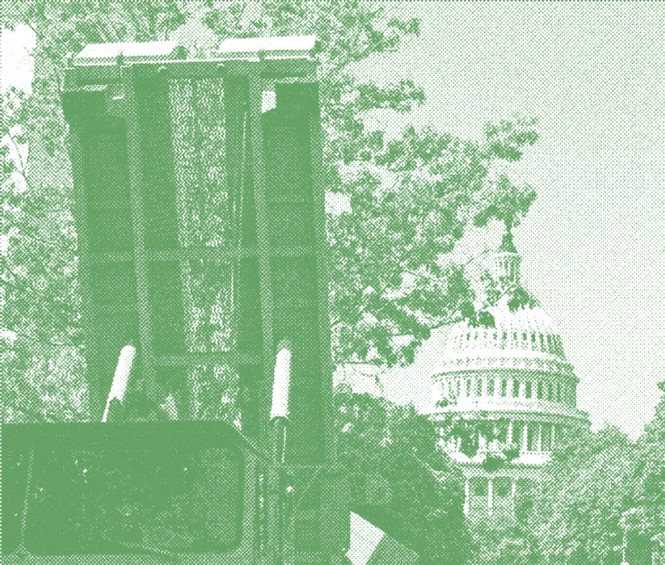
Earlier that day in 2007, technicians from Raytheon and Lockheed had explained to MBZ that, in spite of the launcher’s humble appearance, it was the linchpin of a cutting-edge system. The THAAD functioned as part of a network of devices. After space satellites detected a missile launch, giant, land-based radar systems would track the missile in flight. A mobile THAAD battery could aim its interceptors and fire. Then an infrared sensor in the THAAD missile’s nose cone would become its eyes, as an onboard computer adjusted its course in fractions of a second.
[Read: How the U.S. squandered its strategic advantage]
The Pentagon had devised a new system, called the Bilateral Air Defense Initiative, that would employ the THAAD as part of a triple-layered defense, backed up by the Patriot system and short-range air defenses, or SHORAD. These would all be wired to a new early-warning radar system that could spot incoming missiles. The THAAD was at the zenith of this system because it could hit missiles in the upper atmosphere. The Patriot could intercept missiles that got through, hitting them at lower altitudes. The SHORAD could protect troops.
U.S. diplomats and military brass did not emphasize that the system had only just been approved for production. The first THAAD missiles would not even be delivered until 2011. But MBZ was sold. It would take only 46 seconds for an Iranian missile to reach the UAE, and the THAAD could protect the country’s oil refineries, skyscrapers, museums, and airports. The Emiratis soon made U.S. missile-defense systems a “top priority” for their military spending, according to State Department cables. “For the Emiratis, Iran is a primordial obsession,” one cable reported in 2009. The UAE would become the first foreign country to buy and deploy the THAAD.
In 2022, this bargain proved its worth when a THAAD interceptor knocked down Houthi missiles aimed at the UAE. By that time, Saudi Arabia had also purchased the THAAD, in 2017. Two years later, in 2019, Israel participated in a THAAD training exercise, and it was lent a U.S. THAAD battery in 2023. By early 2026, the THAAD was the umbrella that protected U.S. interests and allies across the Middle East. It seemed to promise security.
But the war with Iran has exposed the flaw in this scheme. The THAAD was never designed to protect an entire country. As capable as the system might be, it was created with a narrow mission in mind: to protect U.S. troops in combat for an extremely limited time. The Army, which oversaw air-defense systems like the THAAD, had wanted a system that could fend off an initial wave of missile attacks long enough for U.S. fighter jets and naval destroyers to fully respond. “What you needed to do was just survive the first salvo, right? Protect your high-value military deployments, the ports, right from the initial salvo, and then we just go destroy them, and the war’s over,” John Ferrari, a retired Army major general who supervised the THAAD system when he was the commander of the White Sands Missile Range, told me.
In the war with Iran, the THAAD has worked precisely as designed—but not at all as promised. The system performed well in the early days of the conflict, intercepting Iranian ballistic missiles with impressive accuracy. But the U.S. has not destroyed many of Iran’s missile launchers, and the war is far from over. And despite planning for just such a conflict for two decades, the U.S. failed to take the steps necessary to convert the THAAD into a system that could provide protection for as long as it would be relied upon to do so.
The U.S. neither amassed a stockpile of THAAD interceptors large enough to see it through a war, nor figured out how to build new ones fast enough to replace them as they are fired. Those are hardly unique failures. Throughout the U.S. military, as the war with Iran grinds on, exquisitely engineered systems are running out of the munitions necessary to make them work. But nowhere are those failures more stark, or more consequential, than with the THAAD.
In 2024, after nearly 20 years of procurement, the United States had a stockpile of no more than 534 THAAD interceptor missiles, according to Pentagon documents. The Emiratis had somewhere between 190 and 290 THAAD missiles, according to arms-sales notifications and Pentagon records. The Saudis, who had just gotten their first THAAD battery up and running, had a stockpile of unknown size. These stockpiles turned out to be a precious national resource for all three countries. Over the past year, though, the stockpiles have been rapidly spent down.
The munitions spending began in earnest last summer, when Israel and the United States struck Iran, eliciting a wave of missile attacks that triggered the interceptors. The spending accelerated this year, when both countries attacked Iran in force and unleashed a munitions-draining war. During 10 months of conflict in the Middle East, the United States burned through a stockpile of THAAD missiles that took roughly nine years to build. Nearly 80 percent of that stockpile is gone, according to recent estimates by CNN. The drawdown has led to a scramble. The Army has rotated THAADs out of South Korea to backfill supplies in the Middle East, while the Pentagon hopes to invest billions of dollars in a race to produce more THAAD missiles—a project that will be finished in 2030 in the best-case scenario.
Munitions stockpiles have long been a neglected element of U.S. military strategy. Pentagon budget writers favor flashier line items, such as new fighter jets and naval destroyers. And munitions procurement relies on a fragile U.S. industrial base that is plagued by points of failure. They are produced by large U.S. defense contractors—such as Lockheed Martin, which makes the THAAD—whose business models constrain them from ramping up production even when a missile shortage is evident.
The THAAD-missile deficit is part of a larger emergency, reflecting patterns that cut across the U.S. munitions supply. The United States and its allies have also burned through supplies of Patriot interceptors, which are often fired in concert with the THAAD. The Tomahawk, an offensive missile, has been used at such a rate that prewar stockpiles won’t be replenished for another four years, according to the Center for Strategic and International Studies. Stockpiles of other offensive missiles, with names like JASSM and PrSM, have been drained to levels that will take months to replenish.
[Read: The one variable that could decide the war]
The missile depletion has reverberated throughout America’s network of military alliances. The point of many arms sales, former Assistant Secretary of State John Hillen told me, is to bind the militaries of U.S. allies with U.S. forces. “Part of our diplomatic framework was to ensure better cooperation in real-time situations,” said Hillen, who played a key role in selling the UAE on the THAAD. “It’s helpful for people to have the same kit, as the Brits would say.” By selling the THAAD and other systems interoperable with those used by the American military to key allies, the U.S. hoped to bring them more closely into the American orbit.
But countries that joined the club are now finding that their membership doesn’t guarantee speedy access to U.S. missiles. Switzerland ordered a suite of Patriot interceptors after Russia invaded Ukraine in 2022, but was recently told to expect a four-to-five-year delay. The Swiss are now looking for other suppliers. The Polish military recently refused a U.S. request to send its interceptor missiles to the Middle East to backfill supplies. Denmark abandoned an $8.5 billion order for Patriots after deciding to prioritize the speed of acquisition, choosing a different system made in Europe. Soon after the U.S. launched Operation Epic Fury in February against Iran, Saudi Arabia announced a new security pact with Ukraine to access Kyiv’s cheaper anti-drone weapons. Many of America’s allies are now looking for a Plan B.
Each THAAD interceptor is essentially assembled by hand, piece by piece, at a Lockheed Martin production facility in Troy, Alabama. Lockheed declined to offer a tour of the plant, citing national-security concerns, but photographs from inside the factory show why production is so time-consuming and expensive. Rows of partially assembled missiles line the floor, their half-open interiors exposing a maze of tubes, circuits, wires, and sensors. Employees sit on wheeled chairs alongside the missiles and painstakingly connect new components. If one connection is faulty, or one circuit board is bad, the result is worse than useless—an interceptor that misses isn’t just a waste, but a squandered opportunity to save lives. Each missile costs about $12 million.
As intricate as the assembly might be, Lockheed’s factory in Troy is actually one of the simpler parts of the THAAD production chain. The industrial base behind the THAAD traces back to hundreds of suppliers that provide microchips, infrared sensors, rocket motors, and specialized fuel propellant. Building this industrial ecosystem was almost as complicated as inventing a missile that could hit a missile; the complexity hindered THAAD production for many years. In 2016, for example, a third-party supplier changed its manufacturing process for a connector that went into the THAAD without telling Lockheed Martin. This caused problems that shut down THAAD production for months.
To complicate matters further, the THAAD was born within the kind of bureaucratic labyrinth that only the Pentagon seems capable of creating. The missile itself was developed and purchased by a Pentagon branch created to accelerate high-tech missile innovation, renamed the Missile Defense Agency in 2002 by the George W. Bush administration. But once the agency designed and purchased the THAAD interceptors, it handed them over to the Army to operate. This built an unresolved tension into the THAAD system from the beginning, in ways that limited the stockpile: The Missile Defense Agency was used to operating with a large budget; the Army was in the habit of pinching pennies.
Major General Ferrari, who oversaw THAAD procurement for the Army, told me the Army resisted pouring money into the THAAD program because of its cost. He bristled when the MDA presented the Army with the bill for new THAADs. “You’re like: Dude, you know, I’m over here eating at McDonald’s, and you’re there at the three-star Michelin restaurant, right? Like, I can’t afford this, right? And that was the tension,” Ferrari said. The Army has struggled ever since to shoulder the THAAD’s high cost. Maintenance work on a THAAD battery deployed in Guam was conducted under a tarp rather than a proper hangar, according to a Government Accountability Office report.
The purchase of interceptor missiles was also hindered over the years by the THAAD’s underlying strategic mission that it would be needed only to protect against the first salvo. This short-term use didn’t justify keeping an enormous supply of expensive missiles in reserve. The first-salvo concept was baked into THAAD purchasing when the Pentagon set the missile’s Acquisition Program Baseline, even as the THAAD was being promoted as the keystone piece of homeland-defense shields for foreign countries. Program baselines can be revisited over the years, but they tend to acquire a persistent inertia that carries forward.

The THAAD purchases were further constrained after 2011, when Congress and the Obama White House were at loggerheads over the budget. Congress had devised a budget-cutting plan, called “sequestration,” that was supposed to be a radical bargaining tool, imposing Pentagon spending cuts that the White House found unacceptable. But the negotiations failed, and sequestration arrived.
Frank Kendall oversaw weapons procurement at the Pentagon during the period of sequestration. He spent several months of every year engaged in contentious horse-trading sessions among military branches and various offices under the secretary of defense that were fighting for money within the annual budget. Each military branch submitted its ideal budget in June. Every service had a wish list, but there was never enough money to go around. The service branches tended to fight for their premier-weapons systems, such as fighter jets, tanks, and destroyers. In the best-case scenario, missile stockpiles were treated as a lower priority. More often, they were treated as the best budget line to slash in order to afford pricier platforms. It was easy to dial up or dial down the number of missiles purchased in a given year, making them a ripe target for cuts.
“You can slice it a little bit. It’s like salami slicing, right? You trim a little bit off, get a little bit of money,” Kendall told me. “Munitions tend to be things that people won’t fight for as much.”
The U.S. THAAD stockpile was built in a slow drip over many years. By 2014, the United States had 48 THAAD interceptors, according to Pentagon procurement documents. In the 2015 fiscal year, only three THAAD missiles were delivered to the MDA. The following year, another 43 missiles were delivered. By 2022, the United States had built a stockpile of roughly 460 THAAD interceptors, according to procurement documents that outlined how many interceptors had actually been delivered (573 had been ordered).
In February of that year, Russian President Vladimir Putin invaded Ukraine.
The flow of missiles to Ukraine began in earnest in late 2021, when U.S. intelligence agencies sensed that Putin might be gathering his forces for an invasion. In the years that followed, the United States sent Javelin missiles, Patriot interceptors, TOW missiles, Stinger missiles, and other munitions to the country. The THAAD was never given to the Ukrainians, but the war would draw down stockpiles of Patriot interceptors, which are an integral part of the same multilayered defensive shield.
The Biden administration orchestrated the movement of missiles to Ukraine using a novel technique called the Presidential Drawdown Authority, an obscure arms-transfer law enacted in the 1960s. The PDA system was initially designed to shift small amounts of equipment from the U.S. to its allies, and was capped at transferring about $100 million worth of materiel each year. In 2022, Congress raised that cap to $11 billion, and then raised it again to $14.5 billion the following year.
[Read: Ukraine may be just the ally America needs]
The PDA was an imperfect vehicle for massive arms transfers. The system didn’t contain a formal mechanism to ensure that U.S. missile stockpiles were replenished at the same rate that they were being drawn down. The Pentagon hastily created a new committee to oversee arms shipments to Ukraine, called the Cross Department Working Group. When the Government Accountability Office asked the Pentagon to provide the formal guidelines for the missile shipments to Ukraine, instead of furnishing a detailed policy paper, the undersecretary of defense for policy provided a set of four slides.
By September 2023, Pentagon officials were concerned about the rate at which U.S. stockpiles were being depleted. The Cross Department Working Group adopted a new policy that month, requiring Pentagon planners to consider whether Congress had provided enough money to refill stockpiles before new shipments could be sent to Ukraine, according to the GAO. In January 2024, the Pentagon paused shipments under the PDA program until Congress could provide the money to replace what had been sent. Congress eventually approved $13.4 billion in replenishment funds that April, and the PDA shipments resumed.
Meanwhile, more munitions had begun to flow to Israel in October 2023, after Hamas had launched a brutal assault, taking more than 200 hostages, and Israel had responded by attacking Gaza. The Biden administration had set up a new system for arms transfers to Israel, largely avoiding the PDA. During the first six months of that effort, the United States made 42 deliveries totaling some 4 million munitions to Israel, according to the Pentagon inspector general’s office. This covered everything from artillery shells to guided missiles.
In 2024, a young Army Reserve lieutenant colonel named Sandra Thomas arrived in Washington to take a new job as the defense industrial base chief inside the office of the Joint Chiefs of Staff. The depletion of missiles and munitions was, by then, an urgent issue. “There were munitions working groups stood up. It’s something that was briefed once a day to different generals,” Thomas told me.
Thomas loves supply chains. She attended college on an ROTC scholarship, and once she was commissioned, she moved straight into logistics. When she left active duty in 2015, she became a supply-chain manager at a Michelin tire factory in South Carolina, a graduate-level crash course in corporate logistics. Thomas orchestrated the flow of crucial minerals, bead wires, and other components as they were fed into the factory, and helped organize the global delivery of finished tires. Then Thomas went back on active duty, and by 2020 she was the quartermaster in charge of the U.S. air base in Erbil, Iraq. She was like a city manager, overseeing a town of thousands in a place where summer temperatures can top 110 degrees Fahrenheit.
But even for someone like Thomas, the U.S. missile supply chain proved frustrating. She was assigned to a team that tried to figure out how the Pentagon could buy all the missiles it needed for the future. The missiles were made by some of the largest and most profitable defense contractors in the world, but those companies were in no position to ramp up production. “They can’t go anywhere. They have no room to surge,” Thomas said.
The Joint Chiefs’ office studied the issue for months, and the results were sobering. Pentagon analysts had set hypothetical targets for increased production of missiles such as the Patriot, the THAAD, and the JASSM. The idea was to see what it might take to expand assembly lines, replenish stockpiles, and have munitions to share with allies. For many common missile systems, doubling production or even boosting it by 60 percent would cost tens of billions of dollars up front. More concerning, even if the funding were available, hitting that increased rate of production would take three years to six and a half years for some missiles.
A Pentagon study from 2018 helped explain why. America’s defense industry faced “an unprecedented set of challenges,” the report concluded. The missiles were powerful, but the defense industrial base that made them was fragile. The industry had consolidated to the point that just two companies received 97 percent of the missile spending. If those companies had a problem, it became the Pentagon’s problem.
These prime contractors relied, in turn, on small manufacturers that had been hurt by the economics of deindustrialization. Just one company in the United States made a vital rocket-fuel chemical called ammonium perchlorate, creating a dangerous single point of failure. If the Pentagon wanted to boost production, it would somehow need to reach back into the supply chain to address these problems.
Thomas and her team met with defense-industry officials and asked them about their supply chains. The top defense contractors were well aware of the problems with missile production; they had been openly talking about them for years. “The tragedy of Ukraine has unveiled some issues and weaknesses for our national-defense enterprise more broadly,” Lockheed Martin CEO James Taiclet told investment analysts during a conference call in 2023. In a later call, he likened the situation to a Dirty Harry movie, where the hero is in danger of running out of bullets. Taiclet told investors in 2024 that Lockheed was trying to address “fragility” in the missile-production system. “We’ve taken an all-hands-on-deck approach where we’ve seen the issues become more significant,” he said.
Thomas was less than impressed with their efforts. She often crossed paths with defense contractors at war games and conferences. When she pressed the defense companies on plans to expand their factories, she mostly encountered roadblocks. They said they couldn’t share proprietary technology with subcontractors, for instance, and couldn’t afford to build a new assembly line unless they had long-term contracts to lock in demand or up-front payments to fund the expansion. But the same companies were simultaneously doling out generous cash payments to their shareholders in an effort to keep stock prices high. Lockheed Martin, for example, gave $6.8 billion back to shareholders in the form of dividends and stock buybacks in 2024 alone, while RTX gave its shareholders $3.7 billion that year.
Thomas rotated out of her job in the Joint Chiefs’ office in July 2025. She was discouraged. Despite the big problems with missile production, the system seemed to be locked in stasis. “I think we’ve identified the problem, but we definitely can’t stop continuing to solve it,” she told me at the time. But, she said, as bad as things were, it still wasn’t the worst-case scenario: “I think that we haven’t hit rock bottom, for sure.”
Seven months later, President Trump launched Operation Epic Fury.
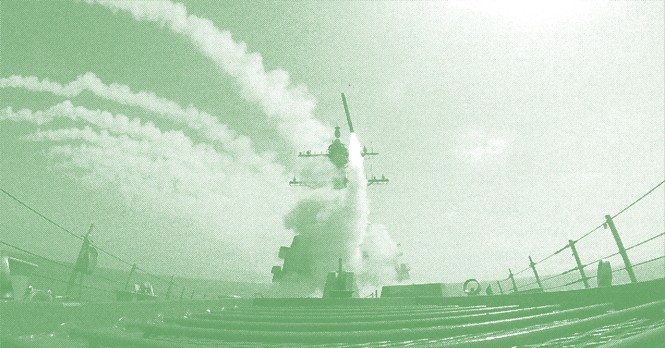
There are 11 THAAD batteries in the world. The United States owns eight, the UAE owns two, and the Saudis have activated one, according to the Saudi Press Agency. (Saudi Arabia has purchased additional batteries, but only one has been reported as active.)
At least five THAAD batteries were based in the Middle East in February 2026. Three of those belonged to the Emiratis and Saudis. In April 2025, Israeli media confirmed that a second THAAD battery was delivered to Israel. Another U.S. THAAD battery was moved to Jordan, where there is a major Jordanian base hosting U.S. forces. Each battery holds 48 interceptor missiles. The U.S. government does not disclose the locations of THAAD batteries, or how many backup missiles are kept in stockpiles in the region.
The United States and Israel launched a joint attack on Iran on February 28, hitting more than 7,000 targets in the first few weeks. The U.S. has not released specific figures on how many munitions it used before the cease-fire in April, or on the level of stockpiles remaining. But outside analysts have formulated their own estimates. The United States used more than 11,000 munitions, costing $26 billion, in the first 16 days of the conflict, according to the Royal United Services Institute for Defence and Security Studies, a British think tank. The Center for Strategic and International Studies estimates that the United States used 1,060 to 1,430 Patriot interceptors before the cease-fire, amounting to more than half of the prewar stockpile. Based on reporting in The New York Times and The Wall Street Journal, CSIS calculates that the U.S. used 1,000 Tomahawk missiles and roughly 1,100 JASSM missiles, depleting those stockpiles by a third and a quarter, respectively.
The THAAD missile was one of the most important of all the American and allied munitions, and it was used promiscuously. More than 150 THAADs were used during the 12-day war of 2025, according to CSIS, while 190 to 290 were used during Operation Epic Fury. CSIS estimates that the United States had only 452 THAAD interceptors left at the beginning of that operation. More interceptors have likely been delivered this year, however. The CSIS estimates that the current U.S. stockpile contains roughly 250 THAAD interceptors.
One truth revealed about the THAAD this year is that it works quite well. The system knocked out ballistic missiles in the upper atmosphere with impressive reliability. But a second truth revealed about the THAAD was that it was facing a threat for which it was not well designed. The Iranians employed a new form of warfare that military analysts call “precision mass,” combining the threat of a limited number of precision-guided missiles—a technology perfected and dominated by the United States since the Cold War—with the power of cheap drones and ballistic missiles.
The THAAD interceptors, which cost $12 million, were used to shoot down Iranian missiles like the Ghadr, which costs an estimated $5 million. Iran had been building these missiles for years, and it was able to send waves of them, depleting the reserves of THAAD interceptors. Iran also fired a newer generation of missile, called the Khorramshahr-4, that can maneuver on its final descent, making it more difficult for a THAAD to hit.
While these missiles rained down from the upper atmosphere, Iran simultaneously dispatched large numbers of Shahed drones, which cost $20,000 to $50,000 apiece. The THAAD is no good against Shaheds, and the Patriot missiles are too scarce to waste in shooting them down. Countries like the UAE scrambled to knock down Shaheds by using attack helicopters and expensive air-to-air missiles fired from jets.
Iran attacked the UAE with particular ferocity. On March 3, Iran launched 186 ballistic missiles and 812 attack drones at the Emirates, according to Axios. Several dozen drones and only one ballistic missile made it through, according to Emirati officials, but the attack strained the U.S. system that was envisioned back in 2007, which tied together the THAAD and Patriot interceptors.
At the start of the war, debris from Iranian drones hit the international airport in Abu Dhabi and the luxury Fairmont hotel in Dubai. Images of the flames and smoke were shared on social media, damaging the Emirates’ hard-won reputation as an oasis of peace and prosperity. The Dubai International Airport, a global transit hub, was also hit that day, and attacked again on March 7 and 11. On March 10, Iranian drones struck a large oil refinery in the remote town of Ruwais, causing a fire and shutting down production. At least three foreign workers were killed in the Emirates in the early days of the war. One of them, a Pakistani driver named Murib Zaman, was reportedly killed by falling debris from an intercepted missile.
Similar attacks unfolded across the region, in Saudi Arabia, Kuwait, Bahrain, Qatar, and Israel. In the Israeli towns of Arad and Dimona, Iranian ballistic missiles made it through the air-defense system on March 21, at a time when the Israeli military was triaging scarce interceptors, according to analysts.
When critics attacked Reagan’s “Star Wars” program in the 1980s, they said the idea of a missile-defense shield rested on a fallacy: A missile shield needed to work perfectly, all the time, or it effectively wouldn’t work at all. If just one or two nuclear missiles made it through, the value of the entire endeavor would be undercut. The shield would have done little more than provide a false sense of security.
A similar logic applied to the Middle East this year. When Mohamed bin Zayed considered purchasing the THAAD, he characterized the decision in near-existential terms, according to a State Department summary of his comments. “MbZ recognizes that partnership with the US is fundamental to the UAE’s continued success,” a 2009 State Department cable reads, “but he also knows that the relationship is controversial among his people, and that if the U.S. is perceived as an unreliable protector, his own power base will erode.”
That raw calculus is now driving strategic reassessments across the region. U.S. military bases, once considered protective shields, now look more like targets. Large investments in U.S. weapons systems are being recalculated for their value against precision mass. Alliances built over years are up for renegotiation—in May, the United Arab Emirates left the OPEC oil cartel in a bid for more independence, dealing a blow to regional alliances.
[Brynn Tannehill: The dangerous mismatch between American missiles and Iranian drones]
The United States’ inability to rapidly defeat Iran or to fully protect its allies could have far-reaching effects on the U.S. position in the Middle East, Stephen Wertheim, a senior fellow at the Carnegie Endowment for International Peace, told me. The Middle East has played a pivotal role in the U.S.-dominated economic system that has existed since World War II. The primary U.S. strategic interest in the region was to keep oil flowing to global markets, powering the global economy. U.S. military bases and interventions ensured that this system survived, Wertheim said. If those bases are abandoned or U.S. allies drift away, the entire system could be at risk. “We could be moving away from a Middle East that can be fairly described as being an American-dominated region,” Wertheim said.
And the damage to America’s reputation will hardly be limited to that region. “For roughly the rest of the Trump administration, we will be running an experiment where the United States is significantly less capable in its defensive capabilities on a global basis,” Wertheim said, as munitions stockpiles continue to dwindle.
After a pause in May, the United States and Iran resumed hostilities this summer. On July 17, an Iranian missile penetrated U.S. air defenses and killed three U.S. soldiers stationed at Muwaffaq Salti Air Base, in Jordan. All three soldiers were assigned to air-defense units, and the base was home to a U.S. THAAD battery. It’s not clear if the THAAD was even deployed during the attack. The Iranians had borrowed tactics the Russians had developed in the Ukraine war, battering U.S. air defenses with a mix of drones and missiles. Seth Jones, an analyst with CSIS, published an essay in the The Wall Street Journal warning that the U.S. had been “slow to learn” the lessons of warfare in the age of precision mass.
Jones recommended that the U.S. military begin acting more Ukrainian. It can erect anti-drone nets and concrete barriers, install drone-jamming devices, and dig new underground bunkers. It’s hardly the stuff of science fiction, like the THAAD. But it just might keep service members alive.
The post The THAAD Delusion appeared first on The Atlantic.