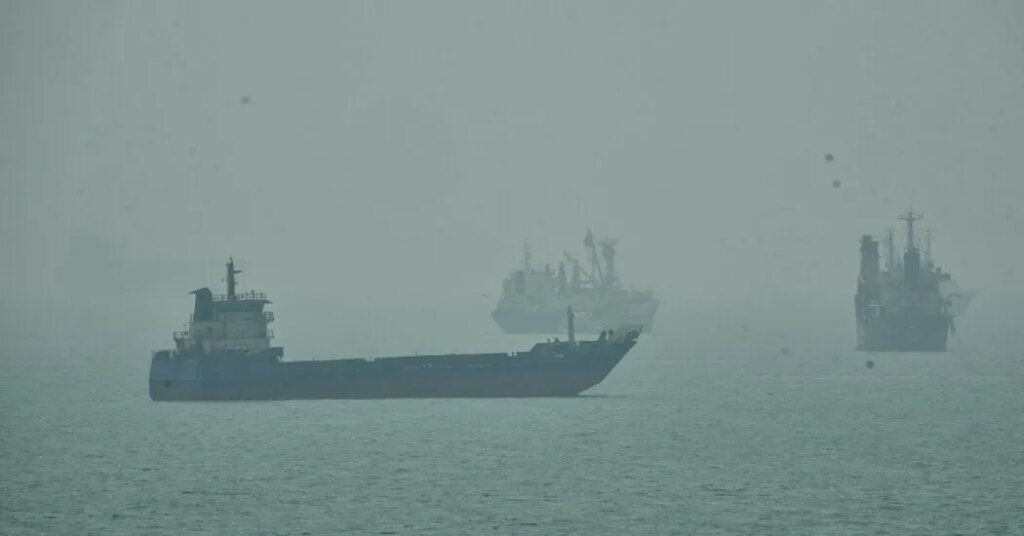
Oil exports from the Middle East have risen sharply this month, some oil analysts say, taking them closer to the level they were at before Iran shut down the Strait of Hormuz in March, a rebound that could ease some pressure on global energy prices.
In September, an average of 10 million barrels of oil has gone through the waterway daily, according to Kpler, a firm that tracks oil tankers. Separately, six million barrels of crude a day has left the Persian Gulf states this month through pipelines and ports that bypass the strait, Kpler’s data shows.
Before the war with Iran began at the end of February, around 19 million barrels of crude left the region daily through the waterway and other routes. Because of the difficulty in tracking tankers, export totals supplied by analysts might not reflect the true flow of oil, but most experts say volumes rose significantly this month.
The turnaround has most noticeably occurred in the strait, even though Iran continues to attack tankers. A U.S. military operation aimed at protecting the vessels from the attacks appears to have encouraged more shipments by big exporting countries, like Saudi Arabia and the United Arab Emirates.
“They are getting a substantial amount of oil out, and it is increasing over time as shippers’ confidence goes up,” said Eugene Gholz, an associate professor of political science at the University of Notre Dame and an expert on conflict in the strait.
President Trump, members of his administration and U.S. military officials have said for weeks that the Strait of Hormuz is open, and that tankers are moving oil through the strait.
Some analysts say the increase in oil exports shows that Iran may be losing its grip on the waterway. In recent months, a U.S. blockade has prevented Iran from exporting oil on tankers, cutting off a valuable source of revenue for the country.
“That tells me the pressure is on Iran, not the United States,” said Martin Navias, a senior research fellow at the Center for Defense Studies at King’s College London.
Despite the success in getting more oil out, the per-barrel price is still well above where it was before the war, and higher gasoline and diesel prices are weighing heavily on consumers around the world.
Even with the recovery in Gulf oil exports, the global supply is below what the world needs, said Dan Pickering, chief investment officer for Pickering Energy Partners, a financial services firm based in Houston.
“We’re still dealing with a tight market,” Mr. Pickering said.
The 10 million barrels of oil a day that Kpler says is going through the strait is a big improvement from the trickle that made it through early in the war. But it is still well below the 16 million barrels a day that went through before the war.
Some tanker tracking firms have lower numbers. TankerTrackers.com calculates that 7.4 million barrels of crude a day has gone through the strait this month.
Daniel Sternoff, a senior fellow at Columbia University’s Center on Global Energy Policy, cautioned against relying on a single number from a tracker, noting that the firms’ totals often diverge. Still, he added, “They do all point to an increase of flows over September.”
Experts warn that Iran could yet step up its attacks on tankers and the energy infrastructure of the Gulf states, which could cause a drop in supply and another rise in the price of oil. A big pipeline in Saudi Arabia that bypasses the strait was shut down after it was attacked this month.
“Iran certainly has a big array of options to escalate if it wanted to,” said Jim Krane, a fellow in Middle East energy studies at Rice University’s Baker Institute for Public Policy. “To me, it looks like they’re holding back.”
And some who have been focused on the situation for months said it was hard to declare the strait truly open.
While oil is getting out in larger volumes, the U.S. military protection requires significant resources and will be hard to maintain indefinitely. Even with protection from the United States, many tankers have been hit when trying to traverse the waterway, deterring some shipping companies from returning.
The strait “is not open to navigation, because it’s not safe,” Arsenio Dominguez, the secretary general of the International Maritime Organization, a United Nations agency, said in an interview last week. According to the group, 85 ships have been attacked since the war began, and 24 mariners have died.
Matt Smith, director of commodity research at Kpler, said that although Gulf crude exports were around 85 percent of their prewar level, normality had not returned.
“Production still needs to rise, and refineries still need to ramp back up,” he said. “This cannot fully happen until the safety risk of crossing the strait has been completely removed.”
The New York Times asked three tanker-tracking firms — Kpler, Vortexa and TankerTrackers.com — for their numbers on the amount of oil going through the strait for each month of the war. Since most tankers turn off their transponders when going through the strait to avoid being easily spotted by Iran, it’s hard to see the transits as they happen.
The trackers therefore piece together transponder signals outside the strait, satellite images and other data to determine which tankers went through and how much oil they carried. A large tanker can carry two million barrels of oil.
In August, Vortexa said, 6.4 million barrels a day passed through the strait on average; Kpler said 5.9 million, and TankerTrackers measured 5.5 million. Those totals were up significantly from flows early in the war, but less than half the prewar totals.
The Trump administration and the U.S. military have said more oil is getting out, but the data they have provided on shipments has been patchy.
Adm. Brad Cooper, the head of Central Command, the arm of the U.S. military offering protection to tankers in the strait, said in a Sept. 19 video posted on X that one billion barrels of oil had been shipped out through the strait “in the last couple months.”
That would equate to than 16 million barrels a day on average, equivalent to the prewar daily total, if Admiral Cooper meant that one billion barrels had gone out over two months.
But Capt. Tim Hawkins, a Central Command spokesman, said “the last couple” meant “a few” months. He declined to say how much oil had, on average, gone out daily since May.
In Washington, a debate is simmering over the amount of crude oil that Central Command claims has passed through the strait. Some congressional Democrats and intelligence analysts said Central Command had not been sufficiently transparent about the methodology it used to reach its estimates.
These officials, speaking on the condition of anonymity to discuss confidential assessments, expressed suspicion that Central Command, under pressure from the White House, had presented inflated estimates about the total amount of oil flowing through the strait.
“The facts released by CENTCOM highlighting building momentum in the Strait of Hormuz are exactly that — facts,” Captain Hawkins said. He added that Central Command gathered its ship traffic data from its own operations, the shipping industry and the Gulf states.
In the last two weeks, he said, over 13 million barrels of oil a day went through the strait.
The White House responded to a request for comment through the Defense Department. A spokeswoman for the department strongly rejected the notion that Central Command was under pressure and stood by its oil flow figures.
“Our service members will remain undeterred and unfazed, and they will continue to ensure commercial vessels transit the strait safely,” the department’s spokeswoman, Kingsley Wilson, said in an email.
Eric Schmitt contributed reporting.
The post Mideast Oil Exports Rebound Even as Prices Remain Elevated appeared first on New York Times.