The customer was an 83-year-old widow commemorating the anniversary of her husband’s death by distributing charity in his name.
That charity was free doughnuts. Five hundred servings’ worth, to be given out after prayers at an Istanbul mosque.
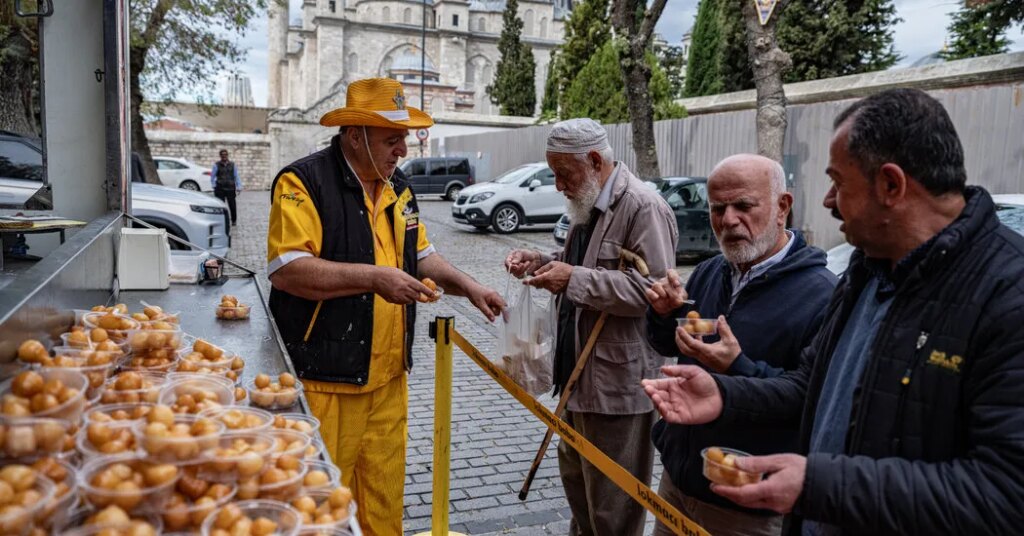
To make the sweets, she hired a mobile doughnut maker, Niyazi Dumlu, 72. On the appointed day last fall, he arrived sporting a white chef’s outfit with yellow trim and a cowboy hat with a star on the front that bore his nickname: Lokmaci Baba, or “Papa Doughnuts.”
He parked his truck near the mosque and opened the back to reveal his doughnut workshop: a gizmo to drop pingpong-ball-sized spheres of batter into a fryer and a metal tub for coating the cooked balls in syrup.
Many families in Istanbul and elsewhere in Turkey distribute these sweets, known as lokma, to mark joyous life events like engagements, births or job promotions. But more commonly, lokma is served to honor the dead.
The idea, Mr. Dumlu said, is that those who eat lokma say a prayer for the deceased, whether they knew them or not. Mr. Dumlu runs the name with an appeal for blessings on an LED ticker on his truck.
After losing a loved one, some Turkish families distribute meals from their homes. But lokma’s advantage is that it can be prepared anywhere, in large quantities.
“People can come pray and eat it warm and fresh,” Mr. Dumlu said.
And the more people who eat it, the more blessings they offer. He often makes 1,000 portions or more.
The lokma tradition makes trucks like Mr. Dumlu’s an occasional, serendipitous sight in Istanbul, a sprawling metropolis of 15.7 million people. Residents navigating crowded sidewalks or snarled traffic chance upon doughnut trucks — or smell them from blocks away — and stop to get a snack and utter a prayer for the soul of a stranger.
Turkish soap-opera buffs have distributed lokma after the on-screen deaths of beloved characters. Last year, fans hired trucks to mark the passing of the film director David Lynch and the heavy-metal pioneer Ozzy Osbourne.
Mr. Dumlu once made lokma for Muslum Gurses, a Turkish balladeer who died in 2013. One customer tried to hire him to memorialize a cat, but Mr. Dumlu talked him out of it.
Mr. Dumlu’s customers have included a businessman honoring his dad, year after year. A son commemorating a father he suspects was murdered. Police officers memorializing a fellow officer who killed himself.
The 83-year-old who hired Mr. Dumlu was honoring her late husband, a kebab shop owner who had scraped for decades to support her and their three daughters.
Mr. Dumlu and two assistants divided portions of prepared lokma into plastic dishes and served them with toothpicks for easy eating.
When the prayer inside the mosque ended, men lined up for doughnuts, as did women and children and teenagers off the street.
Muhammed Omer Gun, a medical student who had come to pray and had been pleased to find a doughnut truck, said sharing lokma made bereavement easier to bear.
“It’s a sad loss,” he said. “But you turn it into something sweet by giving people something sweet.”
A Life in Sweets
Mr. Dumlu’s life has left him deeply familiar with his bereaved customers’ pain.
His mother died six months after he was born, in a poor village in eastern Turkey, he said. His father ran off with a younger woman and left him with his grandparents.
He left school after third grade, and at age 10 moved to Istanbul, where he apprenticed to a baklava maker. His boss beat him, he said, but he could sleep in the shop, which kept him off the streets. He poured himself into learning the confectioner’s art, which brought more work.
At age 20, he married one of his cousins, Muskinaz. He dreamed that somehow, together, they would escape poverty.
“She was the woman who was going to give me the house I was dreaming about,” he said.
They had a daughter and a son. Mr. Dumlu opened his own baklava shop.
His son, Murat, 47, recalled growing up there, playing with dough. His mother always worked with his father, in the kitchen, at the cash register, doing dishes.
Seeking publicity, Mr. Dumlu marketed trays of sweets with words baked into them as “talking baklava” and tried to woo politicians.
He sent his district mayor a tray with his name in it and made the local news, Mr. Dumlu said. He sent similar gifts to Turkey’s prime minister and president. Those made the news, too.
In 1996, he said, he delivered baklava featuring the face of Hillary Rodham Clinton, then the first lady, to an Istanbul hotel where she was staying. He later received a thank-you note from Mrs. Clinton that called his gift “a lovely reminder of the hospitality and warmth of the Turkish people.”
The gimmicks boosted Mr. Dumlu’s notoriety but not his profits, he said. In the mid-1990s, the city closed his shop as part of a neighborhood reorganization, he said. He launched a hunger strike in protest (which also made the news) but that took him to the hospital, so he gave up.
He needed a new job and placed a bet on lokma, he said. Around 2010, he spent his savings on a truck and custom chef’s outfits to launch his new business.
“I was reborn as Papa Doughnuts,” he said.
Lokma turned out to be profitable, and Mr. Dumlu bought a small, tidy apartment, which his wife decorated.
He got her a matching chef’s outfit and nicknamed her Lokmaci Ana, or “Mama Doughnuts.”
His son recalled that his parents had squabbled all the time, but said it was their “love language.”
“When we didn’t hear it, we wondered if there was something wrong,” he said.
Mr. Dumlu’s wife suffered from rheumatoid arthritis, high blood pressure and other ailments that left her vulnerable when the pandemic hit in 2020, the son said. His mother got Covid, had back surgery, broke her hip and got Covid again.
She died in August 2022, plunging Mr. Dumlu into disorienting loneliness.
“She was my everything,” he said. “I lost my hands and my feet.”
Doughnuts in Traffic
The customer was a 42-year-old businessman, Kadir Ilhan, whose wife had died of breast cancer 40 days before.
She was 45, and the couple had two sons, 12 and 18.
Mr. Ilhan said the family had distributed meals from their home after the death. But he wanted to do more for his wife, he said, to reach “as many people as possible.”
So he hired Mr. Dumlu, who parked his truck on an island between two boulevards. Traffic was jammed with honking cars and buses. The idea was to pass out 2,500 portions to anyone who came by.
Mr. Dumlu, in his chef’s suit, manned the fryer.
Mr. Ilhan wore all black. Two decades ago, he said, his wife had walked into the cellphone store where he worked and texted a friend, saying, “I saw a guy here, and I think something is going to happen.”
She bought a phone and ordered a CD player, he said. He delivered it himself, and they went out for dinner.
“It started like that,” he said.
She died of breast cancer in April, after a three-and-a-half year battle.
Mr. Dumlu prepared piles of lokma, and Mr. Ilhan rushed around as if trying to escape his sorrow by handing sweets to passing pedestrians and drivers stuck in traffic.
Doughnuts at Home
The customer was a 72-year-old doughnut maker whose wife had died of Covid four years before.
The customer was Mr. Dumlu.
He parked his truck across the street from his apartment. He put chairs on the sidewalk and hung photos of his wife on the fence, the truck and a table holding prayer books with her name on it that were free for the taking.
He wore a yellow chef’s suit and cowboy hat. His son, his daughter and some friends came. He worked the fryer.
“For the anniversary of our deceased Muskinaz Dumlu,” the ticker read. “The founder of our home, our heart and mother.”
The smell of frying dough filled the street, and drivers stopped to ask for lokma.
“Come back after noon!” Mr. Dumlu yelled.
If the drivers remonstrated, he relented and gave them sweets.
He was melancholy and said he had been unsuccessfully searching for a video he had watched many times of him and his wife bickering. He had asked her which she loved more, him or the flowers she tended on their terrace.
“The flowers,” she replied.
“You just broke my heart,” he said.
He reminisced about their struggles with baklava and their successes with lokma.
“When one spouse dies, a small doomsday comes,” he said. “Mine has come.”
He faced it by making sweets, so that those who ate would send blessings to his wife.
“At this point, what else can I do but send her prayers?” he said.
Gulsin Harman contributed reporting.
The post A Turkish Doughnut Maker Whose Sweets Honor the Dead appeared first on New York Times.