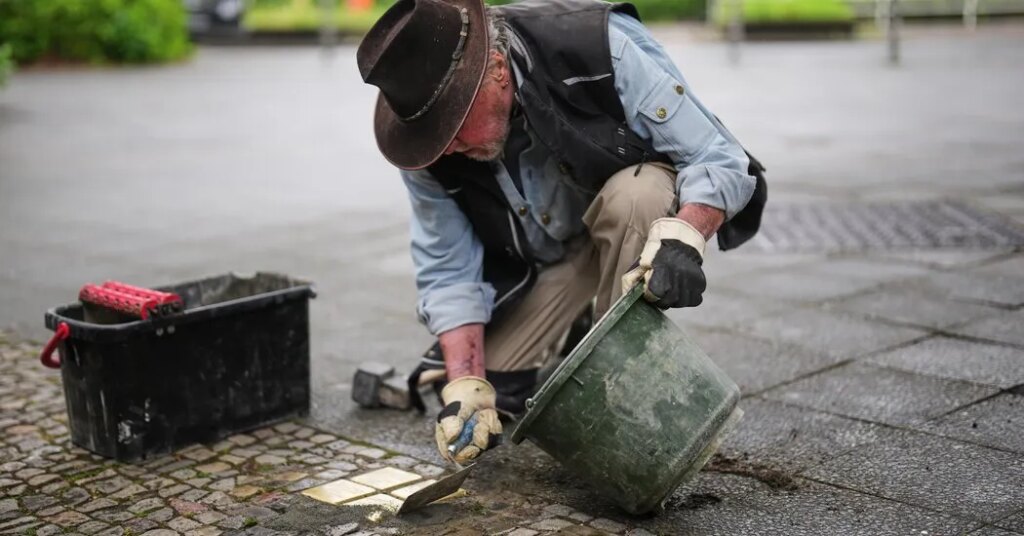
To honor people murdered by the Nazi regime, Europeans across the continent have installed thousands of little memorial plaques in the sidewalks outside the homes of the victims, most of them Jews.
Since the first plaques were installed more than three decades ago, more than 116,000 such “stumbling stones,” as the brass tiles are known, have been unveiled across 31 countries. In Germany, the stones have long been part of a national effort to acknowledge and atone for the country’s Nazi history.
Now, a coalition of far-right and conservative city councilors in eastern Germany have broken with that effort by voting to stop the project — at least in their town of Heidenau, population 16,500.
Last week, the City Council of Heidenau voted 13-6 in a secret ballot to ban the installation of seven new stumbling stones, or “Stolpersteine” in German. The motion was proposed jointly by councilors from the far-right Alternative for Germany party, or AfD; the center-right Christian Democratic Union, or C.D.U., the party of Chancellor Friedrich Merz; and a small alliance of local independents.
The councilors said they were barring the plaques’ installation because people might step on them, potentially disrespecting the victims’ memory. They proposed installing a general memorial instead at the local cemetery.
Their decision has drawn sharp criticism across Germany, including from the C.D.U.’s national leadership, which has long rejected working with the AfD. Memorializing the Holocaust is one of the fundamental tenets of the modern German state and to many Germans, the tiles’ location amid the bustle of everyday life is considered crucial to their impact — precisely because it is so easy to step on them.
Critics of the council’s decision say that the councilors had a hidden motive, given that the AfD openly opposes national efforts to come to terms with Germany’s wartime guilt. The AfD’s national leadership has not commented on the councilors’ decision, but it has long portrayed Germany’s culture of remembrance as a “cult of guilt” — and has campaigned on that issue. Its leaders have also dismissed the significance of the Holocaust and used Nazi slogans.
Germany’s domestic intelligence agency has classified the group as “suspected extremist,” an accusation it denies as politically motivated.
The furor comes as the AfD, once a fringe party, is topping national polls. It also follows the party’s victory in early September in a regional election in the eastern state of Saxony-Anhalt, where it is now trying to form a ruling coalition and become the first far-right party to rule a German state since the Nazi era.
Karin Prien, Germany’s education minister and a C.D.U. member, called the vote scandalous.
Ron Prosor, the Israeli ambassador to Germany, said he felt shame over the vote. “Those who erase the victims of the past erase the past itself,” he said in a social media post.
Roughly 4 inches by 4 inches, the brass plaques are typically inscribed with the name of a victim, as well as the years in which they were born and deported. Each “Stolperstein” is attached to a tiny cement cube, which is in turn dug into the sidewalk in front of the victim’s last known residence.
According to the artist who conceived of the project, Gunter Demnig, the goal is to help people understand the tragedy of each individual death.
“To think about six million victims is abstract, but to think about a murdered family is concrete,” Mr. Demnig, who still oversees the plaques’ production, told Smithsonian Magazine in 2007.
Anyone can apply to lay such a stone. In Germany, where the bulk of them are installed, it is often school classes, youth groups or nongovernmental organizations who raise money to fund the stones and hold a short memorial ceremony to mark their installation.
Every year on Jan. 27, Holocaust Memorial Day, people meet to polish the stones and to light candles.
In a statement, the Heidenau councilors said their intention was to “prevent people from stepping directly on elements of the memorial.”
That argument was dismissed by Anne Nitschke, the activist who had applied to install the stumbling stones in Heidenau. “I see this as an attempt to prevent individual memorials from appearing in the public landscape,” Ms. Nitschke told a public TV station. “It’s simply a way to banish any kind of memorial to the outskirts of the city,” she added.
Christoph Huebner, vice president of the International Auschwitz Committee, an international group that works to preserve the memory of Holocaust victims, criticized the move in a statement. “This is a transparent and despicable attempt to once again drive the victims of the Nazis in Heidenau out of the city and dispose of them where, in the AfD’s view, remembrance has long belonged: in the cemetery,” he wrote.
The town’s mayor, Conny Oertel, an independent, recommended that colleagues vote against the decision, yet still subsequently defended those who voted for it.
“I can say one thing: the entire City Council — truly everyone — is in favor of continuing to commemorate the nation’s victims,” she told a public broadcaster. “It’s just a matter of how to do it.”
The post German Town Votes to Stop Adding Memorials Outside Homes of Slain Jews appeared first on New York Times.