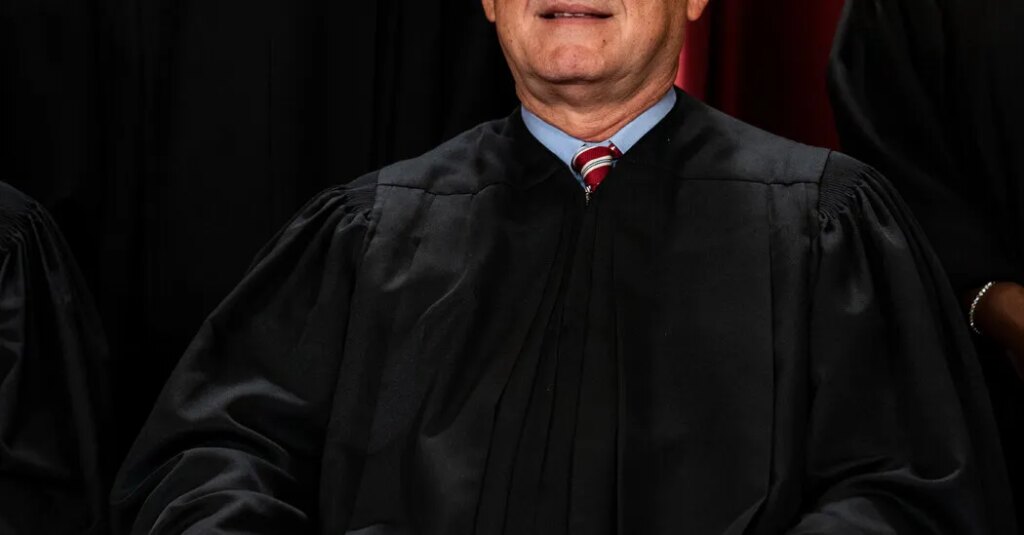
Justice Samuel A. Alito Jr. said on Monday that he will not take part in a major climate-change lawsuit scheduled to be heard next week by the Supreme Court.
The one-sentence announcement from the clerk of the Supreme Court provided no reason for the justice’s recusal. Yet Alito has faced pressure from environmental and court watchdog groups to step aside because he owns stock in two oil companies, and he flew on the private jet of an investor in a company involved in the dispute.
The case could determine whether oil companies face billions of dollars in potential liability for damages from climate change. It is the first matter scheduled to be argued before the court when the justices return to the bench on Monday following their annual summer break.
Justice Alito did not respond to a request for comment.
Supreme Court ethics rules, adopted by the justices in November 2023 after revelations about Justice Clarence Thomas and his undisclosed gifts and travel from Texas billionaire Harlan Crow, leaves decisions about when to recuse from cases entirely at the discretion of the justices themselves. They typically do so when their impartiality could be questioned, such as if a close friend or family member is involved in a dispute or if they have a financial tie to a party, but they are also not required to provide reasons when they choose to do so.
Justice Alito has not reported financial ties to Suncor Energy, the oil company at the heart of the dispute, nor to any other company directly involved in the case. But he has disclosed in his annual financial reports that he owns stock in ConocoPhillips and Phillips 66, both oil companies.
Critics have also pointed to his relationship with Paul Singer, founder of Elliott Investment Management, a hedge fund that is an investor in Suncor. In 2023, ProPublica reported that the justice had taken a luxury fishing trip with Mr. Singer and failed to disclose it. Justice Alito said at the time that he was not required to disclose the trip and had spoken to Mr. Singer only a handful of times.
A spokeswoman for Elliott Investment declined to comment on Monday.
Lisa Graves, co-founder of Court Accountability, a group focused on court reform, said she was glad that Justice Alito would not take part in the case, Suncor Energy v. County Commissioners of Boulder County, because she believed he had “an appearance of conflict that continues.”
“It’s troubling that he took so long to do so,” added Ms. Graves, who also heads True North Research, a watchdog group, which had called on Justice Alito to recuse himself from the case.
The case before the justices involves a lawsuit by Colorado officials, who had sued two oil companies — Exxon Mobil and Suncor Energy — arguing they should help to pay for the damages caused by climate change.
The suit is one of dozens of similar legal fights taking place across the country. The oil companies have pushed back, arguing that such state claims are barred by federal law. The justices’ decision could determine the fate of similar cases in addition to the Colorado suit.
This is the second time this year that Justice Alito has announced a last-minute recusal from a case involving fossil-fuel companies.
The justice announced in January that he would step aside from a dispute over whether oil companies could be held liable for environmental damage to Louisiana’s coastline. As in the upcoming Suncor case, Justice Alito announced his decision months after the court had agreed to hear the case and just days before the oral argument. In that instance, he cited his financial interest in ConocoPhillips, the parent corporation of Burlington Resources Oil and Gas Company.
In that case, although that company had withdrawn from the court filings in the Louisiana case, it remained a party to the case in a lower court, according to a letter from the court clerk.
In April, the remaining justices unanimously sided with the oil companies, finding that they should be allowed to fight the lawsuits in federal court rather than state court.
Jeremy Fogel, a retired federal judge and ethics expert who leads the Berkeley Judicial Institute, said that he agreed with Justice Alito’s decision to recuse because, while
Justice Alito doesn’t own stock in the companies directly involved, the court’s code of ethics applies to situations where a justice’s financial interests were likely to be affected by the outcome of a case.
The outcome of the Suncor case, he said, “seems more than likely to affect the interests of oil companies generally.”
Gabe Roth, who leads Fix the Court, a judicial reform group, called Justice Alito’s announcement on Monday “a prime example of why Supreme Court justices should be required to explain their recusals.”
He said in a statement that the last-minute recusal raises questions without providing answers.
“Is Justice Alito stepping aside because his clerks belatedly found some connection between this case and the companies whose shares he owns?” he said. “Or is this a rare instance where a justice believes that open questions about his impartiality demand his recusal? The court’s lack of transparency and nonexistent rules governing their papers mean we may never know for sure.”
The post Justice Alito Recuses Himself Days Before Major Climate-Change Case appeared first on New York Times.