The British counterterrorism police said on Monday that they would release on bail five men who were arrested as part of an investigation into what appeared to have been a terrorist plot targeting an air base in England that is used by the American military.
Several suspicious vehicles were spotted near the base early Sunday, leading to the arrest of the five men. British officials have not identified the suspects but said that they were being released on bail with strict conditions and that they remained under investigation.
The United States has used the base, R.A.F. Fairford, to deploy bombers during the war against Iran, but it was not immediately clear whether the episode on Sunday was connected to that conflict. On Monday, the Iranian Embassy in London said it “categorically rejects and strongly condemns” speculation that Tehran had any connection.
What happened?
On Sunday, shortly after midnight, the authorities in Gloucestershire, in southern England, said they had received a phone call about three suspicious vehicles that appeared to be traveling toward the military base, the counterterrorism police said in a statement. A bomb disposal robot spent most of Sunday examining three white vans, while 85 families living nearby were evacuated from their homes.
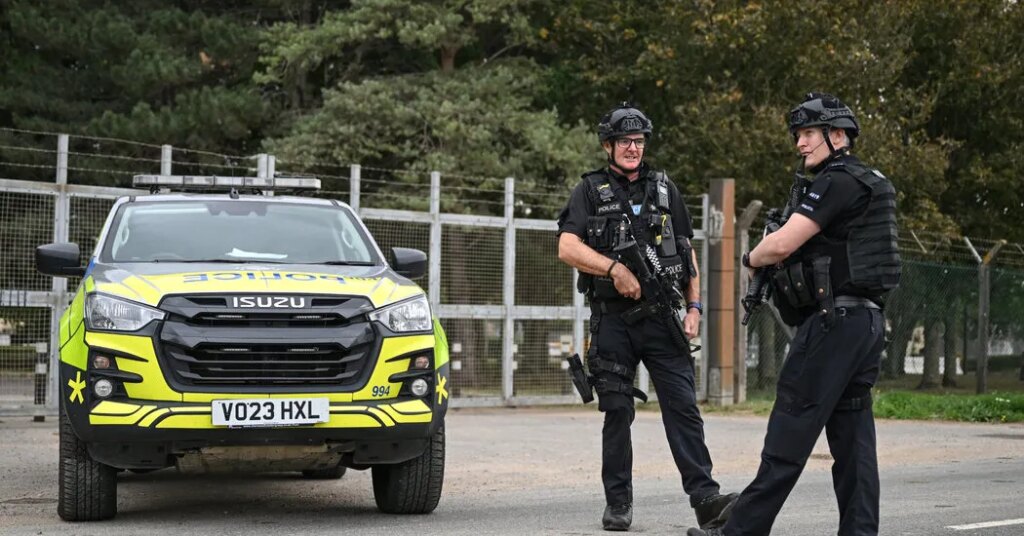
Armed officers responded to the call and the authorities arrested five men on suspicion of “committing offenses under the Explosives Act” and of “preparation of a terrorist act,” the police said on Sunday.
The men were not named, in line with British rules that grant public anonymity to suspects until they are charged, but the counterterrorism police said in a statement on Monday that the five men were in their early 20s and were British nationals from London.
Laurence Taylor, the head of Britain’s counterterrorism police, told reporters on Monday that the men would be “released on police bail” but “subject to stringent conditions” on their movements and contact. “They absolutely remain under investigation,” he added.
He did not say whether investigators had found explosives in the three vans, nor did he discuss any potential target or motive.
How has the U.S. responded?
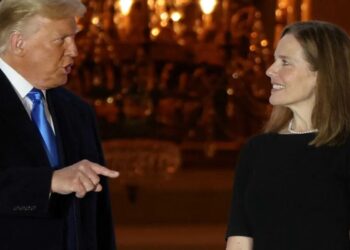
President Trump praised British law enforcement on Sunday and appeared to suggest that the suspects had been under surveillance.
“We had them under investigation,” he said, responding to questions about the incident. “They were looking to do big damage to our fort, and working with the British worked out great.”
Mr. Trump’s statements raised questions about just what was known to the authorities in Britain before the arrest. The British police statements on Monday did not offer any further information about that issue.
The U.S. Embassy in London said in a statement on Sunday that American citizens in Britain should “exercise caution” and “be mindful of personal security.”
How has the U.S. used R.A.F. Fairford?
With a runway more than 9,990 feet long, R.A.F. Fairford has one of only a few European airfields that can be used by heavy bombers. The base was opened in preparation for D-Day in 1944 and has a long history of being used by the United States. In 2003, it was the site of repeated antiwar protests during the Iraq War.
This year, American B-52 and B-1 planes loaded with munitions have repeatedly taken off from Fairford on missions to Iran since the United States and Israel started the war in February.
Keir Starmer, the previous British prime minister, initially refused to allow the Trump administration to use the base for strikes in Iran. He later permitted the Americans to use it for what Mr. Starmer called “defensive” operations, which angered some Iranian officials. His successor, Prime Minister Andy Burnham, has continued that policy.
Mr. Burnham said on Monday that he would chair a meeting on Monday of the government’s emergencies committee, known as Cobra, to discuss the Fairford incident.
Who could be behind a plot?
There are a few possibilities.
Much speculation has pointed to Iran. In its statement on Monday, the Iranian Embassy in London said that it rejected any links to the case and strongly condemned the speculation, which it said would “serve no purpose other than to fuel Iranophobia propaganda in the U.K.”
Previously, Iran had suggested that it could retaliate against Britain for helping the United States in the war.
In July, the Islamic Revolutionary Guards Corps warned Britain that allowing American bombers to conduct strikes against Iran out of its bases would make those British bases legitimate targets.
That same month, Britain accused a proxy of the Revolutionary Guards of directing a wave of actions against Jews in Britain and elsewhere in Europe, including arson attacks on synagogues.
British and European intelligence officials have also called out Russia for suspected attacks that used proxies to evade culpability.
In Britain, two men were convicted in June of conspiring to carry out arson attacks targeting properties and a car linked to Mr. Starmer. One had been recruited by a Russian-language Telegram account.
Experts have also said a plot could be related to Islamist extremism, which remains the biggest terror threat in Britain, according to security services.
Mr. Taylor, the counterterrorism chief, said on Monday that the police were “keeping an open mind in this investigation” and referred to recent cases in Britain in which low-level criminals had been paid to carry out attacks that were ultimately found to have been coordinated by hostile states or their proxies.
“Often this threat becomes visible to us as criminal activity, often at a small scale and committed by individuals whose primary aim is not terrorism but a quick financial gain,” Mr. Taylor noted.
How have the police responded?
Officers arrested the men and then the army deployed robots to examine the three white vans. Counterterrorism investigators worked at the scene overnight and into Monday, uncovering “multiple new lines of inquiry,” the police said in a statement.
On Monday, military and other assets remained deployed at the scene, and a cordon was in place, which the police said would be reassessed later in the day.
Many residents had not yet been allowed to go back home, but the police said that might be possible later Monday.
Vicki Evans, a national counterterrorism coordinator for the police, said, “This has been incredibly disruptive for local people, but I’d like to reassure them that our activity is in the interest of national security, but most importantly in the interest of their own safety.”
Michael D. Shearand Esther Bintliff contributed reporting.
The post What We Know About the Possible Terrorist Plot at a U.K. Air Base appeared first on New York Times.