The Trump administration on Monday finalized its plan to significantly weaken fuel efficiency standards for automobiles, scaling back Biden-era rules meant to reduce gasoline consumption and speed the shift to electric vehicles.
Under the new rules from the Transportation Department, automakers will be required to achieve an average fuel efficiency of 34.9 miles per gallon for new cars and light trucks in model year 2031. That’s far below the standard of 50.4 miles per gallon set by the Biden administration.
President Trump portrayed the change as a way to lower car prices for consumers, as affordability has become a major issue in the coming midterm elections. He posted on social media over the weekend that the new rules marked a “BIG DAY FOR AMERICAN AUTO WORKERS AND CAR BUYERS.”
But critics said that less efficient vehicles could cost consumers more at the pump in the long run. U.S. gasoline prices have spiked because of the conflict in the Middle East, with the national average price for unleaded gas near $4.50 per gallon, up more than 40 percent since this time last year.
The new standards should also be relatively easy for automakers to meet, analysts said, since new vehicles averaged 30.1 miles per gallon in model year 2024. Last year, Republicans in Congress also eliminated fines for any automakers that don’t meet the standards, saving them millions of dollars and making the new rules largely toothless.
Mr. Trump has sought to dismantle federal policies that had pushed automakers to manufacture more efficient gas vehicles and transition to battery-powered models. He has described those policies as an “E.V. mandate” and has argued that stringent regulations push up the price of new vehicles.
“Thanks to President Trump’s leadership, we have finally ended the illegal mandate that forced automakers to produce more expensive electric vehicles that American families didn’t want,” Transportation Secretary Sean Duffy said in a statement.
The move marked the final step in a remarkable retreat from U.S. attempts to counter China’s dominance of electric vehicles.
In February, the Environmental Protection Agency ended all federal limits on planet-warming pollution from cars. Last year, Congress repealed tax credits of up to $7,500 for buyers of new electric cars and also blocked California from setting its own stricter limits on automobile pollution.
Opponents have called the moves shortsighted.
“For fifty years, fuel-economy standards have saved Americans money and cut pollution at the same time, creating cleaner air, lowering prices at the pump, and reducing our reliance on fossil fuels,” said Gina McCarthy, the climate adviser under President Joseph R. Biden Jr. “Rather than keeping the U.S. at the forefront of innovation and improving affordability, this administration has chosen to do the opposite.”
Many automakers had chafed under the Biden-era rules, saying that they would have been extremely challenging to meet and required a rapid shift toward electric vehicles. A leading industry group on Monday said it was still reviewing the final rule but offered tentative praise.
“The standards finalized under the previous administration effectively required a switchover to electric vehicles that was out of step with market realities and customer demand,” said John Bozzella, the chief executive of the Alliance for Automotive Innovation, a lobbying group for major carmakers. “Today’s final rule is an appropriate course correction.”
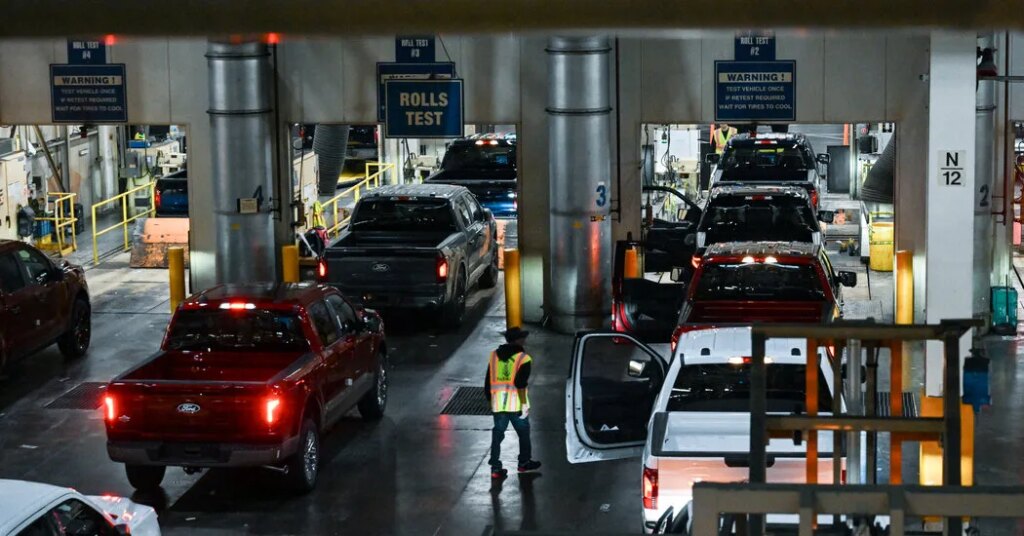
The announcement could further encourage U.S. carmakers to manufacture more big, gasoline-burning pickup trucks and sport utility vehicles, which are more profitable than traditional cars.
But that could threaten automakers’ competitiveness in the long run.
Electric sales are growing rapidly in the rest of the world, spurred by concerns about spiking oil and gasoline prices. U.S. carmakers that delay E.V. development could be at a significant disadvantage to foreign rivals in the coming years, analysts said. Last year, less than 10 percent of new cars sold in the United States were electric.
“Many parts of the world are obviously adopting E.V.s much faster than the United States has, so where do U.S. automakers stand?” said Jessica Caldwell, the head of insights for the automotive website Edmunds.com. “They can’t exactly just turn their backs on the technology.”
The Transportation Department said that the looser standards would reduce the average cost of a new vehicle by $1,300 and save Americans $138 billion over the next five years.
Some economists have disputed those figures. A recent paper published in the journal Science argued that the administration’s calculations contained major inconsistencies, such as in its assumptions about how consumers value the benefits of saving fuel.
“If you do the analysis right, we found that revoking these standards does not save consumers money,” said Christopher Knittel, a professor of energy economics at M.I.T.
Congress created the mileage standards in 1975 in response to an oil embargo by Middle Eastern countries. Since then, automakers have steadily improved the distance that cars can travel on a tank of gas while expanding their electric and hybrid offerings.
Transportation is the country’s largest source of the greenhouse gases like carbon dioxide that are warming the planet. The Biden administration had ratcheted up the mileage standards as part of its sweeping strategy for tackling climate change.
But Mr. Trump, who has rejected efforts to address climate change, attacked E.V.s as part of his campaign to retake the White House.
His administration has also scrapped a companion rule that would have strictly limited carbon dioxide emissions from new cars and trucks. Those rules had been intended by the Biden administration to align with the fuel-economy standards.
Jack Ewing contributed reporting from New York.
The post Trump Sharply Scales Back Fuel Economy Rules for New Cars appeared first on New York Times.