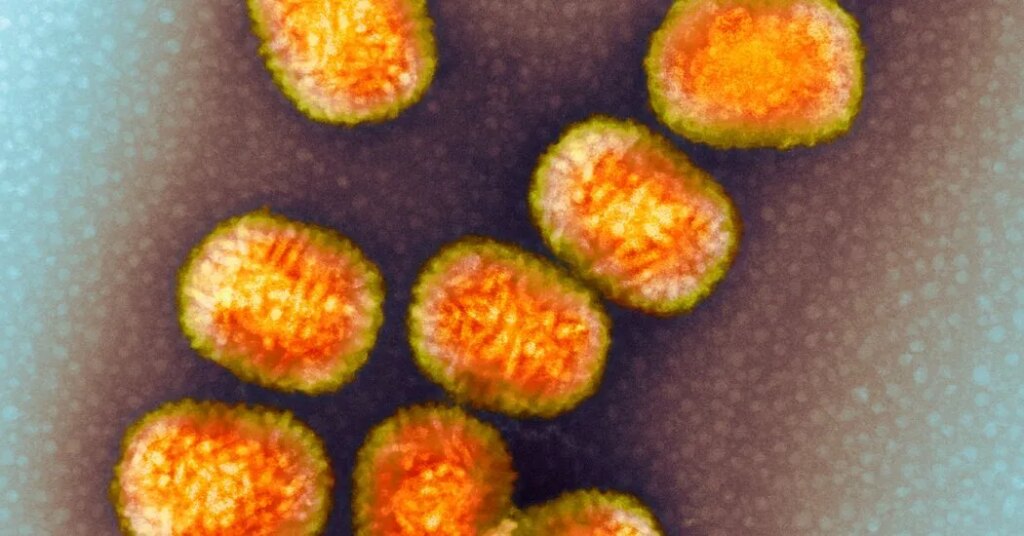
Scientists have discovered a virus that is a tiny bit human, carrying a gene it stole from our ancestors about 100,000 years ago. And this virus may be using our own gene to infect us.
Previous studies have demonstrated that viruses can pick up genes from their hosts. But the new discovery, reported Thursday in the journal Science, may be the first known instance of a virus with a human gene acquired in recent evolutionary history.
“This one hits closer to home,” said Nels Elde, an evolutionary biologist at the University of Utah who was not involved in the research.
The way that viruses replicate makes them particularly good at thieving DNA.
They infect a cell, then co-opt its machinery by injecting their own genes. The infected cell is forced to make copies of the viral genes, along with proteins that package them into new viruses. The new viruses explode from the infected cell, which dies.
Sometimes this process goes awry, and a stretch of the host’s DNA gets bundled into the new viral genes. This molecular error can pose a threat to human health.
Viruses that infect bacteria, for example, can latch onto genes that the bacteria were using to resist antibiotics. These genes don’t do the viruses any direct good, but they can pass the DNA to other bacteria they infect. That’s one way that antibiotic resistance spreads.
Now scientists have discovered a virus that has picked up a gene from humans. The gene wasn’t hidden away: Cedric Feschotte, a biologist at Cornell University, and his colleagues found it as they scanned databases of viral genes.
“I just can’t believe that we haven’t been scooped, because anyone can find these literally in a few minutes,” he said.
Dr. Feschotte and his colleagues discovered the human gene in molluscum contagiosum virus, a distant relative of smallpox. It causes small sores on the skin that typically disappear after a few months. It only infects humans, often children.
The human gene in question, BC200, is mysterious. In the brain, it produces an RNA molecule whose purpose scientists have yet to pin down. Some researchers speculate that BC200 helps control the rate at which brain cells make proteins.
The BC200 gene in molluscum contagiosum virus has some mutations not found in the version carried by people. Those mutations have accumulated since the virus picked it up from our ancestors, allowing Dr. Feschotte and his colleagues to estimate that the virus swiped our gene about 100,000 years ago.
The RNA molecule encoded by BC200 has a peculiar structure that can sometimes cause our cells to insert it into a new piece of DNA. That DNA is returned to our genome, creating an extra copy of BC200.
Apparently it has often happened. Dr. Feschotte and his colleagues have identified 178 copies of BC200 in the human genome, which have accumulated over millions of years. This glitch might have introduced BC200 into the virus as well.
However it got there, the BC200 gene has stayed in molluscum contagiosum virus for the past 100,000 years. Dr. Feschotte has not found a virus without BC200, a sign that they are using the human gene to their advantage.
While BC200’s original purpose may have been managing proteins in our brains, the virus apparently has found a new job for it. Dr. Elde speculated that molluscum contagiosum virus may use our gene to control the production of proteins, a process known as translation.
“Poxviruses love to mess with translation,” he said.
Cells infected by viruses sometimes try to shut down their protein factories to halt the production of new viruses. The poxviruses can use host proteins to restart them.
That could be a problem for humans: Our own BC200 gene may now be providing this service to molluscum contagiosum virus when we become infected.
Dr. Feschotte wondered whether he and his colleagues happened to find a very rare example of a human gene in a virus — or if this is common in viruses. “Honestly, it makes me want to look more,” he said.
The post This Virus Stole a Human Gene and Won’t Let Go of It appeared first on New York Times.