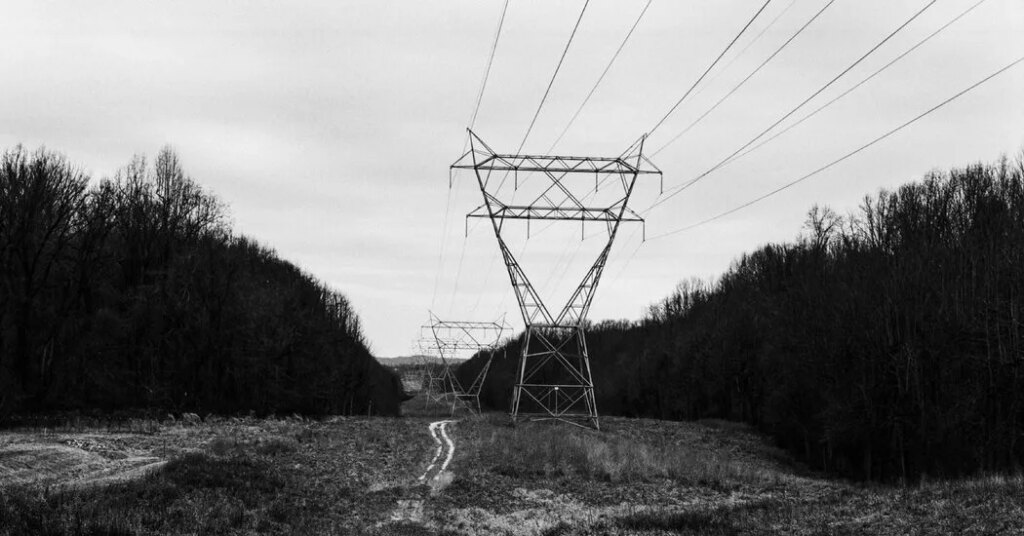
The Chinese government has spent years preparing to attack the infrastructure underpinning American life. It is exploiting the seams in our electricity system and has likely positioned hackers to cause sustained blackouts. While China’s leaders have so far practiced restraint, artificial intelligence is poised to upend that fragile balance.
America’s A.I. boom, and the industry’s voracious appetite for electricity, makes the grid a highly attractive target for China and other hostile states seeking to weaken this country. The boom has also created a wholly novel threat in the form of powerful A.I. agents, which may hack better and faster than the Chinese government is able to and may also be undeterred by the threat of conventional war.
The United States must reinvent its electrical grid to protect against these evolving threats. That means adopting energy technologies that can be swiftly patched and building a more distributed grid that can quarantine and control disruption and keep essential services running if the wider grid goes down.
The industry capable of delivering on all these benefits may be a surprising one: clean energy. The question is whether the Trump administration is willing to build a stronger alliance with the companies that deliver it in spite of its culture war with many of them.
Solar panels and battery storage are unique because they rely on software to direct the generation, transmission and distribution of electricity rather than doing so through the spinning turbines or mechanical switches in coal and gas power plants. When the two of us worked in the federal government on cyberthreats, we found that this more sophisticated approach to power has many uses for national security.
Much of America’s aging infrastructure has had internet connectivity grafted onto equipment that was never designed for it, creating cracks in our armor that hackers — human or otherwise — can too easily exploit. Modern, software-defined energy technologies, however, can be designed from the start to receive security updates, restrict who can access them and quarantine equipment infiltrated by cybercriminals. Done right, digital modernization improves the ability of America’s infrastructure operators to play defense.
That kind of system also allows solar energy and batteries to help stabilize the grid when other equipment fails. Texas, a leader in deploying these modern energy technologies, uses fleets of batteries to soak up surplus sun during the day, and release that electricity back into the grid when power plants are straining or failing. A modern, flexible grid with generation and storage spread across many locations can also separate into micro grids, keeping local services operating in a crisis while the wider system recovers.
The fly in the ointment is that many of the modern energy technologies critical to resilience and national security are produced in China, the country with the most publicly confirmed interest in sabotaging our infrastructure. Congressional Republicans have urged the Trump administration to restrict the deployment of clean energy for that reason, and officials such as Attorney General Ken Paxton of Texas have begun investigations into what they call “CCP -aligned tech products.”
There is a real risk that Chinese hackers will one day try to interfere with the grid, but the risk is not inherent to a “made in China” sticker. It comes from what a component can do and who can control it. Some Chinese infrastructure hardware allows remote software access for routine diagnostics and updates, but those mundane maintenance channels can be repurposed to let an attacker alter settings or disrupt operations from afar. That is in contrast to “dumb” electrochemical cells in a battery, which by themselves possess no way to receive and execute instructions from Beijing or, for that matter, from swarms ofA.I. agents.
The defense industry is already navigating these challenges with aircraft like the F-35 fighter jet, which has Chinese parts. “Smarter” components, like flight computers and sensor arrays, get maximum security scrutiny, while screws and hydraulic hoses get less. We could apply the same ideas to our grid so that we’re not panicking about every foreign component when we digitize it.
The Trump administration’s recent declaration of a grid security emergency could be the vehicle for just such a framework. It recognizes both the growing importance of electricity to national power, and the danger of insecure access to the technology delivering it.
But even with the growing specter of cyberwar and rogue A.I., the administration is too often distracted by its culture war with clean energy. President Trump signed a bill that gutted the wind and solar credits of the Inflation Reduction Act, and his administration has also worked to block many clean energy projects, dismissing solar, wind and electrical vehicles as unreliable and ineffective. (The administration has embraced geothermal energy, nuclear power and batteries. Batteries emerged as a priority seemingly in part because of their role powering drone warfare in Ukraine.) The grid at home, our allies on the battlefield and the cyberdefenses that might have to outrun A.I. all need every electron they can get, as securely as they can get it, with no regard for its politics.
The administration is beginning to realize that national strength increasingly depends on a country’s ability to generate, store and direct electricity. If Mr. Trump’s grid emergency order is put in place with national security as its north star, the modern energy technologies capable of delivering these advantages should be central. Otherwise the government will undermine our best chance at a secure and abundant energy future.
Harry Krejsa is the director of studies at the Carnegie Mellon Institute for Strategy & Technology. Phoebe Benich is a fellow at the institute.
The Times is committed to publishing a diversity of letters to the editor. We’d like to hear what you think about this or any of our articles. Here are some tips. And here’s our email: [email protected].
Follow the New York Times Opinion section on Facebook, Instagram, TikTok, Bluesky, WhatsApp and Threads.
The post Our Power Grid Is Vulnerable. This Is How to Protect It. appeared first on New York Times.