Kevin Huffman, former Tennessee state commissioner of education, is the CEO of Accelerate, a national education nonprofit.
Every few years, international educational test scores are announced, and the United States spends a week lamenting the state of its schools before moving on. The latest Program for International Student Assessment, or PISA, release deserves more attention.
According to the test results, more than a quarter of American 15-year-olds now fail to reach a basic level of reading proficiency — roughly the skill needed to understand a job posting. Math scores are flat but sit at the bottom of a decade-long decline. Both are among the lowest PISA scores this country has ever posted.
These results are alarming, but not surprising. They match the story that the National Assessment of Educational Progress (NAEP) has been telling us for years. Nine-year-olds recently recovered to pre-pandemic performance in reading and approached it in math, but 13-year-olds have lost decades of gains in both subjects, with average reading scores no higher than in 1971, when the test was first administered. In reading and math, both age groups are still performing below 2012 levels, the peak of the accountability era.
The latest PISA results land as the federal role in education is receding. States have always been the primary drivers of education policy, but that has never been truer than today. The good news is that some of them are already proving that progress is possible.
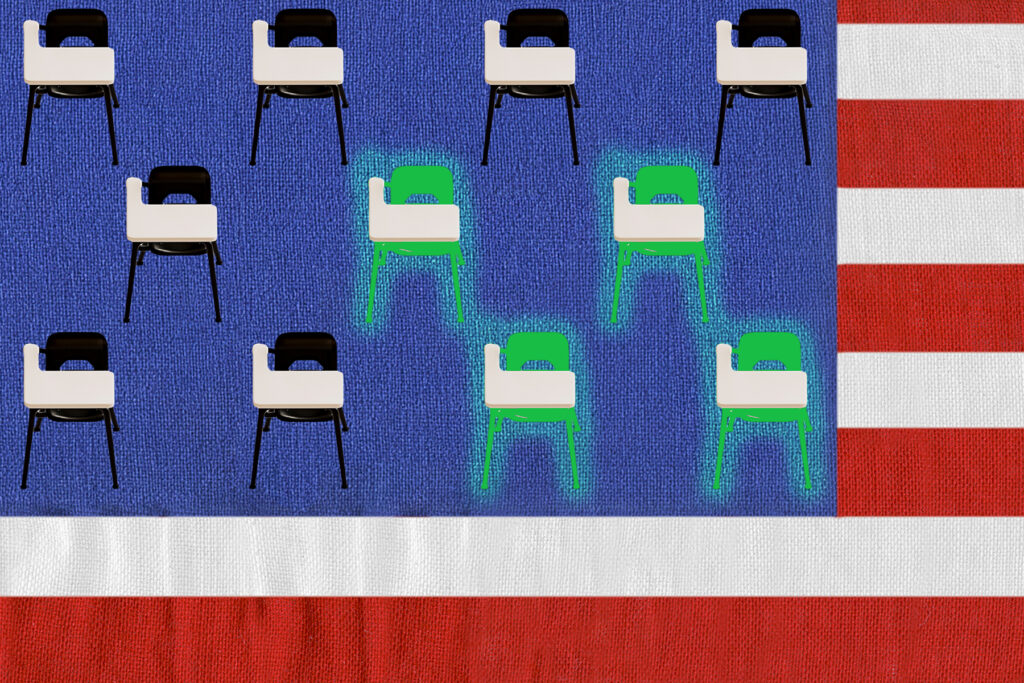
There is no state-level PISA data, but NAEP shows that disappointing national results mask significant state-by-state variation. Mississippi, Tennessee, Louisiana and the District of Columbia have all posted sustained post-pandemic NAEP gains even as scores have fallen nationally, and they have done so with higher poverty rates and — except for D.C. — lower per-pupil spending than the national average. In three decades of testing, this is the first time a cluster of states has moved outcomes this way.
Several have been climbing for far longer. In 2013, Mississippi ranked 49th among states in fourth-grade reading on NAEP. By 2024, it ranked ninth, an astonishing change in a state long written off because of poverty and politics. Louisiana, ranked 50th in 2019, leaped to 16th by 2024 and is the only state where fourth-grade reading has surpassed pre-pandemic levels. Tennessee was in the bottom 10 in 2011 but now is 17th across the four NAEP tests — and near the top of the nation for Black student scores.
While this “Southern surge” is well documented, it remains misunderstood. These states prioritized literacy instruction grounded in the science of reading and adopted stronger math curriculums, but that’s only part of the story. They also embraced practices that drove national progress in the late 1990s and 2000s: high standards, meaningful accountability and a relentless focus on student achievement, backed by strong political leaders committed to implementing the work effectively.
And the surge isn’t confined to Republican states. D.C., a blue city with a strong teachers union, significantly boosted test scores over two decades and led the country in math and reading growth coming out of the pandemic, following a policy playbook similar to the one used by fast movers in the South. Like Tennessee and Louisiana, D.C. has made strong charter school policies part of that work.
None of the ideas implemented are partisan. They are the foundation of every successful education reform effort. Where states walked away from them, scores followed.
While its neighbors raised standards and built accountability systems, Oklahoma’s former superintendent focused on culture-war crusades while eliminating assessments and lowering proficiency bars. The result: Oklahoma fell from at or above the national average in the 1990s to ranking 48th on NAEP in 2024. The state is now trying to rightsize. Oregon dropped proficiency requirements for graduation and allowed test opt-outs that obscured how individual schools were performing. Predictably, its NAEP scores deteriorated even as education spending rose by 80 percent.
Policy, not politics, determines outcomes.
The gap between fast-climbing states and those falling farthest will eventually show up in their economies. A 2025 study found that states with improving NAEP scores saw stronger job growth, lower crime and lower rates of teen pregnancy.
Thirty-six states will elect a governor in November. Whoever wins will take office with more control over education policy, and more responsibility for the results, than any group in decades.
Here’s where they could start in building a strong education agenda:
Set an ambitious public goal with real accountability. States that have improved treat student outcomes as the key measure of success and align policies and resources accordingly. Tennessee set out to be the fastest-improving state in reading and math and then acted like it, investing in proven instructional approaches and sustaining high-dosage tutoring after federal pandemic recovery aid expired. It posted the nation’s second-largest math gains and fourth-largest reading gains between 2022 and 2025.
Lead with literacy. Every state that improved in reading over the past few years implemented comprehensive science-of-reading reforms, including phonics-based approaches. The sharp decline in PISA reading results makes this the most urgent item on the list.
Adopt high-quality instructional materials and ensure that teachers use them. A survey ofK-3 teachers found that about a third still incorporate discredited methods, even after training. A solid curriculum can close the gap between policy and practice, and Johns Hopkins researchers found it is one of the best investments a state can make.
Invest in high-dosage tutoring. Evidence for tutoring is among the strongest in education, with research showing it outperforms alternatives such as smaller classes and an extended school day. A meta-analysis of 265 randomized trials found that regular small-group tutoring adds roughly a third of a grade level of additional learning annually.
Smart policy, grounded in evidence and implemented with discipline, can reverse the trajectory for students nationwide. The states making progress have given us a road map. Now others should follow it.
The post U.S. test scores keep falling. But these states are getting it right. appeared first on Washington Post.