Before President Trump returned to office, unleashing a trade war featuring special animus toward Canada, Michael Goldstein saw his Vancouver start-up as complementary to American interests.
His company, Accelovant, makes temperature sensors used to produce computer chips — the brains of modern manufacturing. Canada and the United States shared an interest in limiting their dependence on chip factories in Asia. He was supplying critical components, many of which were being made in the United States.
But Mr. Trump’s denunciation of America’s relationship with Canada has upended that arrangement. Accelovant is in the midst of a time-consuming, expensive process to shift production from its American factory to a plant in Southeast Asia. The company recently received a $1 million grant from the Canadian government to accelerate plans to reduce its dependence on the United States. Like much of the Canadian business world, Mr. Goldstein is adapting to what many now view as a foundational rearrangement: The United States can no longer be trusted as a reliable trading partner.
“This is the new new,” Mr. Goldstein said recently. “Canada is busting its ass to get out and diversify its markets. This has been a lesson learned. I think it will never go back.”
No one with working knowledge of international business assumes the United States and Canada can easily be pried apart. As neighbors, military allies and charter members of the North American trading bloc, they have been extraordinarily intertwined for decades. Even a marginal reduction of economic ties would entail turmoil, bureaucratic torment and a potential downgrading of fortunes.
American auto manufacturers rely on Canadian factories for parts that often cross the border multiple times before being folded into finished vehicles. The pumping of oil and natural gas in the United States frequently depends on pipes made in Canada. Last year, the two countries exchanged goods worth more than $715 billion.
The industries at the center of Canadian trade have traditionally depended on rail and highway links to move energy and auto parts across the American border. Pivoting toward Asia and Europe necessitates complex alterations to Canadian infrastructure, especially at ports.
“Our economies in North America have integrated over decades,” said Werner Antweiler, an international trade expert at the UBC Sauder School of Business at the University of British Columbia. “Can we really diversify away from the U.S. on a large scale? No. Geography is fate when it comes to international trade.”
Still, Canadian business and political leaders are expressing growing resolve to reduce their susceptibility to the vagaries of the superpower to their south. Every taunt from Mr. Trump about turning Canada into the 51st American state and every threat of fresh tariffs has stoked anger, fueling inclinations to fashion a future centered on trade with other nations.
Mr. Trump has renounced the North American trade agreement, a deal that he brokered and celebrated as a great achievement in his first term. In August, the Canadian prime minister, Mark Carney, abruptly scrapped trade negotiations in the face of demands he portrayed as a breach of Canadian sovereignty. Mr. Trump then imposed steep tariffs on $20 billion worth of imports from his northern neighbor. A U.S. ban on imports of a number of Canadian goods will take effect on Tuesday.
And this month, Mr. Carney followed through on retaliatory tariffs on $20 billion worth of American imports. He has been courting investment from the Persian Gulf and China, and this month he proposed a Canadian tie-up with the European Union.
Amid the convulsions, Canadian companies are looking elsewhere.
“The election of Donald Trump, the fact that it’s happened twice, has really shaken the Canadian businessperson’s confidence in working with the U.S.,” said Chris Hoffmeister, the chief executive of Select Wines, a company in Vancouver that supplies retailers and restaurants across Canada. “It’s just become too unpredictable and undermining of so many values that we thought we shared.”
Select Wines buys its wares from wineries from around the world, traditionally leaning on American producers for about one-fourth of its offerings. In March last year, as Mr. Trump imposed tariffs on Canada, most Canadian provinces banned the importation of American wines. At the same time, Mr. Trump’s contempt for Canadian dominion has undermined the pleasure of placing a bottle of Napa Valley wine on dining room tables.
For most consumer goods, the country of origin is an incidental factor. But wine is a product for which provenance is a central selling point. As the tariffs and invective from Mr. Trump have tainted the allure of Napa Valley cabernet, Mr. Hoffmeister has found himself confronting the mother of all inventory crises. He is stuck with $1 million worth of unsold American wine — about 160,000 bottles, stashed in temperature-controlled warehouses.
“We spent 40-plus years building a competency in the U.S. wine category that we were really proud of,” he said. “Overnight, it went away.”
He has been scrambling to line up alternatives, visiting Europe to cultivate relationships with new producers, especially in Italy.
Once Mr. Trump is gone, so, he figures, will be the stigma on buying American wine. Yet by then, Canadian tastes are likely to have shifted, permanently diminishing the American share of the market.
That expectation has delivered an opportunity to the Okanagan Valley, a wine-growing region in British Columbia, about 250 miles east of Vancouver.
“This is our best year ever,” said Tony Holler, owner of Poplar Grove, a family-operated winery in the town of Penticton, perched on a bluff overlooking Okanagan Lake. Sales are up 15 percent this year as Canadians explore domestic alternatives to American wines, finding their way to Poplar Grove’s pinot gris, syrah and Bordeaux varietals.
A former biotechnology executive, Mr. Holler, 75, bought the winery nearly two decades ago, transforming a niche outlet celebrated by inveterate oenophiles into an operation that produces more than 40,000 cases per year. His four sons work at the winery. His 10 grandchildren roam the property, clambering atop tractors.
Yet even as his winery represents a rare winner in the trade war, it is being hampered by tariffs and uncertainty. Poplar Grove ages many of its wines in oak barrels trucked in from California. If Canada’s retaliatory tariffs remain, it most likely will have to place its next order with barrel-makers in France, absorbing higher shipping costs.
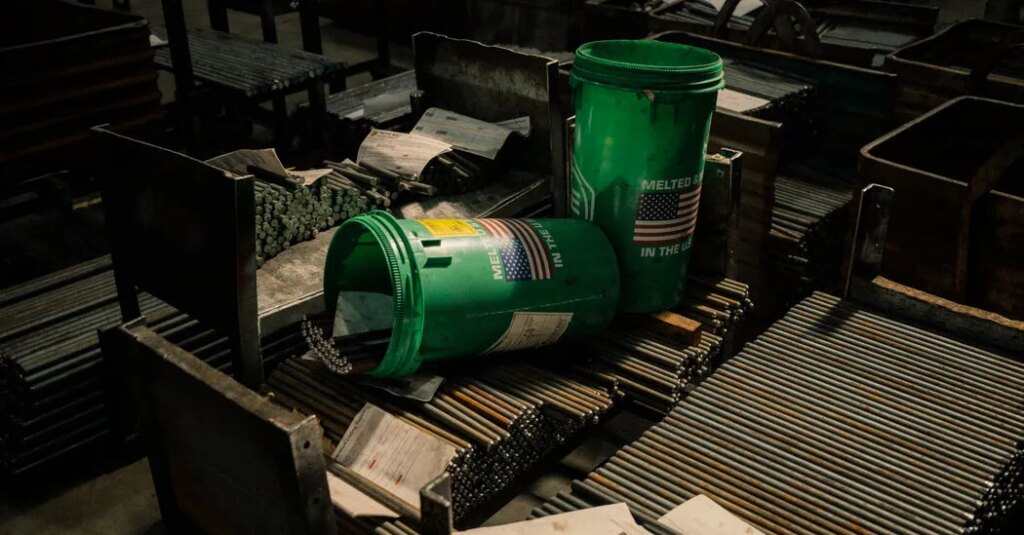
In Langley, a city of 29,000 just north of the American border, Pacific Bolt makes industrial parts for oil and gas production. Inside its factory on a recent morning, men attended to an array of clattering machinery, transforming hunks of steel into fasteners, screws and other components.
Before Mr. Trump’s return, the plant was buying 95 percent of its steel from the United States, spending $4 million to $6 million a year, and trucking much of it in from a factory near Seattle, less than 150 miles away. Transporting each 30-ton load cost about $500.
But Mr. Carney’s retaliatory measures included 50 percent tariffs that recently took effect on steel imported from the United States. Pacific Bolt has shifted purchases to Canadian producers thousands of miles away in eastern Canada, paying much higher freight costs. A recent shipment from Ontario cost $12,000 to transport.
Even while slashing its American imports, Pacific Bolt is paying as much as $100,000 per month on Canadian retaliatory tariffs. Those costs have wiped out profits, prompting the factory to seek savings by importing parts from China.
“We’re struggling to survive,” said the company’s chief executive, Trevor Borland, 44, whose father started the business.
Mr. Goldstein, whose Vancouver-based company makes sensors for computer chip plants, is a reluctant foot soldier in the battle to look beyond the American market.
An engineer by training, he was raised in Chicago but has spent the last three decades in Canada. He had grown accustomed to thinking of the Vancouver technology realm as part of the same ecosystem as Silicon Valley, where he long traveled weekly via commercial flight routes known as the Nerd Bird.
Accelovant previously contracted with an American factory that made many of its products. But late last year, the plant said it no longer had enough capacity. That prompted Accelovant to move its manufacturing to Southeast Asia.
The computer chip business is ruled by precision and high stakes. “If our part fails, it costs our customer half a million dollars a minute,” Mr. Goldstein said. Given that, he was forced to undertake a year’s worth of tests to satisfy customers that the new plant in Asia could satisfy their needs.
Late last year, his company fell prey to the broader permutations of Mr. Trump’s trade war. One of his major customers — a South Korean company that manufacturers chipmaking gear — faced demands from its own customers in China to forswear components from the United States. At the same time, the Korean company’s American customers demanded it not use Chinese-made components. Caught in the middle, the Korean company halted production. Which spelled fewer orders in Vancouver for Accelovant’s sensors.
“Sales literally stopped,” Mr. Goldstein said. “It was an absolute train wreck.”
Spooked, Accelovant applied for the $1 million grant under a Canadian program that helps companies reorient business away from the United States. It is using that money to cultivate new export markets while automating its North Vancouver factory to boost domestic production.
Mr. Goldstein is under no illusion that his company, or Canadian businesses overall, can walk away from business with the world’s largest economy: the United States. Yet he is equally certain that a long-term refashioning is underway, as Canadian companies broaden their sights.
“This is a fundamental shift,” he said.
The post Trump’s Tariffs Push Canadian Companies to Look Past American Links appeared first on New York Times.