The powerful Nor’easter that slammed into parts of the East Coast over the weekend isn’t quite done yet.
As of 10 p.m. Sunday, the slowly weakening storm was centered near Cape May, N.J., with bands of rain still moving through New Jersey, New York City, Long Island and much of southern New England, according to the National Weather Service. The heaviest rain was expected across Long Island, New York City and southern New England overnight.
An additional 1 to 2 inches of rain, with isolated totals as high as 3 inches, was forecast from Long Island through eastern Massachusetts and into parts of New Hampshire and Maine.
The strong winds will slowly die down — an 81-mile-per-hour gust was recorded on Saturday at Montauk Point, on the eastern tip of Long Island — but the storm is not expected to fully leave the area until Tuesday. Gusts of 40 to 50 m.p.h. remained possible from New Jersey to Long Island overnight, though forecasters said diminishing winds and lower high-tide cycles should begin to ease coastal flooding. Minor flooding could linger into Monday.
The storm is likely to be the first of several to hit the East Coast over the next few months, fueled by El Niño-warmed waters in the Pacific.
Gov. Mikie Sherrill of New Jersey said on Sunday morning that conditions along the coast could remain treacherous through Monday morning’s high tide. Over the weekend, New Jersey residents had to be evacuated from their homes along the shore and that dozens were rescued from vehicles, she said. The pounding surf damaged dunes in Atlantic City and neighboring Brigantine, she added, and strong winds pushed water on shore.
“We’re not out of the woods just yet,” she said.
On Long Island, which was lashed by heavy rains and winds, the Nassau County executive, Bruce Blakeman, warned on Sunday of more coastal flooding connected to that evening’s high tide. He also urged residents to “please be aware, be observant” about the possibility of more falling trees, given that the ground was saturated with water.
On Saturday afternoon, Leighton Brown, a 56-year-old Brooklyn man employed by the New York City Housing Authority, was killed by a falling tree, city officials said.
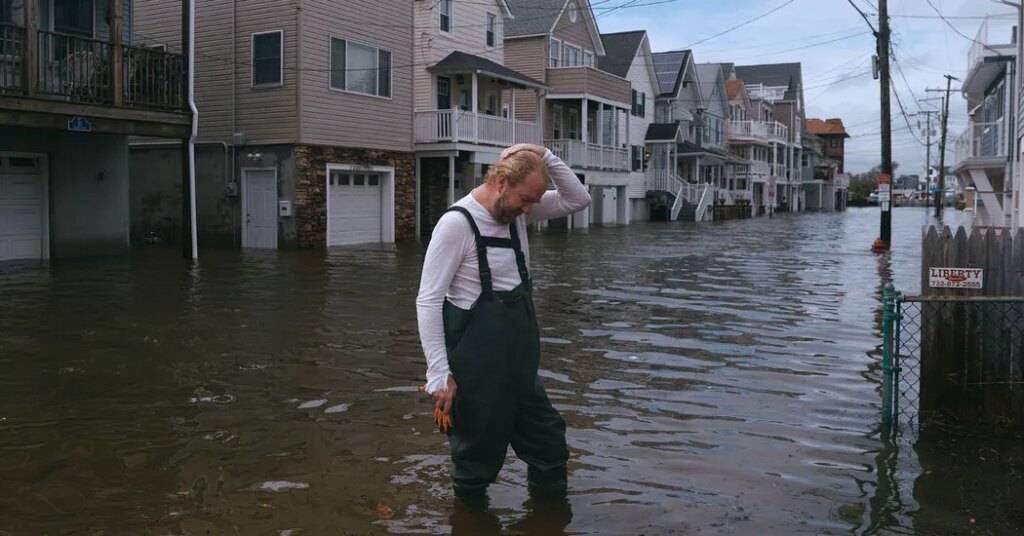
As the storm crawled up the coast on Saturday, the combination of high tides and strong winds knocked out power, canceled flights and events and flooded coastal areas. Streets, cars and some first floors of buildings were submerged.
In Edgewater, N.J., flooding from the Hudson River forced emergency workers to evacuate people from a waterside hotel.
Many along the Jersey Shore talked about the catastrophe brought by Hurricane Sandy in 2012. For those who experienced that storm, there was a general feeling that this nor’easter was a relatively minor event.
Wind gusts exceeded 50 m.p.h. in several places on Saturday morning, reaching 62 m.p.h. in Nantucket, Mass., downing power lines and causing outages.
The storm also wreaked havoc on travel plans. Over the weekend, about a quarter of the flights in and out of Boston Logan International Airport were canceled, according to the online flight tracker FlightAware. Across the Northeast, hundreds more flights were delayed.
For some surfers, however, the weather brought excitement. These were the first major swells of the season, offering the chance to catch some waves. One surf shop worker in Rhode Island described the conditions as being “like Christmas morning.”
By Sunday afternoon, utility crews had restored power in many communities, but at 8 p.m. on the East Coast, New York remained hardest hit by outages, with nearly 13,000 customers affected across the state, many of them on Long Island, according to the tracker PowerOutage.us. More than 10,800 customers were out of power in Connecticut, and more than 3,600 in New Jersey.
Reporting was contributed by Kevin G. Andrade, Mark Bonamo, Nazaneen Ghaffar, Hilary Howard, Isabella Kwai, Mack Liederman, Bernard Mokam, Christina Morales, Chelsia Rose Marcius, Anushka Patil and Raymond Zhong.
The post Nor’easter Weakens but Remains a Threat appeared first on New York Times.