After years of fumbling around for an effective campaign message, Democrats seem to have finally found one in affordability. The idea couldn’t be simpler: Life’s essential goods have become intolerably expensive, and somebody ought to do something about it.
Zohran Mamdani campaigned on this theme in New York City and won, as did more centrist candidates like Mikie Sherrill in New Jersey and Abigail Spanberger in Virginia. Similar platforms are now driving midterm campaigns for high-profile Democrats such as James Talarico, Rob Sand and Roy Cooper. Affordability links the high costs of living to Republican policies, particularly tariffs and the Iran war; it’s no wonder Democratic strategists are embracing it as a campaign message.
Winning elections is no small thing. Yet to provide a lasting advantage for the Democrats, the affordability issue can and should be more than about high prices. The great risk for the Democratic Party right now is to fail to reckon with the much larger and more powerful issue that affordability candidates are tapping into — and to end up disappointing voters once again.
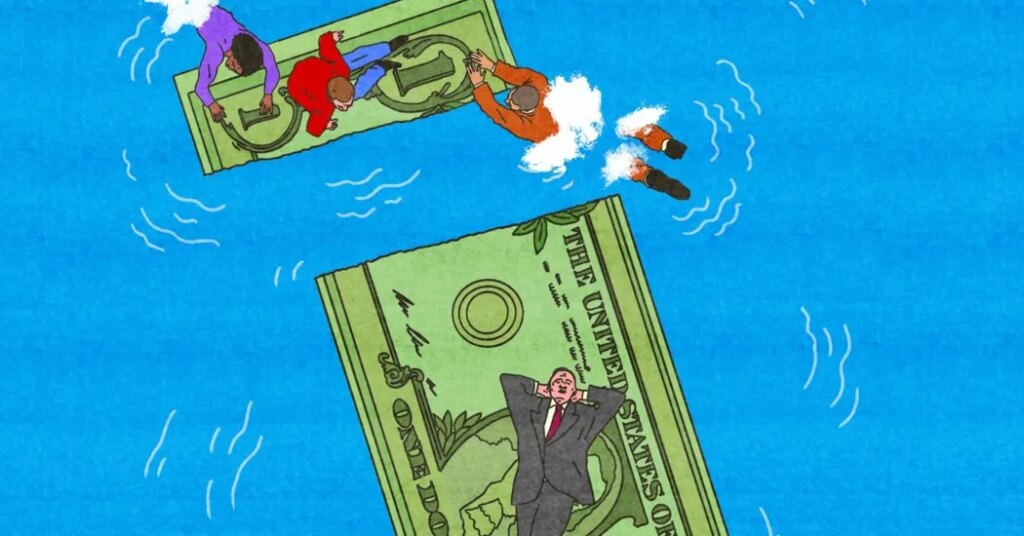
The most important political division in our times is not between Democrats and Republicans, or socialists and capitalists; it’s between those who think today’s economic system is fair and working well for most people, and those who do not. While a minority of Americans defend the current system, citing aggregate indicators like growth rates, a majority see things differently.
A recent CBS News poll found that some 60 percent of Americans think the economy is “unfair” and that most people under 45 say they have fewer economic opportunities than their parents did. In a recent Economist/YouGov poll, 66 percent of Republicans said that the gap between rich and poor is a “big problem.” Though the stock market is up and the United States is not suffering a recession or mass unemployment, Gallup’s monthly Economic Confidence Index has been persistently negative.
To run a proper affordability campaign — one that taps into a discontent even deeper than that over high prices — Democrats should cater to this widespread sense of unfairness. The key message is rebalancing: a promise to level out a lopsided economy that favors huge concentrations of wealth.
That message can risk sounding like generic political talk about standing up for the little guy. Credibility has to come from a platform of policies that shift economic power away from the big guys in ways that voters can readily understand.
You see this in the platforms of candidates who have run on affordability. Mr. Mamdani’s government-run groceries stores are supposed to make milk cheaper, yes — but also to undercut the power of corporate food conglomerates. Ms. Sherrill’s utility tariff for data centers is designed to lower energy prices for consumers, yes — but also to force Big Tech to pay for its own infrastructure. Mr. Sand hopes to lower home prices, yes — but in part by barring private equity from buying up single-family homes as investments.
What we are seeing is the resurgence of an age-old American ideology of economic balance. While it lacks a formal name, it may well be the most popular ideology in the country.
There are signs on the campaign trail that some Democratic candidates grasp the appeal of this broader affordability message, as when Mr. Talarico, running for Senate in Texas, says that “the biggest divide in this country is not left versus right” but rather “top versus bottom.” Democrats should not be afraid to hit this message harder: The problem is not just high prices but also the structure of the economy. If Democrats can embrace what affordability is really about, they might do even more than win elections; they might bring about the change that most Americans, including most Republicans, say they are looking for, and in so doing, realign our politics.
Americans have repeatedly rebelled against imbalances of power. From the American Revolution to the election of 1800, from the Jacksonian war on the national bank in the 1830s to the farmers who participated in revolts against monopolistic railroads in the 1870s, from the progressive era to the New Deal, Americans have repeatedly sought to offset or balance concentrations of power.
To call it “populism” undersells the point. The historian Arthur Schlesinger Jr. perceptively observed that the United States oscillates every few decades between periods of “private interest” (pro-business individualism) and “public purpose” (civic-minded reform). The cycle goes back to the early 1800s, when an economy dominated by Eastern banking and commercial interests was upended by a series of small-producer presidents, beginning with Thomas Jefferson, who led the movement that would ultimately open the Midwest and West to millions of small farmers. The Jacksonian era, the Civil War, the Progressive Era and the New Deal were the public’s reckoning with the powers of the financial sector, slaveholders and corporate monopolies.
We’re in a similar period of private interest today. For the past 40 years we’ve let large businesses and the richest Americans concentrate wealth on the theory that at some point, later on, the winnings would reach everyone. Unfortunately, that “later” never came.
Making things worse, the economic imbalances in our time are more varied than the simple divide between rich and poor. We also have economic divides between geographic regions, between generations, between small and large companies, between employers and employees. And now, seemingly, we have a divide between the tech industry and everyone else: We’re often being told that if left alone, A.I. is a tide that will lift all boats — but the skeptics have history on their side.
It is not a coincidence, in this context, that the American antimonopoly tradition, exemplified by the lawyer and Supreme Court Justice Louis Brandeis, has re-emerged. You can see this in the sweeping lawsuits against Live Nation, Google, Meta, Amazon and Apple, and in the recent verdict against Meta and YouTube concerning social media harm. You needn’t be an economist or technocrat to understand that concentrated market power is a threat not just to widespread prosperity but also to social cohesion.
You don’t even need to be a Democrat: Recall that JD Vance, before becoming the vice president, voiced many of the same concerns as today’s affordability candidates — as have Republican politicians such as Josh Hawley, Brian Fitzpatrick and Phil Scott. The election of Donald Trump in 2016, of course, was at least in part a reaction to the same sense of economic imbalance, especially among rural and working-class voters.
To be sure, there are those who insist that efforts to rebalance economic power will destroy the vitality that gives America and American business its dynamic character.
Politically, this worry has less force than some imagine. To understand why, consider the National Football League. It is by far the nation’s most popular and most financially successful sports league, and it is constantly rebalancing power among its teams through tools such as a hard salary cap (which Major League Baseball lacks) and aggressive revenue sharing. In a laissez-faire N.F.L. that was run more like today’s American economy, New York and Los Angeles would dominate. Instead, Kansas City, Detroit and Baltimore compete too. If the league’s fans, representing perhaps half of the country, prefer regulated competition in their football, why wouldn’t they want it in their economy?
Some Democrats fret that a full-throated message of economic balance will sound too radical for most voters — a worry exemplified by figures like Mr. Mamdani, who campaigned on affordability while describing himself as a democratic socialist. But for every Mamdani, there’s an Abdul El-Sayed, a self-described capitalist who campaigned on an affordability platform to win the Democratic Senate nomination in Michigan. In this vein, Mr. Talarico’s campaign calls him a “proud capitalist” while he also laments that “the richest 1 percent of Americans now own more wealth than the entire middle class.” To see our current political moment as a replay of the old contest between socialism and capitalism misses what’s really going on.
Rebalancing or redressing economic power can mean many things. In the midterms, the Democrats campaigning on affordability are proposing a variety of strategies. Some, like Mr. Sand, who’s running for governor in Iowa, favor what’s sometimes known as an “abundance” approach: cutting the red tape that slows housing construction, for example, to help lower housing prices. Others, like Mr. Talarico, emphasize more direct forms of help, such as federal down-payment assistance for first-time home buyers.
But the most salient difference between candidates will be less about method than about credibility and resolve. A cautionary tale is that of Kyrsten Sinema, the former Arizona senator who once campaigned as a “fighter” for “the forgotten middle class and the powerless in our society” only to end up as a great ally of the pharmaceutical industry and a key opponent of strong drug-price reform. As Ms. Sinema’s case reminds us, the forces opposing affordability politics should not be underestimated. While theirs is a minority position numerically, it draws from powerful industries and individuals who benefit enormously from the economic system remaining as it is.
Let us not be naïve about this: Campaigning on a platform to rebalance economic power may appeal to a broad swath of voters, but it can cost candidates corporate support and ultimately, donations, and it takes a lot of money to run for office. This calculus, more than any ideological qualms, is what can lead to a mere superficial embrace of affordability — as in Ms. Sinema’s case — or to wishy-washy economic commitments, such as the ones Kamala Harris put forward during her presidential campaign. While paying mere lip service to affordability might help protect donations in the short term, ignoring what a large majority of voters want — after promising to serve them — is a recipe for long-term unpopularity.
Indeed, a golden opportunity exists today for Democrats precisely because Mr. Trump’s second administration has entirely abandoned efforts to address economic imbalance and instead has become a case study in corruption and command capitalism. Mr. Trump and some of his officials, such as Treasury Secretary Scott Bessent, have taken to denying that there’s an affordability problem or refusing to take any responsibility for it. A growing popular disillusionment with Mr. Trump’s economic management (more than 70 percent disapproval) means that his experiment with strongman economics has run its course — and is offering Democrats a chance to take the issue of economic balance and make it firmly their own.
The greatest beneficiary of our country’s partisan divisions is the economic status quo. If it were possible to translate the preferences of the American public directly into policy, I suspect that we would see fundamental changes to our economic order, changes that rebalanced the power of wealth. That’s why the main challenge today is to overcome the politics of distraction and division and to convert the affordability instinct into a program of political action. Doing that isn’t easy — but history shows that earlier generations pulled it off in even more difficult times. The fact that we’ve done it before should give us hope.
Tim Wu (@superwuster) is a law professor at Columbia, a contributing Opinion writer and the author of “The Age of Extraction: How Tech Platforms Conquered the Economy and Threaten Our Future Prosperity.” He served on the National Economic Council as a special assistant to the president for competition and tech policy from 2021 to 2023.
The Times is committed to publishing a diversity of letters to the editor. We’d like to hear what you think about this or any of our articles. Here are some tips. And here’s our email: [email protected].
Follow the New York Times Opinion section on Facebook, Instagram, TikTok, Bluesky, WhatsApp and Threads.
The post Affordability Is a Winning Message for Democrats. But There’s an Even Better One. appeared first on New York Times.