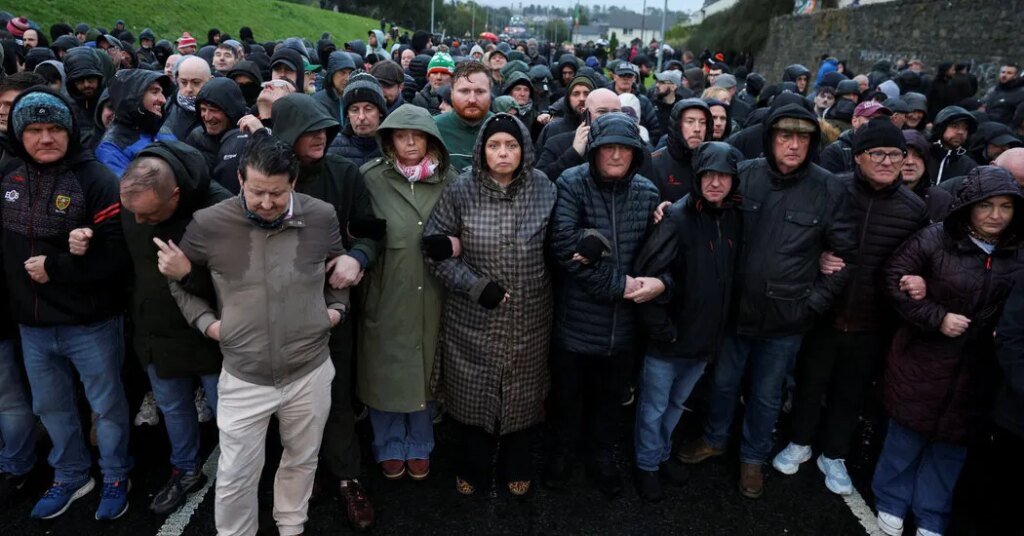
After a judge ruled on Sunday that a contentious march by a Protestant group through a mostly Catholic area in Northern Ireland could proceed for the first time in nearly three decades, residents blocked the streets to prevent the marchers from passing.
The tense standoff on the streets of the town, Portadown, risked violence that could threaten the fragile peace in the region, where sectarian divisions caused bloodshed for decades during the period known as the Troubles. During that time, largely Protestant unionists who wanted Northern Ireland to remain part of the United Kingdom were in conflict with the largely Catholic nationalist camp that has long sought unification with the Republic of Ireland.
Northern Ireland has been governed by a power-sharing arrangement between the unionist and nationalist parties since 1998, when peace was brokered by the Good Friday Agreement. But some parades and other symbols of the sectarian conflict have long proved contentious.
Since 1998, there had been a ban on any march by the Orange Order, a Protestant unionist group, passing through the Garvaghy Road area, a mostly Catholic, nationalist part of Portadown, after marches there had been the scene of repeated sectarian violence.
The ban has been challenged for years, with the Orange Order and its supporters maintaining that they have a legal right to march in the area.
Early on Sunday morning, after much legal wrangling, a judge determined that the march could proceed with strict rules — only 35 people could take part in a demonstration lasting from 8 a.m. to 9:30 a.m., and no supporters or bands would be allowed. The local Orange Order said in a statement that it had appealed to its members to conduct themselves “peacefully and responsibly.”
Hundreds of local protesters gathered on the street to decry the decision and prevent the march from taking place. Among them was Michelle O’Neill, the first minister of Northern Ireland, whose nationalist Sinn Fein party is in a power-sharing agreement with the Democratic Unionist Party, a structure that was created as a result of the peace process.
“No right-minded person would make this decision,” Ms. O’Neill said of the court judgment allowing the parade.
She questioned why, after 28 years of blocking the march, legal authorities decided to allow it to proceed and, she said, “to bring this mess back onto this community.”
The head of the Democratic Unionist Party, Gavin Robinson, said that Ms. O’Neill was breaking the law by taking part in the protest blocking the parade. In a news conference on Sunday evening, he voiced “appreciation for the determined stance that the Portadown Orangemen are taking” and said they would wait as long as it took to be able to hold the march.
By early afternoon, the march had still not taken place, after the police advised the Orangemen that they should not try to make their way through the area because of the large protest. The police urged residents to clear the road, but residents continued to block the route.
As heavy rain fell on Sunday afternoon, Breandán Mac Cionnaith, the head of the Garvaghy Road Residents’ Coalition, told reporters that residents were “prepared to stay here for whatever time it takes” to continue blocking the march route.
“Here, we have an organization that is openly sectarian, forbids members of this community to even join it, wants to march through this community at any time it wants,” he said in an interview broadcast by news outlets. “It should not be permitted, just the same as racist marches.”
Chris Bryant, the British government’s secretary of state for Northern Ireland, urged calm in an interview from the Labour Party conference in Liverpool, England, on Sunday.
“I wish we weren’t in this position, I wish we weren’t in the position of relitigating things of the past,” he said.
It is “important that everyone abides by the law,” he added.
The government of the Republic of Ireland said in a statement that it was “very concerned about the situation.”
“Our primary concern remains to avoid a return to the divisions of the past, recalling the significant progress made over many years in furthering reconciliation under the Good Friday Agreement,” it said.
Claire Hanna, the leader of Northern Ireland’s Social Democratic and Labour Party, was at the scene of the standoff on Sunday afternoon, and in a video posted on her account on X said that “people should all be able to go home and we should work on how we move forward together.”
“I urge people not to get sucked into the politics of polarization and division and domination,” she added.
The post Standoff in a Northern Irish Town Over Contentious Sectarian March appeared first on New York Times.