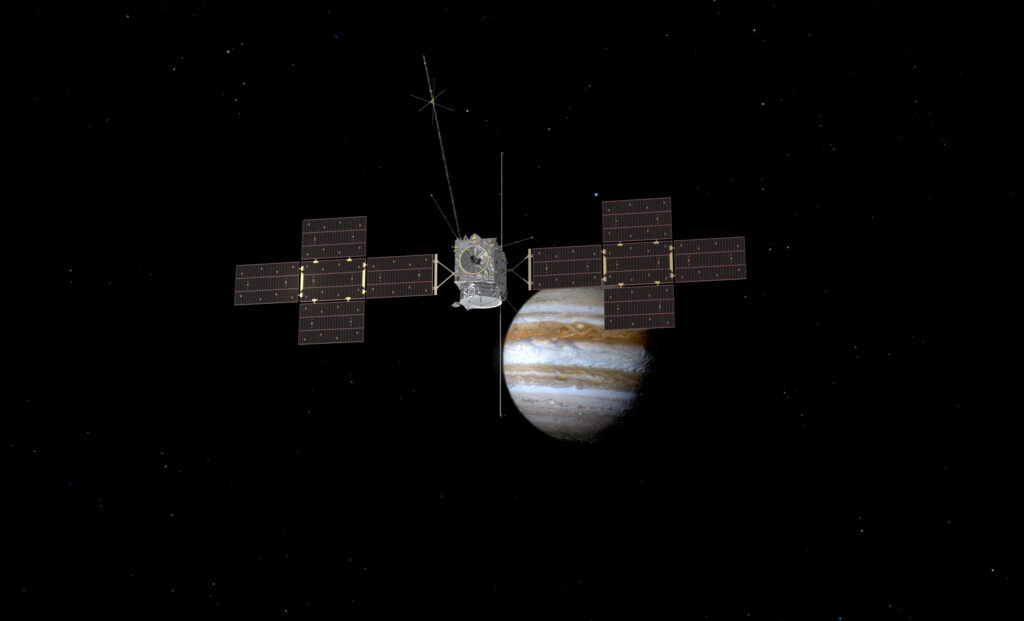
The path to Jupiter’s moons, which scientists believe could harbor conditions friendly for sustaining life, is long and paved with Earth flybys.
The European Space Agency (ESA) launched its Jupiter Icy Moons Explorer (Juice) in April 2023, to focus on the behemoth’s two largest moons, Ganymede and Callisto. Juice will also gather scads of data about Jupiter itself and the smaller moon Europa, which scientists consider one of the most promising places to look for life in the solar system.
There’s just one hitch: Juice won’t arrive for another five years.
The next step is to zip within 5,400 miles of Earth, a Monday morning maneuver that will give Juice a crucial gravity assist to boost its speed.
“We still have a long journey ahead before reaching Jupiter in 2031, but every step we take now brings us closer to our destination,” said Olivier Witasse, project scientist for the mission.
The flyby will also give the spacecraft a chance to practice observations it will need to make as it explores Jupiter and its moons, with Juice’s instruments gathering data for a week and a half surrounding the close approach. That means, of course, intriguing new images of our home planet from afar. But more of the flyby data will be the sort of thing only scientists could love. For example, the spacecraft will be a rare visitor to the long tail of Earth’s magnetic field, offering experts a glimpse at how much that tail flaps in the face of the constant stream of charged particles flowing off the sun.
“It’s very serendipitous,” said Patrick Brown, a space physicist at Imperial College London and instrument manager for the Juice magnetometer.
Seeing how the instrument responds to Earth’s magnetic field will give scientists the information they need to better interpret what it measures out at Jupiter’s icy moons. There, the instrument is a vital part of Juice’s investigation of these worlds. The magnetometer will peer beneath each moon’s icy shell, measuring its thickness, as well as the depth and saltiness of any ocean hiding below. It’s those hidden oceans that scientists believe may have the conditions necessary for life to thrive — lots of liquid water, a source of energy and the elements most commonly found in organisms.
“The moons of the outer solar system are kind of like the next undiscovered country,” said Cynthia Phillips, a planetary scientist at NASA’s Jet Propulsion Laboratory in California. “They’re very different from any place that we’ve really observed up close before.” Phillips is not involved in the Juice mission, but is the project staff scientist for NASA’s Europa Clipper mission, which is also currently en route to the Jupiter system, where the two spacecraft will do complementary work.
Although Juice will gather limited data about the most tantalizing moon, its insights will still flesh out scientists’ understanding of Europa’s habitability. “Studying the whole system of Galilean satellites helps to give us really good context for a place like Europa,” Phillips said.
Juice’s next milestone will come in three years, when it zips past Earth again before heading out to Jupiter for good.
The post Why a spacecraft exploring moons where life may thrive is zipping by Earth appeared first on Washington Post.