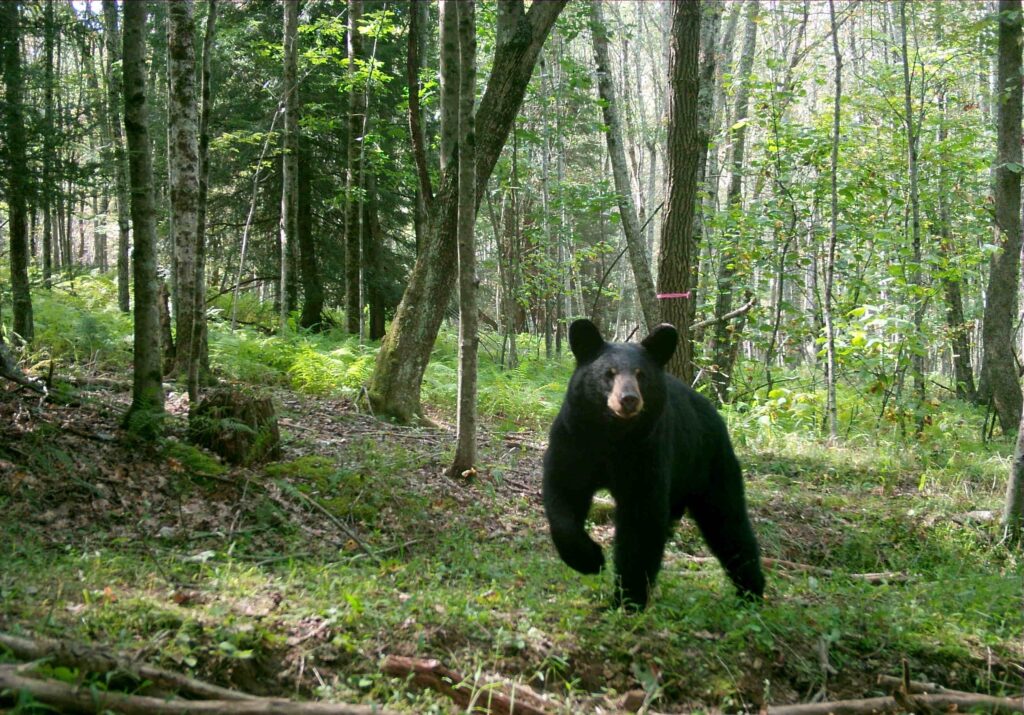
For over a year, scientists at Virginia Tech analyzed videos of black bears in a special bear-monitoring center at their campus in Blacksburg. They wanted to better understand bears’ habits as they prepare to do what they’re known to do best: sleep.
Experts were able to watch four pregnant females that had been tranquilized by wildlife experts and brought in from the wild. The bears were kept in large enclosures for nine months, and experts watched them as they ate, climbed, prepared their dens for their cubs, gave birth and then played and cared for their newborns.
And they watched them get ready to hibernate and then sleep. In total, they analyzed about 22,000 hours of bears being, well, bears.
Their work was published in June in the journal Proceedings of the Royal Society B: Biological Sciences, and experts said it sheds new light on how temperature and the length of a day can impact the hulking creatures as they bulk up for their long winter’s nap.
“The thinking generally is that as temperatures get colder and days get shorter, they hibernate and do less activity,” said Brogan Holcombe, a doctoral student in Virginia Tech’s geospatial and environmental analysis program who was one of the study’s authors. “But we found that even when the days got shorter, if it was still warm out in December, they were up and active when they should have already been hibernating.”
All the bears involved in the study were released back into the wild.
Holcombe said her team’s work shows that there’s more of a link between when bears go into hibernation and the changing ecology of the planet.
That means that as climate change causes warmer temperatures, bears could stay out and about in the wild later, rather than heading into their dens to start hibernating in the winter.
But that could present a challenge. If there aren’t enough acorns or plants because of the warmer temperatures, the bears could be left with less to eat.
Marcella Kelly, a professor in Virginia Tech’s Department of Fish and Wildlife Conversation, another co-author of the research, said it could mean trouble for both bears and humans.
“If the temperatures rise and there’s nothing for them to eat because the plants are dormant for the winter, they could try to seek out people-food more,” Kelly said. “And then you have more of an increased chance of human-wildlife interactions.”
The post Scientists analyzed 22,000 hours of bear videos. This is what they learned. appeared first on Washington Post.