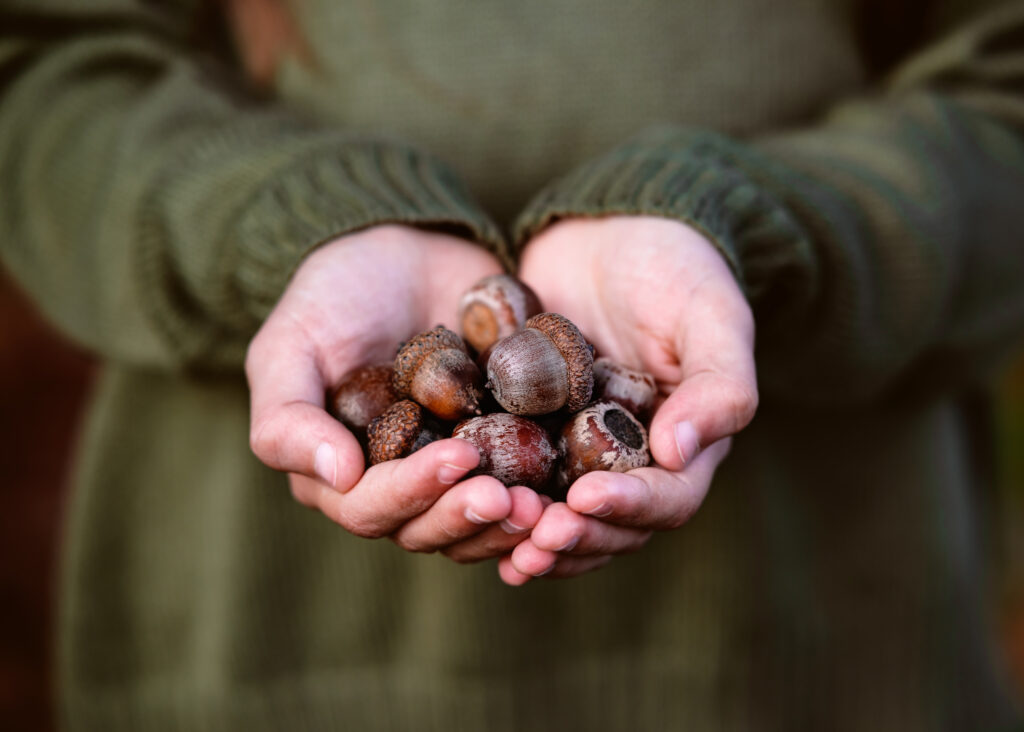
As autumn descends, it’s nearly impossible to ignore the acorns as they thunk onto roofs and burst like popcorn under car tires. The U.S. Forest Service estimates that there are about 40 billion oak trees in the United States, and as the weather cools, they begin to drop a bounty of nuts — an all-important food source for squirrels and chipmunks, deer, bears, birds and other animals.
But acorns aren’t just critter food. For a long time, they were an important food staple for people, too. Before colonization, Indigenous North Americans were especially dependent on acorns, says Sean Sherman, an Oglala Lakota chef known as the Sioux Chef. “It was such a massive, important part of their diet,” he says.
Acorns were dried or roasted, ground into flour and used to make porridges, soups and breads. “They were getting most of their carbs and essential fats from acorns,” Sherman says. “They’re highly nutritious.”
Acorns contain essential vitamins and minerals, including a big dose of manganese, folate, and vitamins E and B6, and they are rich in antioxidants. And it’s looking like acorns could be the next popular superfood: They have been popping up on the menus at popular restaurants, in cookbooks and in food influencer content. Some tree breeders, food scientists and chefs are working to put the humble acorn back on our plates.
A traditional ingredient
There are about 500 types of oak trees in the Northern Hemisphere. Acorns from various varieties have a long history of culinary uses in many of those countries, though only a few traditional dishes include them today. In Korea, they’re used to make dotorimuk, an acorn jelly, and noodles called dotorimuk-guksu. Acorn flour is the main ingredient in the Sardinian bread pan’ispeli, and they are roasted to make the traditional Lithuanian drink giliu kava, or acorn coffee.
Sherman, 52, is among the chefs putting a renewed spotlight on acorns as part of his nonprofit organization North American Traditional Indigenous Food Systems, which he founded in 2018 to promote Indigenous food.
At Sherman’s acclaimed Minneapolis restaurant, Indígena by Owamni, he has featured acorns on the menu “quite a few times.” And his new cookbook, “Turtle Island: Foods and Traditions of the Indigenous Peoples of North America,” a finalist for a 2026 James Beard Media Award, includes instructions for making acorn flour, as well as a recipe for acorn cakes that uses the flour alongside honey, cassava flour, baking soda and salt. The cakes, Sherman says, have a “nutty, earthy flavor.”
In many Indigenous communities, he says, acorns never really left the menu. But by and large, they fell out of vogue.
At a prestigious food symposium a few years ago, Sherman heard an academic on a panel speaking about the history of acorn eating in Europe. He recalls, “It was kind of like, ‘Can you believe the people were eating pig food?’”
Some European settlers also brought that outlook to the Americas. “You have a whole different group of people with a different culture, and a lot of them wanted nothing to do with what the Natives were eating,” Sherman says. “They’re bringing in their own crops, growing trees and berries that are comfortable to them, and eventually whole food systems change.”
Joan Montserrat, co-founder of a tree nursery in Spain’s Catalonia region, became interested in acorns and cultivating oak trees after hearing his grandmother talk about eating sweet acorns straight off the tree when she was a girl.
“Here in the Iberian peninsula, human acorn consumption has also been lost, same as in the States or even more,” he says. “Some old people still feel a kind of shame about having to eat acorns, because they associate acorn consumption with hardship through wartime and being poor.”
At his nursery, Balano Trees (from the Greek word balanos, which means acorn), Montserrat, 43, grows and sells seedlings grafted from the holm oak, a cultivar that grows nuts so sweet that they can be eaten straight from the tree, which is not the case for most acorns.
A bitter nut
The shift from acorn consumption also could be attributed to the processing required. Most oak varieties produce nuts that are full of tannins, astringent compounds that make a raw, just-off-the-tree acorn way too bitter to eat. To render them edible, those tannins must be leached out in a time-consuming process that involves boiling or soaking the acorns in water for days or even weeks.
“You definitely don’t want to consume acorns unless they’ve been processed properly,” says Kenneth Asmus, 72, who runs Oikos Tree Crops near Kalamazoo, Michigan. For more than 40 years, he has been breeding oak cultivars to establish crops that produce low-tannin or even tannin-free acorns, which he thinks could pave the way for more wide-scale consumption.
“The difference between something widely eaten, like a chestnut, and an acorn is the tannins,” Asmus says. “When I first started the nursery, I’d meet people who were trying to create varieties that were naturally low in tannins. I got involved with various people and groups who were exchanging acorns, and for a while I was acorn central.”
When Montserrat started his oak nursery, he looked for the trees his grandmother had spoken of. “I traveled to a lot of rural places in the Iberian peninsula and Balearic Islands, and spoke to many old people who’d say, ‘That oak over there is sweet,’” he says. “Now we have plantations to cultivate the sweet acorn, not as a new nut but a recovered one.”
Montserrat’s nursery sells dried acorns and acorn flour in addition to young oak trees, and he is working to develop mechanized tools to help harvest and process acorns on an industrial scale wherever oak trees grow.
“Our goal is to produce an industrial ingredient, not a gourmet, premium thing. We want the acorn cookies in the supermarket,” he says. “In the past — in the U.S., here, in many places — the acorn was not just one food of many that was gathered from the forest. It was the staple food. It was quite important. And we think it still has this potential.”
The future of food
More oak tree farms, the growers say, also could create major ecological benefits. The trees support more biodiversity than most other tree species. They capture carbon and replenish the soil and, once seedlings are established, require very little water or fertilizer.
“Most importantly,” Montserrat says, “they produce without inputs. Without irrigation, without chemicals and without tilling the land.”
Asmus believes that within the next few decades, a robust market for acorns will emerge as farmers and landowners embrace agroforestry as part of a climate-change-driven shift toward more sustainable food systems.
“You’re starting to have some real investment in tree crops in general,” he says. “Maybe we’ve always thought of oaks as part of the wood market, but I’ve seen trees with branches so heavy with acorns they’re weeping over to the ground. You see that, and it’s easy to start thinking of this as a fruit crop tree.”
There are also economic opportunities in growing ancestral ingredients, especially acorns, Sherman says. “More production could create some real economic development, especially in rural places,” he says. “It’s a good opportunity for tribal communities.”
Although you can buy acorn flour online and from some specialty stores, it may be a while before acorn products become a common sight in grocery stores. But in the meantime, Asmus says, there’s no better time than the present to start planting trees.
“You can start an oak orchard today,” he says, “and in five to 10 years, you’ll have your own acorns to eat.”
The post The case for America’s original superfood — the acorn appeared first on Washington Post.