SPOKANE, Wash. — Dailon Wells-Dutton woke up in a room that wasn’t quite his own, in an apartment that was not his home. His mother had tried, in the aftermath of a wildfire that destroyed their neighborhood, to replace the philosophy books and family photographs the 17-year-old boy had lost. But his closet was mostly empty, and the teddy bear tucked into a brand-new bed was not the threadbare one he’d carried everywhere since he was 3.
“Kiddo, when do you leave for school?” Kimberly Wells-Dutton, his mother, asked while Dailon filled a thermos with English breakfast tea. He checked his phone and told her he was about to go.
“Parking is horrible at this time, so I want to get there a little early,” he said.
Kimberly watched as her son stashed the thermos in his backpack. He’d always taken school seriously, but this year, he seemed especially eager to set off each morning to the one place where his life still felt normal.
“We’re doing the final dig today,” Kimberly told him. “I’ll give it one last shot, see if there’s anything else I can salvage.”
“I don’t go to the property,” he said quietly. He’d looked around only once, right after everything burned. He told his mother he didn’t want to mourn things. He wanted to think of this time as a blip, not a life-altering loss. He wouldn’t let the arsonist who set the fire destroy more than he already had.
Still, Dailon did wake up some mornings grieving Blue Bear, the stuffed toy his grandma had given him when he was a toddler. He wished he still had the custom knee braces that allowed him to play football without pain. He wanted the handwritten notes in his yearbooks back, the reversible bomber jacket he’d ordered special off Instagram, his lucky size 15 cleats.
He’d known, almost as soon as he realized he’d lost his house, that he might not play this year. He was a 6-foot-4, 300-pound offensive lineman with loose ligaments. Without the braces, a season of blocking felt daunting, and he wasn’t sure he had enough of himself to give to a team that had been light on spectators the year before.
Since the covid pandemic, many Shadle Park High School families had decided they’d rather stay home than shiver in the bleachers. But Spokane felt like a different town now. The sense of community that had fractured during one tragedy had cohered again during this one, and the football team felt like a place where Dailon might offer, if not his knees, then something else helpful.
He hugged his mother, then drove toward the school where he’d spent most of his daylight the past three years. When he arrived, he saw Shadle Park looked the same as it had before — huge and teeming with activity.
He strode inside, and he didn’t pass a single sign memorializing the fire. There was no donation box, no hint that 40 students and staff members were living, as he was, in temporary homes. That decision to provide a disaster-free zone was an intentional one, based on the advice of leaders from other cities where wildfires had leveled entire neighborhoods. Officials understood their schools had to do more than educate students. They had to become safe harbors, a stabilizing force not just for their students, but for entire communities as well.
The bell rang, and Dailon forgot about the fire and everything it took. He had civics class to attend.
SPOKANE STUDENTS AND TEACHERS were in their final weeks of summer vacation Aug. 1 when police say an arsonist walked along a railroad track on the west side of town. He found a spot where he knew a fire would “get bad,” court documents say, and then he lit a device he’d made from matches, notebook paper and a cigarette.
The fire moved quickly. It jumped the Spokane River and then rushed up green bluffs until it reached Dailon’s house nearly four miles away. He and his family were out of town when their neighbors called to tell them they were being evacuated. All they had time to grab were Dailon’s cats.
Two other wildfires were burning nearby, and together they came to be called the Spokane Complex fires, what one official called “probably the largest, most destructive fire in Washington’s history.” Sixty-five thousand people fled their homes, and by the end of the weekend, whole chunks of Washington’s second-largest city were reduced to ash and the skeletons of cars.
As the fires burned, Spokane School District officials knew they already had an important role to play for the families of the 167 students who were displaced. More than a hundred nonprofits wanted to help, but “you can do unintended harm and just add to the chaos if there’s a thousand different entry points for people to access services,” Superintendent Adam Swinyard said.
And so Dailon’s high school became a meeting point — both online and in person. The district’s technology department worked overnight to create a website where every nonprofit could list its services. Other officials quickly turned Shadle Park into a day care and a disaster assistance center, and dozens of staff members sacrificed their last few weeks of vacation to staff them both.
Some of the families who came seeking help were school families. Their kids ran track or played softball. But most hadn’t been connected to Shadle Park in years, if ever. That first week, Swinyard sat next to an older man at a cafeteria table. Swinyard asked if he wanted any food or water, and the man started weeping. He told Swinyard all he’d had to remember his father by was the Purple Heart he’d earned on the beaches of Normandy. It had been on his mantel. Now, it was gone.
Swinyard and his staff spent weeks handing out free clothes and food. They guided people down to the gymnasium, where booth after booth walked them through the processes for making insurance claims and setting up appointments with the Environmental Protection Agency.
Dailon’s mom went to the center every other day. Initially, Kimberly was just looking for help to rebuild her life. Having insurance adjusters and people giving away pet food and pots and pans in one place made her suddenly chaotic life feel a bit easier. She kept going because being there felt cathartic. Other people were crying and grieving as much as she was. In her son’s gymnasium she felt as if she were part of a community again.
Still, she wasn’t sure if she should take Dailon with her. She saw the way he went tense at the place he’d started calling “the property” instead of “home” and she didn’t want to ruin his idea of school, too. His senior year was only two weeks away.
Eventually, he told her he wanted to go. That first day, they stopped by booths handing out gift cards for groceries and thrift store clothes, and then they met with people from a Buddhist temple. Dailon ran into friends and their parents. He saw his third-grade teacher and learned he had also lost her house. As he talked to other teachers and counselors, Kimberly realized that the high school was already healing her son.
All around them, people were connecting in ways they hadn’t in years. Diem Pham, whose son Karden Nguyen played football with Dailon, hadn’t known any of the other sports moms before the fire. But she and Kimberly bonded over raising boys through a once-in-a-lifetime tragedy, and soon, Pham was promising to cook Vietnamese dinners for Kimberly.
Families were able to fill their newly rented closets with outfits they found at Shadle Park, but most of the donated clothes didn’t fit Dailon. Even sports teams didn’t think to include size 14 shoes in their generous offerings. But the Booster club found him a new letterman’s jacket. And a local company that takes all of Spokane’s school pictures offered to send digital copies for free.
As the first day of school approached, Kimberly asked Dailon nearly every afternoon if he’d decided whether to play football. He’d torn a ligament in his knee his junior year and he’d worked hard to rehab it after surgery. He’d spent all summer attending football camps to ensure he’d be ready for the opening game, and he’d talked to recruiters about going to college on a football scholarship.
After the fire, though, Dailon and his mom both worried that playing wasn’t the smartest idea. If he got injured, how would he rehab in a second-floor apartment?
He told his mom he didn’t want to rush the decision. He’d been a captain of the team the previous year, and he knew, if he did it again this semester, he would need to devote most of his time to the team. He didn’t want to abdicate any responsibilities, but he also felt like he wanted to spend more time with his family after everything.
“I don’t want to let anyone down,” he said.
Finally, right before school started, he went to an amusement park with a few of his teammates, and he talked through his decision with them. The next morning, he called his mom into his bedroom.
“I’ve made my decision,” he said. “I’m not going to return to football.”
AT FIRST, TEACHERS and counselors said they wrestled with how much to talk about the fire. Some wanted to call every family who lived in the burn zone.
“All of us wanted to jump in and say, ‘What do you need? What do you need?’ because that’s us, we want to help,” counselor Stephanie Filippini said. “But a lot of students are looking for normalcy. After they lose a home, they just want to come back to school and be a normal student. We could provide that safety and that security and that consistency as a school.”
For Dailon, so much of his routine was gone. His mother had taken his picture in front of the family maple tree every first day of school since kindergarten. Now that maple was scheduled for removal. He started his senior year in the only clothes he had — a pair of khaki shorts and a button-down he’d been wearing the day of the fire.
Once he was inside the school, though, he did feel something like his old self. He wasn’t a loud guy, but he could be funny and charismatic, a little wisecracking.
He spent his mornings studying civics and leadership, and then, after lunch, he headed to stagecraft, a class that allowed him to write and record sports news segments for the morning announcements. A few days before the football team’s second game of the year, Dailon and a wide receiver named Justyce Enger brainstormed ideas for future broadcasts.
“What PSAs do you think we should do?” he asked Justyce. “We could interview Hunter and Josh, or for fun spots, we could do ‘Notes With Nathan’ where Nathan just riffs on things he’s taken notes on.”
They roamed the cafeteria with a video camera for a while. They made jokes and talked other teenagers into participating in silly montages, and then back in the editing bay, Justyce cut the clips together while Dailon palmed a football someone had left behind. He spun the ball around. He went quiet, then ran a finger over the laces.
The theater teacher stopped by to talk to him. And though he didn’t mention anything that had gone on before school started, school leaders say that kind of check-in will become increasingly important as the semester drags on.
Some students were living in RVs, which they’d told teachers seemed kind of like camping. But Spokane would turn dark and cold soon, and school leaders knew RV living might begin to feel as traumatic as the fire itself. Other kids might realize in the winter that they no longer had a coat or a warm hat.
“When dealing with kids with trauma, there’s no playbook,” Swinyard said. “Right now our work is to make sure we’re watching really closely and maintaining lines of communication.”
One way school leaders have tried to do that is through an initiative they call “IRL.” The school now requires every student every day to do something after school with other people.
“We want kids off of screens, out of their homes, doing things together in real life,” Swinyard said. “And that’s important for every kid regardless of what they’re going through. But it’s even more important for kids that are in trauma and are struggling. It’s just to get them doing healthy activities, get them moving, get them around each other.”
And so when Kimberly called Dailon’s football coach to say her son wouldn’t play this year, the coach told her he wouldn’t take Dailon off the roster. He could still stand with the team on the sidelines, and he could rejoin later if he changed his mind.
Kimberly told the coach that was great, but Dailon had something bigger in mind. He wanted to learn from the trainers who’d helped him through his knee injuries, she said. He wanted to intercept his former teammates as they limped off the field, and he wanted to tell them, no matter how much everything hurt, to keep talking.
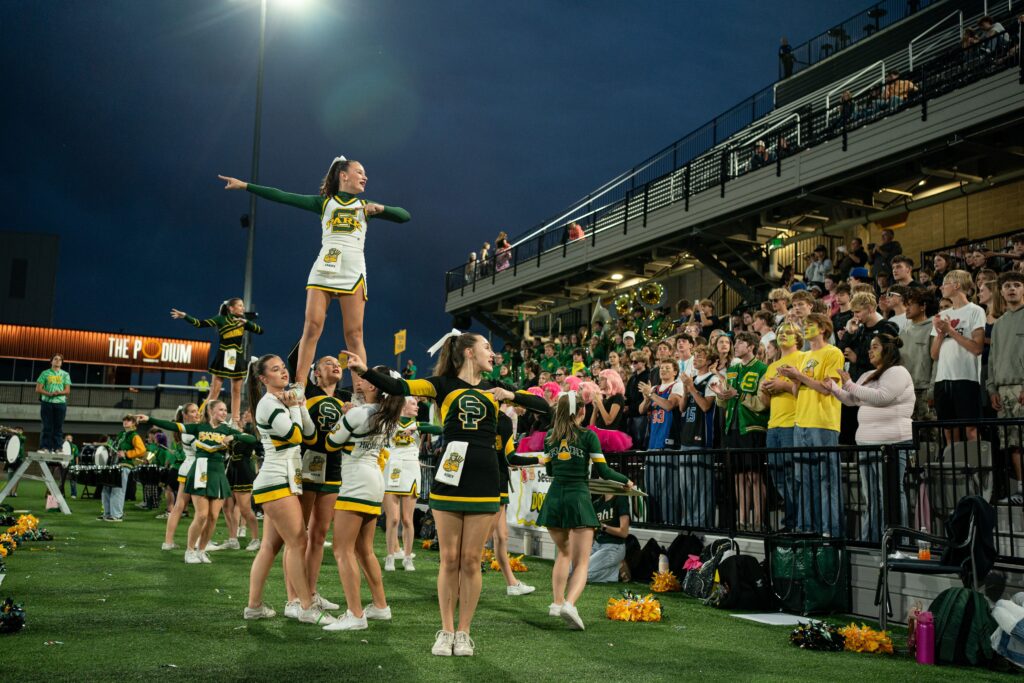
THE SHADLE PARK HIGHLANDERS lost their first game, 31-13, but a few days later, a crowd filled the entire student section and most of the public stands for a home game against Sageview.
Kimberly and her husband and daughter showed up right at kickoff. They stood at the top of the bleachers, and they unwrapped caramel apple suckers.
Sageview went up 27-0 with three minutes left in the first quarter, and the Highlanders moved backward on three consecutive plays, but Shadle Park’s fans remained engaged. They yelled. They groaned. They told each other they planned to attend every single game.
“They may not be good games,” one man told another, “but the community needs us.”
Kimberly snapped photos of Dailon. He wasn’t in uniform, but he was, as his coach had promised, right on the sidelines. He handed out bottles of Powerade as the other boys left the field. He slapped his classmates’ backs, and when a receiver hit the ground in ankle pain, Dailon knelt beside him.
“He’s exactly where he needs to be,” Kimberly said. “This is what’s best for him this year.”
Sageview won, 54-6. The Shadle Park crowd had very little to cheer for, but they stayed to the end.
The post After wildfires devastated Spokane, a high school became an oasis of normalcy appeared first on Washington Post.