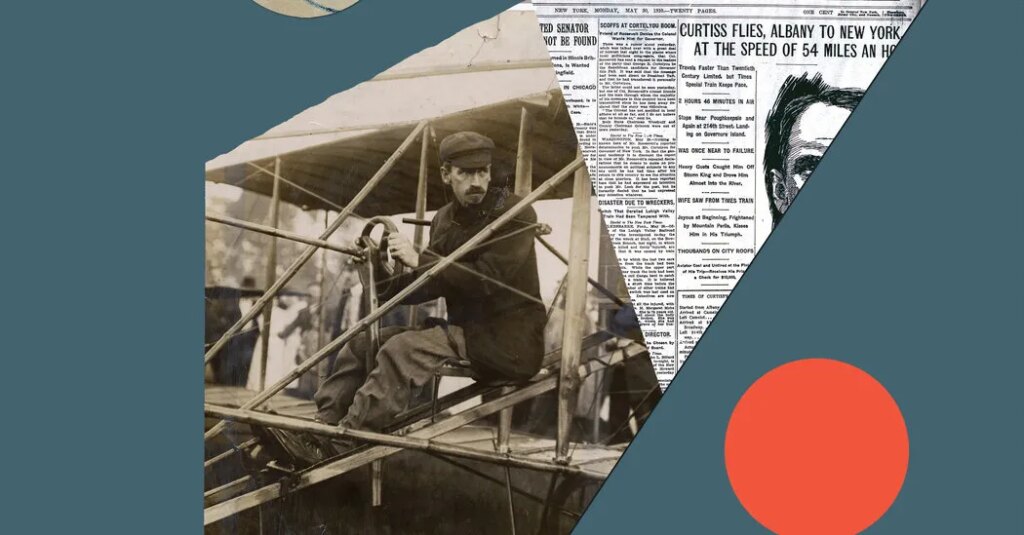
It would have been a wondrous sight in 1910: a tiny aircraft, small to the naked eye, like a bird or a bat, swooping up and down, shuddering at moments and then effortlessly still, gliding down the Hudson River and, if all went well, into the history books
Such was the scene on the morning of May 29 that year, when the dapper daredevil Glenn Curtiss attempted a seemingly improbable feat, flying a bamboo-framed biplane some 150 miles from Albany, New York’s capital, to New York City, to try to capture a $10,000 prize offered by The New York World, one of a bevy of local dailies at the time.
And following along, chugging away on a pair of steel tracks, was a special train chartered by The New York Times, an act of journalistic one-upsmanship and flood-the-zone brio, coverage that would eventually span a half-dozen pages, from A1 to A6, including The Times’s first front-page photograph: a shot of Curtiss’s takeoff from the outskirts of Albany.
The flight was just one of many acts of derring-do that captured the public imagination in the late 1800s and early 1900s, a period of rapid discovery and new technological marvels. Carr Van Anda, The Times’s managing editor during this era, was determined to document important “firsts” in science and exploration.
A year before Curtiss’s trip, The Times sponsored Robert Peary’s effort to reach the North Pole, even as another paper, The New York Herald, backed an expedition by Frederick Cook, a rival and onetime collaborator of Peary’s. In the end, neither man is believed to have reached the pole, though both claimed to, prompting a correction in The Times nearly 80 years later. (Today, the paper would never undertake financial sponsorship of an expedition; paying for news is prohibited by The Times’s code of ethics.)
In 1910, aviation was also a new frontier, often consisting of brief flights that were little more than stunts — joy rides at air shows. But Van Anda understood the higher stakes of Curtiss’s flight — the longest undertaken in the United States to date and the first long-distance flight between two major cities. It was a landmark test for aviation as a viable mode of transportation and one that everyone understood could very easily end in tragedy.
Indeed, during this era, the pages of the paper were often filled with terrifying stories — and running counts of fatalities — from ill-fated flights: “HOXSEY’S PLUNGE TO DEATH,” read one on Jan. 1, 1911, describing the grisly demise of Archibald Hoxsey, the then-holder of the world’s altitude record, in an accident that left the aviator’s dead body “broken and twisted,” still sitting in his “telescoped” biplane.
Despite such tragedies — or maybe because of them — the nation raptly followed the advent of air travel, making Curtiss and others up in the skies boldface names.
The prize that Curtiss was seeking to claim had been backed by The World’s famed publisher, Joseph Pulitzer, who, blind and in failing health, was living much of the time on an opulent yacht called Liberty. The terms were simple: $10,000 for a trip from Albany to New York, or vice versa, by plane or dirigible, completed within a 24-hour period.
Pulitzer initially offered his prize in 1909, as part of the celebration to mark the tricentennial of Henry Hudson’s discovery of his eponymous river. A year later, with the challenge still unmet, the publisher re-upped the offer, modifying the rules to allow two stops and travel either way between Albany and New York.
Though The Times had been pre-empted as a sponsor, Van Anda wasn’t going to let The World win. He sent a team of reporters, assigning one to board the train in Albany, along with Curtiss’s nervous wife, to follow the aviator’s planned progress.
Curtiss, then 32, was something of an unlikely celebrity, a taciturn aviator who rarely smiled in photos or sketches at the time. He is not nearly as well known as the Wright Brothers, with whom he feuded, or later aeronautical trailblazers like Charles Lindbergh and Amelia Earhart.
With an open-air cockpit equipped with a small wooden seat, the Curtiss plane had a single propeller driven by an eight-cylinder, 50-horsepower motor, wings made of rubberized silk and a steering wheel that handled the plane’s elevator and rudder, according to a 1972 biography of Curtiss by C.R. Roseberry. The wheels below were bicycle wheels, placed alongside two airtight metal cylinders to keep the flier afloat if he had to bail out in the Hudson. Gas and oil were a constant concern, as were all manner of other potential perils: winds, rain and the occasional flock of geese.
The average speed of Curtiss’s contraption? Fifty-four miles an hour, a rate The Times noted was faster than the Twentieth Century Limited, the famed express passenger train, but not too fast for the “Times Special Train,” chartered from the New York Central Railroad.
Even so, the engineer hired by The Times had been “incredulous” about the speed of the plane, opening the train’s throttle to keep up, with the train’s small group of passengers bolting from side-to-side depending on where Curtiss flew.
And flew he did, soaring as high as 5,000 feet, though, according to the front-page story, he also came perilously close to disaster, making his way past cliffs and canyons and “eddying” currents, all of which left Curtiss’s biplane pitching “like a yacht in a hurricane.” At one point, the plane dropped very low, skimming roofs and a factory tower before recovering.
The paper’s plan for following Curtiss was clever — and fast-moving. The correspondent on the train wrote a series of updates that were dumped at stations along the route: quick hits, usually only a few paragraphs, which were then telephoned to clubs, hotels, and other locations in New York and posted on bulletin boards.
A photographer aboard the train, determined to document the flight, hung out the side of a train car, sometimes held by other passengers to keep him from falling.
Other reporters filed articles from locations under the flight path, including a church in Poughkeepsie, where an angry pastor “lashed the church folks” for ditching Sunday services to watch Curtiss whiz by instead, and at West Point, where cadets in dress coats gave the pilot a 500-voice cheer.
Correspondents fanned out around the city, too, gathering man-on-the-street interviews from northern Manhattan — where Curtiss, leaking oil, landed for a refill — to Times Square, where gawkers caught a view from the Times Tower, helped by “powerful field glasses.”
“Like a gadfly,” one spectator said, “when the sun strikes its wings.”
As the plane headed south, automobiles sped down the city’s West Side hoping to catch a glimpse, even as spectators crowded the roadway. On the Hudson, tugboats and ferries and steamers and smaller craft all “came to standstill,” with eyes cast toward the speeding plane. Thousands climbed onto rooftops, some “beside themselves with enthusiasm,” with men and women clapping and tossing their hats in the air, imbued with a sense, The Times wrote, of “having taken place in the history of the world’s progress.”
“My,” one observer said, “isn’t it glorious.”
The plane wobbled a few times as it finally approached Governors Island, before Curtiss sailed in, easing his aircraft onto a strip of sandy field a few seconds after noon. He’d flown so quickly, there was only one journalist there: a reporter from The Times.
Ever stoic, Curtiss said he felt little fatigue, blithely noting, “I guess there is some sleep coming to me.” And, of course, a $10,000 check, soon delivered by a representative from The World.
There was a reminder, too, that the stoic aviator was capable of emotion: Upon landing, he kissed his wife, a buss that the paper caught on camera and published. And asked what bliss he’d found in his journey, so high above the earth, at the blazing speed of 54 miles an hour, Curtiss recalled one particular moment.
“The pleasantest thing I remember,” he said, “was trying to wave to Mrs. Curtiss on the Times Special Train.”
In typical Times fashion, the reporters sought to place the event in historical context. “The conquest of the air, the effort to solve the equation presented by gravity, has engaged men since the time when legend precedes authentic history,” one wrote, weightily.
Among those watching this conquest, and striving to summarize its import, was a Captain Mills of the American Liner Philadelphia, a trans-Atlantic shipping company, who had berthed his ship at a West 23rd Street pier and watched Curtiss pass overhead.
“That fellow has the royal right of way,” the captain gushed to a Times reporter, noting that Curtiss “doesn’t have to go to starboard or port, but just keeps full speed ahead.”
And while the captain insisted he wasn’t yet worried about losing his job, he seemed to intuit that the flying machine he had seen through his binoculars might one day pose a threat to his own line of work.
“If they can carry the fuel,” the captain concluded, “there is nothing to stop an airship from crossing the Atlantic.”
The post The Daredevil Aviator on Page 1 appeared first on New York Times.