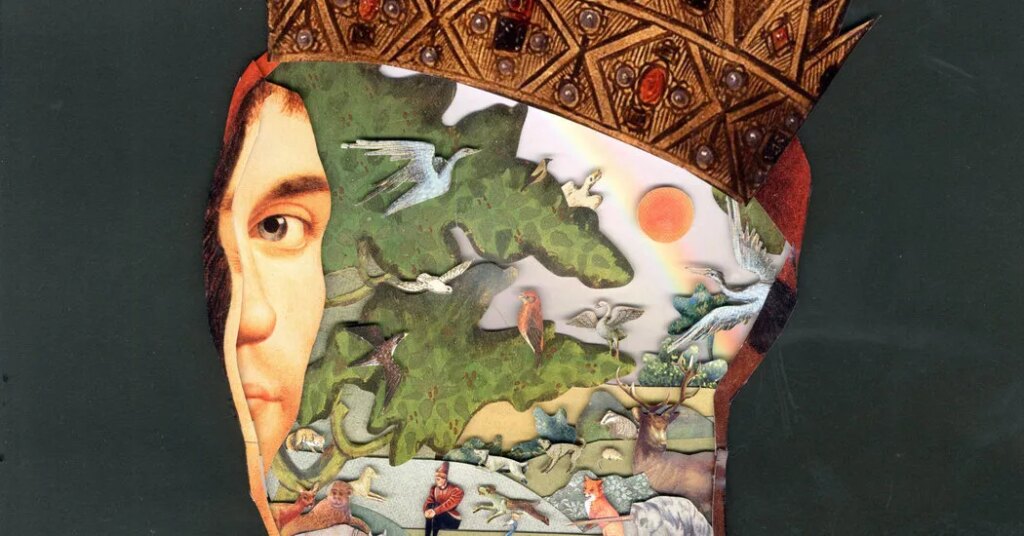
MAY WE FEED THE KING, by Rebecca Perry
The narrator of the British poet Rebecca Perry’s debut novel, “May We Feed the King,” is an unnamed curator who specializes in historical re-enactments in the rooms of moldering old properties. Like a novelist, the curator sees her job as going beyond what visitors can actually see; she feels it is her duty to conjure up a particular feeling. And so she avoids “generic” scenes of tables piled high with roasts and pies and fruits in favor of something more suggestive: “A small silver fish head on a plate, placed on the floor for a cat?” she says. “That gives us a sense of a person, and begins to animate a room.”
As the novel opens, the curator has begun work on a new project in a 750-year-old palace somewhere in Britain. First she must spend time in the rooms, learn their history, get to know the people who lived in them, come to “inhabit” them “entirely.” Then it is time to look through the ledgers, to see which monarch from which period will be featured.
She is drawn to one king in particular, seemingly pre-Renaissance, whose entry consists of one solitary page, a “mess” of annotations “added over time as his story retrospectively evolved,” the narrative of his reign “altered, challenged, embellished, struck through, left to rest as one great question mark by people who damned him.” “What a reduction of a life,” she thinks. Soon after this decision has been made, it is as if a portal opens in the novel, and then we are with him, beside this long-ago king.
Either that, or we are inside the extremely detailed back story the curator has invented for this vexed, mysterious king. The throne has fallen to him after both of his older brothers have died, though he is thoroughly uninterested in doing any kinging at all, a royal Bartleby. As the third in line to the crown, “the King” had been “allowed to become odd”: He is kind to animals, “enjoys fruit in its raw form” and has no stomach for power.
As the King refuses to behave like one — i.e., to hassle, tax or slaughter anybody — Perry deftly evokes the court’s descent into confusion and paranoia in the absence of executive agency. His council wonders, Is he deeply pious? Grief-stricken? A cuckold, a fool? His kitchen staff is baffled that the King never asks for anything, or sends anything back, or throws anything across a room. What happens if a king is a man of no appetites or desires? “How will he master a horse, and swipe men down in battle, if he cannot tear meat from a bone?”
This is a work of historical fiction that is about fiction, and storytelling. The King’s reluctance to act — that is, to become a character — turns his reign into a narrative without plot. Robbed of any privacy, he is watched at all times, by the reader as well as by his subjects, observed through a window or a crack in a storage trunk, as though we are spying on him from within.
This, Perry shows, is what it is to read, whether a novel or history: to get a glimpse of a scene from just one angle, and to be left there to imagine what the Queen has whispered in the King’s ear. Stories about him are invented, or exaggerated, and passed from attendant to attendant, rumors spreading across the court “like ink in water.”
Even actual, verified events are matter for speculation; after a particularly tense council meeting, when the King has been antagonized by his chief adviser, reports vary as to how the King responded. Did he whimper, or ask for help, or admit he was right, or tell him to “stop it,” or did he say, as the adviser himself heard, “You will regret this”? This king thwarts official narratives. His ultimate fate is unknown, either to the keepers of the royal ledger or to the reader.
When we return from this medieval interlude to the present day, the curator asks the reader how we understand what we just read. “How do we know anything about history?” she asks of an audience of 40 people who’ve come to see the palace exhibit. What is recorded of the past is only ever partial, she argues, revealing more about the teller than the subject.
And so she enlists archivists to help her complete her scenes. “I told them that for every piece I positioned, every decision I made, they should make an opposing or concurrent one,” the curator explains to the visitors. “I needed a safeguard against certainty.” Skewed as they may be, historical accounts can still contain valuable information. We just have to know how to decipher it.
MAY WE FEED THE KING | By Rebecca Perry | Transit Books | 276 pp. | Paperback, $18.95
The post This Booker Finalist Imagines the Life of a Reluctant Medieval King appeared first on New York Times.