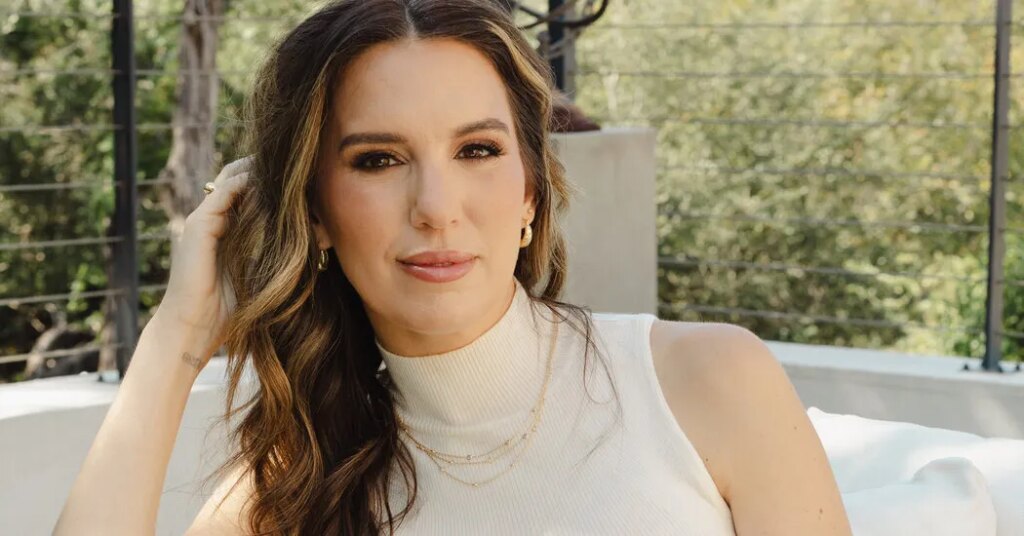
Christy Carlson Romano was nervous as she grabbed a wakesurfing board on a small boat on Lake Austin.
Handing Romano a lifejacket, her friend Emily Papermaster jokingly asked, “How do you get stage fright?”
Romano, a former child actor, playfully retorted, “Because I’m traumatized,” and then dived into the water.
Romano, 42, quickly got up on the board as she carved along the waves, a consummate performer’s smile concealing her nerves.
If she wasn’t enjoying herself, you’d have never known, a lingering remnant of her childhood.
It was a typical August day in Austin, Texas, where Romano — known for her lead roles in 2000s classics like “Even Stevens,” “Kim Possible” and “Cadet Kelly” — now lives with her husband and their two daughters. She was enjoying a bit of “adult summer,” she said, in between shuttling her daughters to activities and making social media content with her husband.
In the early aughts, if you were a tween, Romano was a household name — a constant on Disney Channel, where she was at one point in three leading roles simultaneously. At 19, she starred as Belle on Broadway. Her agents were trying to position her as the next Jennifer Aniston. But behind the scenes, there was also incredible emotional and financial pressure. As her smiling face was splashed across billboards in Times Square, she was grappling with substance abuse.
These dualities are at the heart of her memoir, “Once Upon a Trainwreck: The Fall and Rise of a Child Star,” out on Oct. 6.
It’s a forthright, often bleak, look at her early years on sets.
While some of her peers, like Hilary Duff, Miley Cyrus and Selena Gomez, have stayed in the spotlight, Romano has mostly left the stage behind. She went back to school and eventually moved her family to Texas, where she wouldn’t “feel the pressure of the industry.”
She has been a polarizing figure in the ex-child-actor world, with occasional criticisms of her peers and social media gaffes. In 2024, she criticized the bombshell docuseries “Quiet on Set: The Dark Side of Kids TV,” leading some to call her a hypocrite.
When she started drafting the book two years ago, Romano thought the process would be straightforward, “a linear document about my life.” What she found instead was unexpected closure amid pages about familial dysfunction, alcoholism and sexual violence.
While many of her followers are longtime fans who describe growing up alongside Romano, others accuse her of clinging to the past.
“People want and expect me to still talk about the past, but only in a way that makes them comfortable,” Romano said.
A Growing Genre
In recent years, a few voices of child stardom survivors have turned into an avalanche of unflinching accounts.
There was Jennette McCurdy’s best-selling “I’m Glad My Mom Died,” which cracked open a discussion about exploitative work conditions and abusive stage parents, and several others like it.
Other Disney names, including Cyrus, Duff and Demi Lovato, have shared stories about being sexualized at a young age, having their bodies scrutinized and feeling pressure to be perfect.
Romano, who fled the Hollywood bubble and is a bit older than those other celebrities, reflects from a different vantage point. Much of the book is a love letter to her daughters, offering insight for when they are older, but Romano hopes her writing will contribute to the shifting understanding of what is at stake for “high-performing children,” like actors and athletes.
For most people, the view of former Disney stars is much cheerier.
Over lunch that August day at a members-only club, a fan approached the table to say hello to Romano, bringing up an episode of “Even Stevens” in which Romano’s character, the overachieving Ren Stevens, sings a song about man walking on the moon.
Romano graciously chatted and encouraged the woman to attend an upcoming book signing. Fans still do this a lot; it happened again later that day over dinner. Romano embraces it, but it can also be a reminder of darker moments.
It had been only a few days since Hayden Panettiere, another former child star, died of an accidental drug overdose at 36. Romano felt her death acutely, though she did not know Panettiere well.
“You can’t help but feel a tethering,” Romano said. “You say to yourself, like, ‘That could have been me,’ in a weird way, like in a very quiet, subconscious way.”
She added, “You say to yourself, ‘If I had taken the wrong roads, if I had not stopped drinking, if I had not met Brendan, my life could have looked very different.’”
Romano struggled with alcoholism for years, beginning as a teenager, she said. She said drinking became her “solution for everything.” She would think, “Oh, I need to be social, so I’ll go get a drink,” she recalled.
She and her husband, Brendan Rooney, a veteran Marine she met in film classes, are sober now. Romano stopped drinking when she became pregnant with their first child in 2016. The couple say they are trying to build a life for their children with less pressure and more stability.
A Rapid Ascent
Romano, who started working at 6, was discovered by a talent manager in her Connecticut hometown and was shuttled to auditions by her mother. Her early roles were darker than the Disney fare she became known for — including as Mary Phagan, the child whose rape and murder is at the center of the Broadway musical “Parade.”
She and her mother moved to Los Angeles in 2000, when Romano got the role on the hit “Even Stevens.” She quickly became one of Disney Channel’s main faces, also playing the misunderstood drill team captain in the movie “Cadet Kelly” and voicing the titular teenage vigilante in “Kim Possible.”
She attended school remotely while working long days on set, where she felt the crew encouraged the sibling hatred dynamic between her character and Shia LaBeouf’s.
She described LaBeouf being directed in one scene to “pelt” her in the face with “paint-filled tomatoes,” which caused her braces to cut up the inside of her mouth.
Romano said she felt as if she had to balance fitting in with the adults while also being expected to act like her “Even Stevens” character, a goody two shoes, even when off camera.
While drinking with fellow underage friends during a press tour, she worried about what any missteps might mean for her career.
“I lived in fear a lot,” Romano said.
Behind the scenes, things were tense with her parents, who Romano said “occasionally hit” her as a child. She and her mother spent much of the money she had earned irresponsibly, she said, leaving her nearly broke by the time she was 24.
Her mother often pitted her against Duff, the star of “Lizzie McGuire” and the blond ingénue to Romano’s brunette villain in “Cadet Kelly,” Romano writes in the book.
Romano’s fraught relationship with her mother, Sharon, looms large. She describes her as a manipulative and at times physical disciplinarian. “She has zero patience and takes her anger out on me,” Romano writes. Still, she said that her mother told her “when it stops being fun, we’ll stop,” and that she blamed herself for not leaving the industry sooner. They are on better terms now.
When it came time for Romano to pivot to mature roles, she struggled.
She was told she was too old for Disney lead roles, but too young to be a parent or a teacher onscreen. “You kind of get stuck doing just the TV stuff and you don’t have a lot of opportunities to get out of it,” Romano said.
An Online Second Act
While she still acts occasionally — she has a Hallmark movie coming out this Christmas — in recent years Romano has turned to social media. Her video diaries are part earnest reflection and occasional rage bait, with clicky titles like “How I Lost ‘The Princess Diaries’ to Anne Hathaway.”
From the outside, it can look like Romano might be stumbling, unable to let go of her past. She’s in on the joke, she insists, even if some people think she is “giving crazy aunt vibes.”
She recently deleted all social media apps from her phone, and she and her husband have a designated device for when they need to scroll or post.
“I can’t be fighting battles online over things that just aren’t true or just are never going to have a deeper context,” Romano said, “or try to win people over that are just not my people.”
Still, her online second act has been lucrative, Romano said, seated at her kitchen table on a recent Saturday afternoon. She’s traded signing autographs at fan conventions for signing brand deals, an indication of changing industry norms.
In the epilogue of her memoir, Romano writes about being hit in the face in a much-covered accidental discharge at a gun range where she went clay pigeon shooting with her husband. It was a moment that gave her clarity, she said, about her priorities.
Some online were critical, saying she was milking the moment.
“People think that I really want attention,” Romano said. “There’s this idea of just like, ‘There she goes again.’”
But for Romano, the experience helped her finally shed lingering childhood doubts: She no longer cares.
The post Can a Former Disney Star Let Go of the Past? appeared first on New York Times.