MAN IN THE MIRROR: Hope, Struggle, and Belonging in an American City, by Anand Giridharadas
Although “Man in the Mirror,” the new book by the journalist Anand Giridharadas, is subtitled “Hope, Struggle, and Belonging in an American City,” it is in some ways an only-in-New-York story. Varied, dense and frenetic, the city is sui generis, perhaps the single one in the United States where an utterly normal existence is possible without knowing how to operate the machine that is central to American life elsewhere, namely, the automobile.
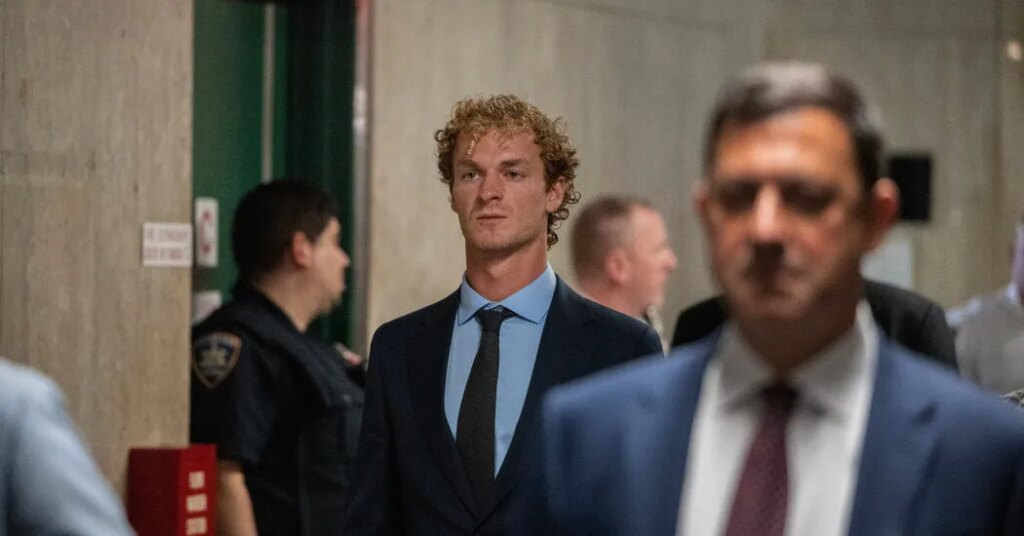
Instead, public transportation is the city’s lifeline and frequent preoccupation. This book — often brilliant, occasionally frustrating — is an extraordinarily wide-ranging investigation of the circumstances underlying a lethal incident that occurred on a northbound F train on May 1, 2023: the death of Jordan Neely, a mentally ill homeless man, after a fellow passenger put him in a chokehold in an apparent attempt to subdue him when he began screaming. The passenger was later identified as Daniel Penny, a part-time surfer and architecture student who had moved to the East Village after leaving the Marines.
Neely was Black and Penny was white, and reaction to the case soon divided emphatically along racial fault lines. In the Black community, Neely’s death was an excruciating reminder of the earlier choking deaths of unarmed Black men, like George Floyd, or Eric Garner, who had died on Staten Island in 2014 after being placed in a prohibited chokehold by a police officer who was never charged with a crime.
A chorus of Black leaders, including the Rev. Al Sharpton, who eulogized Neely, demanded Penny’s prosecution. Demonstrators camped outside the office of the district attorney, Alvin Bragg, and a Los Angeles-based P.R. adviser pushed humanizing stories about Neely onto national television. On May 11, Bragg’s office charged Penny with second-degree manslaughter.
In response, Ron DeSantis, the Florida governor and soon-to-be presidential candidate, linked to a fund-raising site on his social media account that ultimately raised over $3 million for Penny’s defense from more than 66,000 donors.
The battle was set.
Rather than moving on to the outcome of the case, “Man in the Mirror” diverts. Through intensive interviews with Neely’s relatives and a friend of his, Giridharadas shows how the vortex of poverty dragged Neely’s life down to Hadean depths. In 2007, when he was 14, his adoring mother, Christie, who moved in and out of shelters with her son, was killed by her boyfriend, most likely by way of — incredibly — a chokehold. The boyfriend then dumped her body, hidden in a duffel bag, beside a Bronx highway. At the ensuing homicide trial, the boyfriend represented himself, forcing Neely, who testified, into a ghoulish confrontation with his mother’s killer.
A skilled Michael Jackson imitator, Neely had made a living busking in his teens, but eventually his life cascaded downward. With his father, in Neely’s description, “largely absent from his life,” he was soon living on the street, plagued by the familiar devils of homelessness, drug use and mental illness, in his case schizophrenia.
Giridharadas’s title is drawn from a Michael Jackson lyric as quoted at a news conference by the Neely family’s lawyers: “I’m looking at the man in the mirror and I’m asking him to change his ways.” The change the lawyers and — seemingly — the author ask of us is in our treatment of the homeless and the mentally ill.
The remarkable scope of this book is demonstrated in a series of involving portraits, including of unhoused New Yorkers, whose meager possessions are routinely swept away in police raids but who nevertheless reappear on the same sidewalks hours later; of touchingly dedicated outreach workers who try to lead the homeless to safety; and of public health figures butting heads over policy. Startlingly, a problem that began when thousands of mental health patients were released onto our streets during the mid-20th-century push for “deinstitutionalization” now finds many advocates for the unhoused, including Neely’s lawyers, arguing for the involuntary commitment of people like him.
After nearly 300 pages, the book arrives at the point promised from the beginning: Daniel Penny’s trial. Giridharadas’s empathy for Neely is, understandably, intense. In describing the painstaking autopsy conducted by the city after Neely’s death, he writes, “Here was a body that had been variously neglected, hounded, tossed about and given the runaround by the City of New York for most of its life.” Where, he goes on, was such care for Neely “when the systems of schooling and foster care and shelters and mental health and prisons were being designed and funded?”
This is an exhaustively reported book by a ferociously talented writer. But again and again, the author’s clear allegiance to Neely undermines the supposedly evenhanded reporting he claims in an author’s note as his goal, especially once he gets to the trial.
By this point, Giridharadas has relayed without comment more than a dozen times the description of Neely’s death by his supporters as “murder.” I was stunned, therefore, to read the prosecutor’s first words to the jury: “The defendant’s intent, it not only wasn’t to kill. … It was an intent to protect people on the subway car from a person that was perceived to be a threat. … This is even a laudable intent, to jump in when most people wouldn’t.”
Earlier in the book, Giridharadas writes that “before Daniel Penny’s arm went around Neely’s neck, Jordan had been trying to say something to whoever would listen on the F train” about being trapped between jail and an experimental treatment he’d rejected. This, though, was hardly what people in the subway car heard. As Giridharadas relates in his account of the trial: “One bystander after another on that F train was brought in to speak of the fear and dread and sense of defenselessness they had felt” when Neely entered the car and began an extraordinary tirade, screaming, according to one witness, “I don’t care if I die, I don’t care if you die. Kill me. Lock me up. I don’t care if I go to jail for life.”
Two women, one white, one Black, both longtime riders of the subway, emphasized the frightening nature of his behavior. “I was fearful, truly, that was the moment I was going to die,” the first said. The second was more succinct: “I was scared shitless.”
Having conceded that Penny was lawfully justified in restraining Neely, the prosecution’s case came down to maintaining that Penny had held the chokehold too long, because of “the defendant’s belief that Mr. Neely did not deserve even the minimum modicum of humanity.” This argument did not convince the jury.
For one thing, two other riders helped Penny to restrain Neely as he continued to struggle. Giridharadas never states how long it took the police to arrive after the first passenger called 911, but the defense made much of the officers’ delayed appearance on the scene as emblematic of a broken system that failed both the other commuters and Neely himself. By the time the officers arrived, Penny and the others had released Neely — his body had gone limp — but one officer still felt his pulse. However, the officers were not equipped with resuscitation masks and refused to administer mouth to mouth, for fear of contagion.
Giridharadas questions why the judge excluded evidence about Neely’s background apart from records of his mental health while allowing Penny to introduce evidence of his compassionate character, including a Marine Corps medal for humanitarian service. Giridharadas laments: “Even in a case about whether one man deprived another of humanity, it was possible that the aggressor would be humanized and the victim dehumanized, such that the trial itself would replicate the very act it presumed to judge.”
Despite the prosecution’s efforts to make the trial turn on this conceit, a criminal trial is not a contest about the relative humanity of anyone. Its aim is solely to determine whether the prosecution has proved the defendant guilty beyond a reasonable doubt. Having spent more than 40 years in criminal courtrooms, as both a prosecutor and a defense lawyer, I can say only that the rulings Giridharadas found so unfair conform to the rules of evidence as I have long understood them.
Indeed, the one person in the vast cast of this complex drama for whom Giridharadas’s sympathies are notably limited is Daniel Penny. In the moments after his acquittal, Giridharadas observes that Penny “appeared to be in a place of relief more than remorse” for Neely. Lost on Giridharadas is the ordeal Penny had endured, having spent a year and a half under the stigma of a homicide charge and the threat of a prison sentence for a crime of which 12 fellow citizens had just pronounced him not guilty.
After Penny’s acquittal, he stood outside a Manhattan bar smoking. “Almost to a person,” Giridharadas writes, passers-by “stopped and shook his hand and thanked him.” This near-uniform response from an ad hoc cross section of Manhattanites made me — but not apparently Giridharadas — wonder if anyone in the D.A.’s office had ever really expected to convict Penny. Did the prosecutors believe they could convince beyond a reasonable doubt all 12 members of a jury drawn at random from the ranks of people just like those who had walked by?
MAN IN THE MIRROR: Hope, Struggle, and Belonging in an American City | By Anand Giridharadas | Knopf | 464 pp. | $35
The post A Ferociously Talented Writer on the Subway Death That Divided New York appeared first on New York Times.