Classified documents provided to Congress include an assessment by the U.S. intelligence community that Saudi Arabia has not ruled out the option of developing a nuclear weapons program, U.S. officials told The Washington Post.
The sobering intelligence outlook has compounded concerns from some U.S. lawmakers about President Donald Trump‘s agreement to assist Saudi Arabia with establishing a civilian nuclear program, which they fear could enable the development of a nuclear weapon and spark an arms race in the volatile Middle East.
The nuclear deal authorizes American businesses to kick-start tens of billions of dollars of nuclear energy projects in Saudi Arabia in what the administration hopes will strengthen U.S.-Saudi ties and forestall the kingdom’s collaboration with U.S. adversaries such as Russia and China.
Upon announcing the deal in July, the administration said it “will advance U.S. and regional security by upholding high standards of nuclear safety, security, and nonproliferation and strengthening the United States’ competitive edge in civil nuclear technology.”
But a growing number of Democratic lawmakers are raising concerns that the deal creates a pathway to enriching uranium in Saudi Arabia to nearly 20 percent, adding to fears that some nuclear material could be diverted for military purposes. In Congress, a 90-day review period is underway, and lawmakers can pass legislation to block the deal if they can generate enough support.
“With this deal, the Trump administration is departing from precedent, adopting looser restrictions, and caving to Saudi demands by agreeing to a process that is all but certain to allow Riyadh to acquire the means to enrich uranium and possibly develop nuclear weapons,” a group of Democratic senators, led by Sens. Ed Markey (Massachusetts) and Jeff Merkley (Oregon), said Friday in a letter to Secretary of State Marco Rubio.
The State Department provided its own input in the classified documents sent to Congress last month, said the officials, who like some others spoke on the condition of anonymity to discuss a sensitive security matter. The department, they said, comes off as more confident in the agreement’s safeguards and assurances from the Saudi government.
Merkley told The Post that the United States should not be taking Saudi Arabia’s word on a matter this important.
“It’s bogus as hell,” he said in an interview, arguing that the Saudis’ demands, which include the possibility of producing nuclear fuel at home rather than importing it, suggests a desire to build a program that isn’t purely for civilian use.
“If they’ve given up the intent to develop a nuclear weapon, then they’d give up domestic enrichment and reprocessing power, right? They’d accept massive inspections from the IAEA,” he said, referring to the International Atomic Energy Agency.
The Saudi government did not respond directly to questions from The Post but relayed an earlier statement from its energy minister, Abdulaziz bin Salman, who said the program will be “peaceful” and developed with “the highest levels of responsibility and transparency.”
The State Department defended its support for the agreement, saying in a statement to The Post that the United States “does not and will not support a Saudi nuclear weapon program.”
“It reflects a proactive, realistic approach to the need to expand and strengthen nuclear energy cooperation while maintaining the strongest nonproliferation standards diplomatically achievable.”
The CIA declined to comment.
The deal restricts Saudi Arabia’s uranium enrichment to less than five percent at first but after an additional study and written agreement, it allows that limit to increase to 20 percent, a level that can be enriched to weapons grade fairly quickly. The enrichment limits were reported earlier by the Wall Street Journal.
Democratic lawmakers have questioned how the Trump administration could permit a deal that opens the door to 20 percent enrichment when it so harshly criticized President Barack Obama’s 2015 Iran nuclear deal that capped enrichment at 3.67 percent for 15 years.
Another concern is the inspections process. The deal does not require Saudi Arabia to participate in what’s known as the “Additional Protocol,” which requires a country to provide the IAEA access to all stages of the nuclear program’s fuel cycle and research facilities.
Experts worry that the IAEA will have no way of verifying whether Saudi Arabia is secretly developing a nuclear weapon at undeclared facilities.
“This should not be acceptable in the case of a country like Saudi Arabia that seeks the capabilities to produce fissile material and has threatened to pursue nuclear weapons,” wrote a group of 20 nuclear nonproliferation experts, including former IAEA director general Hans Blix, in a letter to Congress this week.
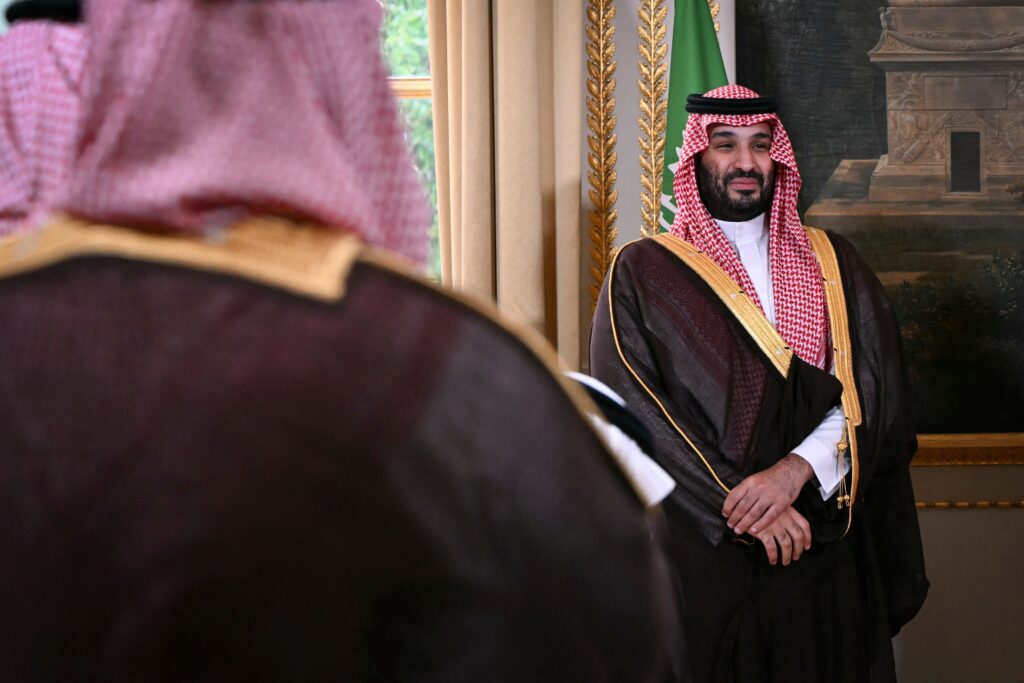
An often-cited concern among experts is Saudi Crown Prince Mohammed bin Salman’s comments in 2018 warning that Riyadh will develop a nuclear weapon if Iran does.
“Without a doubt, if Iran developed a nuclear bomb, we would follow suit as soon as possible,” he said.
The Trump administration bombed Iran’s nuclear facilities last year during Operation Midnight Hammer, but its enriched uranium is believed to be intact, albeit under rubble. Iran’s leadership, meanwhile, has grown more hard-line since the start of the war earlier this year and the assassination of the country’s supreme leader, raising fears that it could fast-track efforts to obtain a bomb.
“It is very clear that as this war in Iran continues to unfold, that the Iranians are going to fiercely defend their ability to develop a nuclear weapons program, and as a result, any action that we take in Saudi Arabia will only further accelerate a fallout nuclear arms race in the region,” said Markey.
Some Democrats praised the intelligence community for speaking frankly about the threat of Saudi Arabia developing a nuclear weapons program given the pressure the Trump administration has placed on intelligence officials in the past who provide assessments that raise doubt’s about the president’s policies.
“The last remnants of truth tellers at the intel agencies are holding on by their fingertips,” said Rep. Brad Sherman (D-California) who has closely reviewed the deal.
Advocates for the deal say U.S. companies would be well-placed to win lucrative contracts with Saudi Arabia and that it would sideline Chinese and Russian companies while strengthening U.S.-Saudi ties.
Democrats, however, say the president’s allies are the ones most likely to benefit.
“Jared Kushner, for example, accepted a $2 billion investment from a Saudi sovereign wealth fund after leaving the White House at the end of the first Trump Administration,” the Democratic senators asserted in their letter to Rubio, referring to the president’s son in law and informal envoy.
“Westinghouse Electric, meanwhile, stands to make tens of billions of dollars if this agreement moves forward. Westinghouse’s majority owner is closely associated with Newmark, the real estate firm run and owned in part by the sons of Commerce Secretary Howard Lutnick,” the lawmakers’ letter says.
Spokespeople for Kushner, Westinghouse, Lutnick and Newmark did not respond to requests for comment.
Some Democrats, including Rep. Gregory Meeks (New York), are hoping to block the effort by introducing legislation to disapprove the deal during the three-month period of congressional review. But without a two-thirds vote supporting it, Trump could veto the bill, and the agreement would take effect as written.
A bigger obstacle could be Trump’s insistence that Saudi Arabia normalize relations with Israel as a condition for the deal. A senior administration official said that this remains a firm requirement, but analysts say Riyadh is unlikely to do this while the Israeli government continues to rule out the creation of a Palestinian state.
The post Saudis have not ruled out developing nuclear weapons, U.S. intelligence assesses appeared first on Washington Post.