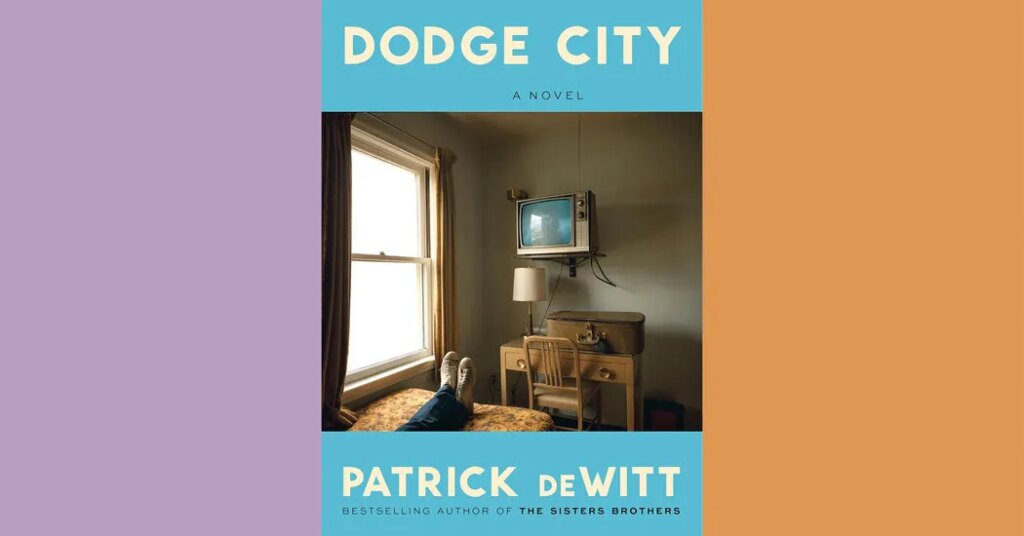
DODGE CITY, by Patrick deWitt
It’s an unavoidable cliché in discussing Patrick deWitt’s fiction to note the surprising range of genres he takes on, from a realist addiction chronicle to an old-timey western to a screwball class satire and more. His output more closely resembles that of an old studio film director’s than of a typical contemporary literary novelist, with certain themes and preoccupations reappearing across books of otherwise disparate subject matter.
His dialogue in particular serves as a distinctive through line, with pages of repartee in an off-kilter, slightly formal register flowing through all of his novels. His writing tends toward the picaresque, his characters moving through series of strange encounters that accrue meaning through juxtaposition. I will not use the word “quirky,” but its possibility often lurks just off the page.
DeWitt’s sixth book, “Dodge City,” is a brisk, melancholic road trip novel set in 1967. The protagonist, Lee Clarke, hailing from the perfectly named Concrete, Wash., has been kicked out of U.C.L.A. “after an event of violence between himself and another student,” and subsequently receives a draft notice for Vietnam. In the induction office, looking at a hideous, jingoistic poster of an eagle, Lee “understood that he was in danger to be standing among such men as these who believed that the eagle image was suitable for framing, or that any room on earth should feel the way this room felt.” After a desultory attempt at bargaining with his draft officer (“OK, but what if somebody really doesn’t want to go?”), he resolves to flee to Canada.
There’s an admirable impulsiveness to this decision. Lee’s charm as a character is his Bartleby-like refusal to countenance objections to his objection: “He had known, from the moment he first read his draft notice, that there was only one sensible response to such a thing.” He agrees to drive a Jaguar from Los Angeles to New Jersey for a car delivery service, and from there up to Montreal, intending to visit each of his family members in various parts of the country along the way. He brings along a bag of Benzedrine tablets and leaves behind his bohemian girlfriend, Cal, and his surfer buddy Robin — no points for guessing what goes down between those two in Lee’s absence.
Surprisingly, given the subject matter, this is not a story with a great deal of conflict, even though Lee finds each of his family members — father in Concrete, mother in Billings, Mont., brother in Duluth, Minn., and sister in New York City — in varying degrees of crisis. At times, it feels like a bookend to deWitt’s first novel, “Ablutions,” a breathtakingly ugly and inventive book about the doings of rock-bottom alcoholics in a Hollywood dive bar.
As in that book, some of the best scenes in “Dodge City” depict baroquely self-destructive behavior, though here they’re presented in a gentler register. Lee’s alcoholic father has fallen all the way to dogcatcher (“last job in town”) and is living in his van because the house is full of stolen dogs he’s going to bring to the pound to meet his daily quota. Lee’s brother, Harry, has torpedoed his relationship with his fiancée, Sally, through his serial infidelity; he and Lee spend his visit taking pills, drinking heavily and wandering around Duluth looking for Sally, who dumps a glassful of beer filled with cigarette ash on Harry’s head when they catch up with her. Lee’s mother is living with her confirmed-bachelor brother Wallace, where they bicker like Big and Little Edie. His twin sister, Grace, in nursing school in Greenwich Village, is having a series of reckless work affairs.
“Do you think what you’re doing to America is friendly?” Harry asks Lee at one point, to which Lee reasonably replies, “Going to Vietnam is friendly?” I found myself thinking about why deWitt decided to write about 1967 now, why the story of a sensitive, not-terribly-political young man fleeing an unjust war felt urgent. It seems to me he’s saying, in a calm but firm voice, that sometimes doing the right thing isn’t actually complicated. Sometimes, when the call comes from a despotic government to commit violence against your conscience, the bravest thing you can do is refuse.
DODGE CITY | By Patrick deWitt | Ecco | 248 pp. | $28
The post A Draft Evader’s Drug-Fueled Farewell Tour to His Family — and America appeared first on New York Times.