Many housing projects around the country are tackling major challenges — including rising homelessness, an aging population, social isolation and the cost of housing — by rethinking how we live together. These “intentional communities” take myriad forms, including apartment buildings for formerly homeless youth, affordable villages for veterans and their families, and multigenerational communities where foster families and older adults live side by side.
We wanted to learn more about the types of intentional communities taking shape across the country, so, alongside previous coverage on the topic, we posted a call to readers. Nearly 3,000 people responded. The places they told us about mostly fell into three distinct buckets: intergenerational communities, veterans’ communities and transitional communities.
Intergenerational communities
Mark Dunham of Washington, D.C., wrote to us about his work developing intergenerational communities.
This model traces its roots to 1994, he said, when a community called Hope Meadows opened on a converted Air Force base in central Illinois. Hope Meadows was designed to house foster families alongside older adults who act as “honorary grandparents,” in exchange for subsidized rents.
The model has since spread widely, with offshoots such as Treehouse in Easthampton, Mass. Treehouse has 60 rental homes, all affordable, with social spaces like a community garden and a library.
Bridge Meadows in Portland, Ore., has nine townhouses for families and 27 apartments for single older adults. It offers affordable rent and some social services like mental health counseling. The project has three locations with more on the way.
Mr. Dunham said he had helped design similar communities, including an apartment complex called Patuxent Commons in Columbia, Md., where a quarter of the building’s 76 units have been set aside for people with disabilities.
To work as intended, these communities need a few key elements, he said, especially affordable housing and ample staffing. But the real key is leveraging the relationships that can form between neighbors — “that’s a no-cost treasure.”
“When I entered this work, I was naïve about it,” Mr. Dunham said. “It’s messy — it’s like real life.”
Veterans communities
Several readers pointed us to communities for veterans.
In New Orleans, Bastion is home to wounded veterans and their families.
About a fifth of the community’s 58 homes go to civilians. The units are a mix of permanent supportive housing, market-rate housing and affordable housing.
Kate Dwyer wrote to us from Grants Pass, Ore., where a legal battle over the city’s public camping ban resulted in the landmark 2024 Supreme Court ruling that has led to encampment clearances nationwide.
Ms. Dwyer said she was helping raise money for Hillcrest Veterans Village, which will have 36 affordable permanent housing units for low-income veterans. The village includes three apartment buildings and a community center where neighbors can gather for events or services.
Transitional communities
As a response to homelessness, temporary housing can be divisive.
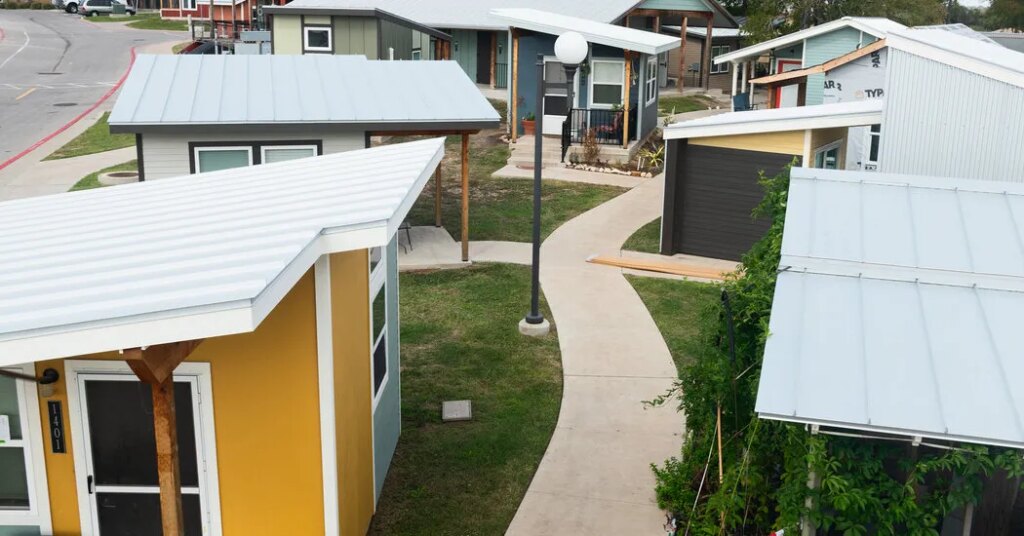
But as people wait years or decades for subsidized housing, and new construction inches slowly forward, many communities have turned to quicker and cheaper approaches. Often, these take the form of tiny-home communities that offer temporary housing — but they vary widely in terms of whom they house and for how long, and how they’re governed.
Kilmeny Miller, 30, wrote to us about Gardenview Village, a tiny-home community in Bellingham, Wash., housing people who are 55 and older or have health issues. The village has 35 units and is funded by the city. Residents live there free and are expected to eventually transition to permanent housing, with the support of case workers from the village’s nonprofit operator.
In 2019, Jerry Jutting and his husband, John Zmolek, opened a transitional housing community for youth in Seattle. Residents, most in their early 20s with a history of homelessness, usually live there for about a year before moving on to independence.
The project is small: 13 studio units, a rooftop garden and shared spaces for events and programming, all in an apartment building managed by YouthCare, a social services organization that offers supportive services to residents.
This arrangement means Mr. Jutting and Mr. Zmolek don’t have to worry about the day-to-day task of managing tenants or the cost of vacancies when there is turnover — YouthCare pays a set rate each month and collects rent directly from residents. The building’s social purpose also makes the community exempt from property taxes, allowing the couple to lease it for less.
The project was motivated in part by the couple’s experience with their two adopted sons, who both struggled with addiction, mental illness and periods of homelessness that, as parents, they often felt helpless to address.
A few months before the building opened, the couple lost their son, James. He was killed while trying to help his brother, who attacked him while in the grips of a paranoid schizophrenic hallucination.
Mr. Zmolek and Mr. Jutting named the project James Place Studios. So far, it has housed more than 100 young people in need.
The Headway initiative is funded through grants from the Ford Foundation, the William and Flora Hewlett Foundation and the Stavros Niarchos Foundation (SNF), with Rockefeller Philanthropy Advisors serving as a fiscal sponsor. The Woodcock Foundation is a funder of Headway’s public square. Funders have no control over the selection, focus of stories or the editing process and do not review stories before publication. The Times retains full editorial control of the Headway initiative.
The post The Communities Sprouting in the Wake of the Housing Crisis appeared first on New York Times.