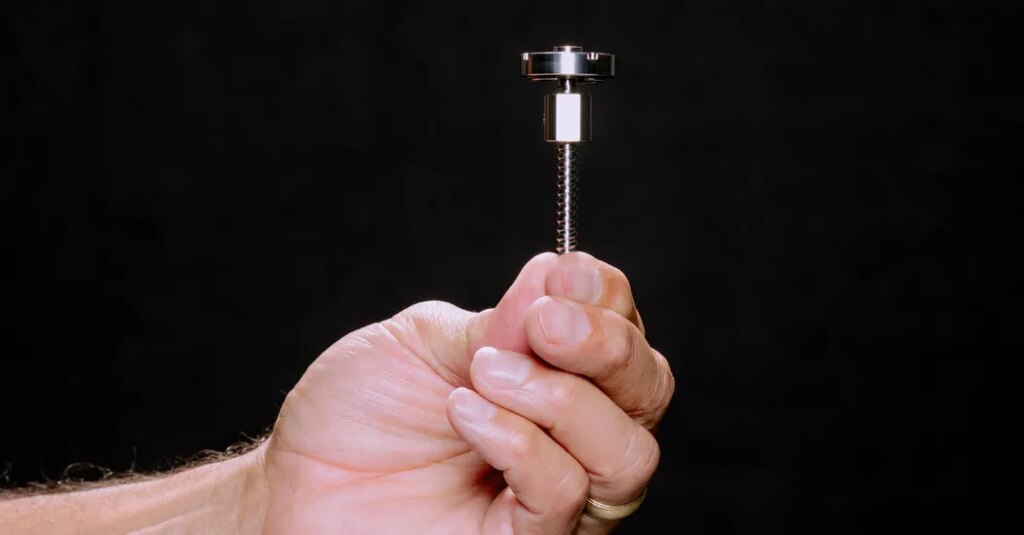
It’s a spiral carved into metal, attached to a mechanism that might not look out of place in a junk drawer. Almost no one outside a small, obsessive community of machinists and engineers has ever heard of it. But this humble component, called a precision ball screw, is essential to producing Patriot missiles, airplanes and humanoid robots.
As the Trump administration works to replace or upgrade weapons systems depleted by the war in Iran, these screws are in short supply, adding months or even years to the time it takes to make a missile.
“It has created a choke point,” said Nick Kolar, executive vice president of sales for aerospace, defense and space at Umbragroup, an Italian ball screw maker with a factory in Saginaw, Mich. He estimated that demand has increased as much as 50 percent since 2020.
Ball screws are far from the only component of a missile that can be hard to source. Rare-earth magnets, solid rocket motors and high-grade explosives also pose a challenge. But the long lead times on something as seemingly simple as a screw illustrate a festering problem with the American industrial base.
Only a handful of companies in the United States are capable of making these screws for the U.S. military. Most of them are already at capacity, so it will take time and investment to produce the number of screws required for the weapons the Trump administration wants.
It’s a “highly engineered component not many manufacturers out there are able to support,” Mr. Kolar said.
Missiles are controlled by electronic mechanisms, called actuators, that move their fins at precise angles in order to reach their targets. Each actuator contains a ball screw so precise that its accuracy is measured in units that are roughly one-hundredth the width of a human hair. Missiles typically contain at least four actuators and therefore need at least four ball screws.
Ball screws, which contain recirculating balls that reduce friction, turn rotary motion into linear motion, like a corkscrew. Those made for common industrial purposes, such as those used in electric power-steering systems in cars, don’t need to be as precise. They are relatively easy to get.
But the ones that go into missiles often take a year to produce and can cost more than $1,000 apiece.
A missile can be built only as fast as its slowest supplier. A precision ball screw can be assembled in weeks, but getting the special heat-resistant steel from a mill to start making the parts takes many months. A host of other steps take additional time, from heat-treating the steel so that it doesn’t warp to sending the screws out to another shop to be plated with chrome or another substance.
Defense contractors like Northrop Grumman and Lockheed Martin know that there’s a long lead time on ball screws, so they procure them far in advance to avoid disruption, said Jeff Kaney, who briefly owned BGT Aerospace, a company that supplied specialty ball screws to Northrop Grumman. Because BGT designed screws from scratch, and took on tricky orders that other companies could not handle, it often took two years to deliver a batch, he said.
“It’s such a pain point that buyers or planners know that they have to order years in advance,” Mr. Kaney said.
Cory Tellbuescher, chief commercial officer of Velocity One, the private-equity-backed firm that bought BGT, said the company was investing in new machinery and taking other measures to speed up production.
The United States isn’t the only country struggling to make ball screws. Although China set a goal of producing at least 80 percent of the high-end ball screws it uses, the country fell short, according to a 2025 report by the U.S.-China Economic and Security Review Commission. Beijing still imports roughly 90 percent of them, mostly from Europe and Japan, and has taken stakes in foreign companies to try to close the gap, the report said.
In January, Lockheed Martin struck a deal with the Trump administration to triple annual production of Patriots — also known as PAC-3 interceptors — which are essential for knocking threats out of the sky. To do that, Lockheed must buy three times as many actuators from its supplier, Moog, which in turn must purchase three times as many ball screws from Umbragroup.
Moog’s chief executive, Patrick Roche, said on an earnings call in July that the company was prepared to meet the demand, but alluded to potential problems getting the necessary components. “The critical concern now is the expansion of industrial capacity,” he said.
In a statement, Lockheed Martin said the company and “its suppliers are taking decisive, urgent action to deliver more missiles faster for the U.S. and its allies.” The company is investing more than $8 billion to boost capacity, build commercial partnerships and modernize more than 20 American factories, according to the statement.
In August, Raytheon announced that it had won a contract to increase annual production of Tomahawk cruise missiles to 1,000 from fewer than 90. However, Mr. Kolar said it would take time and a lot of investment for suppliers to be able to deliver enough ball screws.
He has had to deliver bad news to customers. “They need parts in 12 weeks to support the ramp-up for Raytheon,” he said. “We can’t do that. It’s a new design to us. We’re looking at a year.”
A spokesman for RTX, the parent company of Raytheon, declined to comment.
A spokesman for the U.S. Defense Logistics Agency, which procures items for the military, acknowledged the long lead times on ball screws, noting that they are “often driven by complex manufacturing processes and rigorous quality assurance.”
Start-ups tend to have more difficulty procuring ball screws, according Rika Jain, chief operating officer of Salient Motion, a Hawthorne, Calif.-based company founded in 2022 that makes actuators for missiles and commercial aircraft. She said sourcing the screws had been so challenging it set up a subsidiary in Michigan, Saginaw Precision, to make them in-house.
“Ball screws have been a bottleneck, are currently a bottleneck and will continue to be a bottleneck,” she said.
Designing ball screws for new missiles can add 12 months to the delivery timeline. That process includes inspections that test prototypes and certify the manufacturing process, a lengthy and expensive endeavor for companies. Once certified, ball screw vendors are locked in, making it difficult for actuator suppliers like Moog to find new vendors when a production schedule lags far behind.
Saginaw has been an epicenter of ball screw production since General Motors began using them for steering gear in the 1930s. A division of the automaker pioneered their use in airplanes during World War II, producing huge ball screws that went inside B-29 bombers. That factory is now owned by Umbragroup, one of the largest suppliers of ball screws for aerospace and defense in the West.
Small machine shops around Saginaw have filled low-volume or specialty orders. But many have gone out of business or been acquired by larger companies.
Tara Murphy Dougherty, chief executive of Air, a software company that helps the U.S. military speed up its acquisition of replacement parts, said closures took a toll on the entire industry because they shrank manufacturing capacity.
“It creates an immediate single-point failure for our national defense.,” she said in an email.
Pat O’Brien, who in the 1980s founded Emcor, a ball screw company in Bay City, Mich., said about eight of his competitors had either gone bankrupt or been swallowed by bigger firms. He attributes his own survival to old machinery. Instead of going deeply into debt or taking on investors to purchase new, expensive lathes and thread grinders, he bought used ones from the 1950s and reconditioned them himself.
He has some steady work that brings in predictable monthly income for his nine-person shop. Under one contract, he sells 60 ball screws a month for roughly $1,000 each. Lately, he has received more calls from defense suppliers.
But he is cautious about taking on new work because he doesn’t have enough skilled machinists.
“We’ve turned down business from good companies,” he said.
The post This Screw Is Needed for Missiles and Planes. Buying One Can Take Years. appeared first on New York Times.