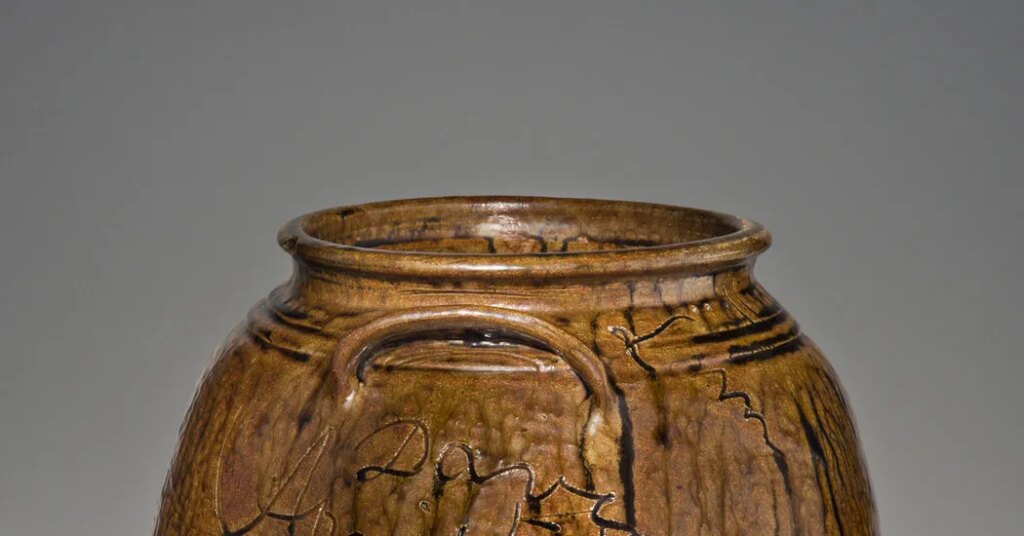
The Milwaukee Art Museum is expected to announce on Monday that it has returned two historic jars in its collection by the enslaved artist David Drake to his descendants. In doing so, it joins a growing list of museum and private collections turning over Drake’s work to family members, who have been on a quest to reconnect with their heritage.
Drake made and inscribed ambitious stoneware jars while enslaved in South Carolina in the 1800s, despite punishing conditions and anti-literacy laws that prevented teaching enslaved persons to read.
The Milwaukee Art Museum subsequently bought back one of the restituted jars, signed “Dave” and dated 1855, for an undisclosed price. This arrangement was inspired by a similar restitution agreement in 2025 reached by the Museum of Fine Arts, Boston and the descendants of Drake.
The second returned vessel, larger but unsigned, will remain at the Milwaukee museum on loan from the family.
“The museum was a great partner to work with,” said Yaba Baker, Drake’s great-great-great-great grandson, who serves as the family spokesman. “We’re excited about the fact that they’re not just acquiring a pot but developing school programs to extend the Dave story,” he added, describing an educational initiative in its early stages.
The Milwaukee museum was one of the first in the country to bring Drake’s work to national attention, starting with a 2010 homage to Drake by the Chicago artist Theaster Gates.
Later, the institution created an ongoing display, called “The Dave Project,” showcasing the two Drake jars at the entrance of its American art wing. The vessels were on loan from the Chipstone Foundation, a Milwaukee-based nonprofit that studies and promotes decorative arts.
Late last year, the Drake family reached out to Chipstone asking about restitution of the works. The foundation turned to the museum for input. The new director of the Milwaukee Art Museum, Kim Sajet, helped broker the deal, securing the donation of the jars from Chipstone to the museum this month, which made the restitution possible.
“This arrangement gives the museum an opportunity to continue building trust within the community,” Sajet said. “What is really exciting now is that we can keep developing the conversation around ‘The Dave Project.’”
Sajet started her job a year ago, shortly after her departure as director of the Smithsonian’s National Portrait Gallery. Her resignation there followed a tweet by President Trump “terminating the employment of Kim Sajet” in which he described her as “a strong supporter of DEI,” or diversity, equity and inclusion.
“I’m very proud of that actually,” Sajet said of Trump’s remarks Wednesday in a video interview. “I’m a little disappointed he didn’t add ‘access,’ because I care about access as well as inclusion.”
She said she plans to use the jars and Drake’s story to reach a broader audience and better serve the Milwaukee Public Schools, the museum’s largest educational partner.
Drake is one of very few enslaved American artists whose biographies are known at all. He worked in the Edgefield area of South Carolina, famous for its alkaline-rich soil and pottery trade.
Despite anti-literacy state laws, he learned to read, often inscribing his name “Dave” on pots. At times he also etched poignant couplets or poems in the clay, riffing on biblical sayings or the vessels’ functions. Many were used for storage of food, like beef.
One of the largest surviving jars of this variety, called poem-jars, set a record for American pottery when it sold at auction for $1.56 million to the Crystal Bridges Museum of American Art. That purchase, in 2021, helped to galvanize Drake’s descendants, who did not own a single pot, to begin their own journey to reconnect with, and recover, their ancestor’s work. They later established the Dave the Potter Legacy Trust.
In October 2025, the Museum of Fine Arts Boston agreed to return Drake’s work to the trust in what is widely believed to be the first restitution of artwork to descendants of an enslaved artist in the U.S. Soon, Gates, the artist, gifted his one pot to the family, which is lending it to Hampton University for display starting Oct. 21.
Other restitutions to Drake’s family have come from two private collectors on the East Coast and two Georgia institutions, the Telfair Museums in Savannah and Georgia Museum of Art in Athens. The Georgia Museum also reacquired the work.
“All the jars that have come back to us that have signatures or poems on them are on display in a museum so the public can see them,” Baker said. “Our goal is to make sure that the public gets a chance to get to know Dave. We think he is an unsung hero in Black history. “
Dozens of other museums, from the Metropolitan Museum of Art in New York to the de Young Museum in San Francisco, also own Drake vessels. The family’s lawyer, George Fatheree, said he expects two more “significant” restitutions in October, pending museum board approvals.
Still, he said, “There have been museums that flatly refused to engage with the family. Others are just stalling, hoping this goes away.”
The post Milwaukee Museum Returns Pots by Enslaved Artist David Drake to Family appeared first on New York Times.