This week, The Times rolled out a list of the top 100 TV shows of the 21st century, as decided by a large group of television watchers and insiders. A few familiar shows, long anointed as part of the Mount Rushmore of prestige TV, topped the list: “Breaking Bad” at No. 1, “The Wire” at No. 2 and “Mad Men” at No. 3. (A fourth behemoth, “The Sopranos,” just missed being eligible, having debuted in 1999.)
Any list of great artworks presents a portrait of the era that produced them — in this case, the prestreaming era 20 years ago when cable channels like HBO and AMC ruled the dial and America felt like the world’s last remaining superpower. But what strikes me about these shows is not just how closely they echo their era but how presciently they envisioned the turmoil to come that would lead to the moment we’re in now.
“The Sopranos,” “The Wire,” “Mad Men” and “Breaking Bad,” besides being among the best shows the medium has ever produced, together served as a televisual Four Horsemen of the Apocalypse. Two hundred years from now, when people look to understand life in the United States in 2026 — a time of masked federal agents in the streets, presidential pardons for sale and gulag-style detention camps for immigrants — they’d be well advised to bypass whatever happens to be playing currently on TV. Despite these shows’ very different premises — one about the mafia, one about the drug trade in Baltimore, one about advertising on Madison Avenue in the 1960s and one about a chemistry teacher turned meth kingpin in New Mexico — all four contained clear warnings about where the country was headed, and their warnings have come true. Critics, at the time of their release, saw them, collectively, as prestige antihero television. We can now see they all had the same antihero at their core: America itself.
In 2008, “Breaking Bad” offered two separate portraits of American decline. The first was a portrayal of the financial crisis-era plight of the middle class. A good man with a decent job cannot afford even basic health care. The message: Don’t get unlucky in America. You’re on your own.
But the show shifted over its five seasons, subtly, slowly, into a portrait of a capitalist overlord run amok. The show was about meth in suburban America but now feels like an allegory about the material rise and spiritual decline of Silicon Valley. Like tech lords, Walter White sells an addictive product, produced by a proprietary formula, along global logistics networks, that generates a pile of cash so big the money is virtually meaningless. His accomplice Jesse asks him if he’s in the meth business or the money business, and the answer is neither: “I’m in the empire business,” he replies. Elon Musk couldn’t have put it any better. Seen from the vantage point of 2026, it’s almost too on the nose that Mr. White joins forces with a crew of white-power supremacists in his relentless quest for impunity.
“The Wire” was more systematic in its portrayal of societal breakdown. Its show bible — the detailed proposal and outline written before production — promised it “will be, in the strictest sense, a police procedural,” but one that addresses “larger universal themes that have more to do with the human condition, the nature of the American city and, indeed, the national culture.” David Simon, one of the show’s creators, was a journalist before he made television and Ed Burns, his co-creator, was a retired homicide detective. The great strength of “The Wire” lies in the depth of its creators’ familiarity with their subject matter, established over years of experience.
In “The Wire,” previously dependable social institutions flail and end in failure. Unions die. Journalism erodes, beset from within and without. The police devolve into a military force imposing its will with ever more desperate brutality against the most vulnerable citizens. Over its five seasons the show was less a snapshot than a warning about the corrosive effects of hypercapitalism as it consumes society. For all its gritty contemporary realism, the world that “The Wire” envisioned is the world we live in now.
“Mad Men,” with its swaggering advertising executives, seemed at first like a celebration of American optimism. When people talk about making America great again, this is the “again” they’re likely talking about. But inside the show’s portrayal of an imagined apex of American life was a revelation of the darkness that lay inside it. The show’s hero, Don Draper, is a whole-cloth creation: the son of a prostitute who stole another man’s name and rose to a new life, a kind of perverse Horatio Alger. The countercultural critique of advertising, which gave the show its central tension, is that advertising turns values into slogans and emotions into products, and once a feeling has been sold, it’s gone. “What is happiness?” Mr. Draper asks in a meeting. “It’s a moment before you need more happiness.”
The show ended with Mr. Draper having a spiritual crisis, retreating to a Californian Shangri-La of personal reinvention, where he looks to get in touch with how he really feels. But what he discovers, in the show’s memorable final moments, is that the counterculture — the authentic opposition to corporate consumption of human feelings — just wants to buy itself a sugary drink under the slogan “It’s the real thing.” Even the desire for authenticity can be converted into a product, packaged up and put on sale. Transaction is the only reality, and everyone sells out. Has there been a better definition of Trumpism?
Perhaps the most prescient show is “The Sopranos,” which among other attributes taught us sympathy for the gangster — or, rather, revealed to us just how willing we are to cheer a gangster on. Over the show’s six seasons, Tony Soprano’s evil kept expanding, his cruelty becoming more explicit, as “The Sopranos” taught us that everyone in America, even within crime families, is out for themselves. It offered a critique of the emerging hypocrisies that justified self interest above all, and showed how the survivors of all this brutality, even the wealthiest among them, still sat around wondering why they’re so unhappy. Sound familiar?
The show’s opening episode didn’t portend a program that would define one era, let alone prevision another. In its basic comic contrast and play on stereotypes, it felt like an extended riff on “Analyze This” — mafioso seeks therapy. But in his very first session with Dr. Jennifer Melfi, Tony articulated the show’s broader theme: “It’s good to be in something from the ground floor. I came too late for that, I know. But lately I’m getting the feeling that I came in at the end. The best is over.” What was he talking about? The mafia? Manhood? The country? “Many Americans, I think, feel that way,” Dr. Melfi agreed. Twenty-seven years later, it’s safe to say it’s not a feeling anymore. It’s a certainty.
In his 1947 book, “From Caligari to Hitler: a Psychological History of the German Film,” the critic Siegfried Kracauer charted the collapse of the Weimar Republic through its movies, which were rife with hypnosis, haunted men, sexual obsession, criminal authorities, abjection, split identities, technologies run amok and mass death. He called film the national “soul at work,” because it was produced and consumed collectively. The public fantasies captured the incipient reality.
Perhaps it’s coincidence but when Carmella Soprano visits a therapist in the third season of “The Sopranos,” his name is Dr. Krakower. In that scene — and I’m not sure there’s a better scene in the history of television — Carmella nearly storms out of his office. “You can leave now or you can stay and hear what I have to say,” Dr. Krakower says. She sits back down.
“You must trust your initial impulse and consider leaving him. You’ll never be able to feel good about yourself. You’ll never be able to quell the feelings of guilt and shame.” His advice? “Take only the children, what’s left of them, and go.”
Carmella hedges. Faced with her predicament, she’s not sure how to process her conundrum or her complicity.
“One thing you can never say,” Dr. Krakower tells her, “that you haven’t been told.”
Stephen Marche is the author, most recently, of “The Next Civil War” and the host of the podcast “Gloves Off.”
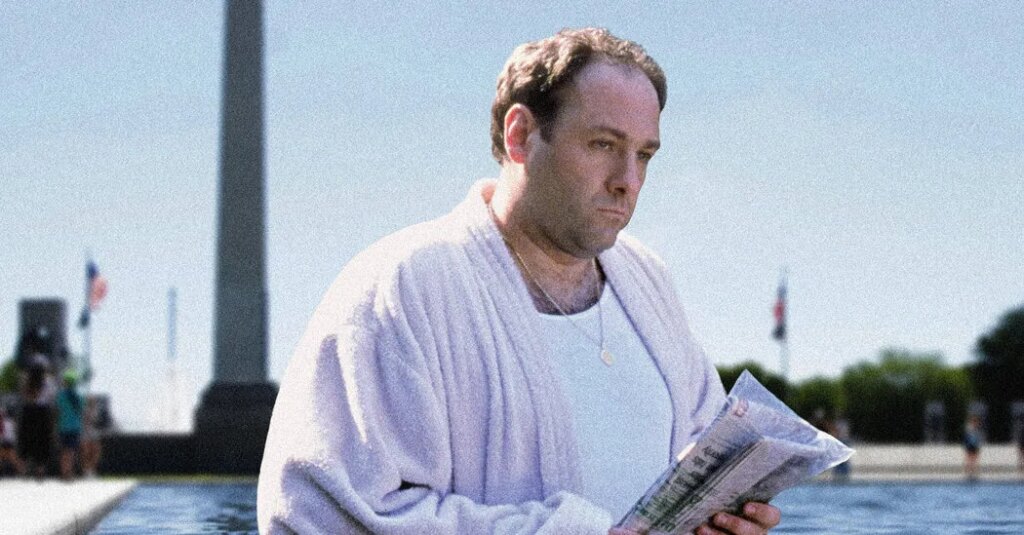
Source photographs by Rahmat Gul/Associated Press and HBO/Alamy.
The Times is committed to publishing a diversity of letters to the editor. We’d like to hear what you think about this or any of our articles. Here are some tips. And here’s our email: [email protected].
Follow the New York Times Opinion section on Facebook, Instagram, TikTok, Bluesky, WhatsApp and Threads.
The post The Four TV Shows That Heralded America’s Fall appeared first on New York Times.