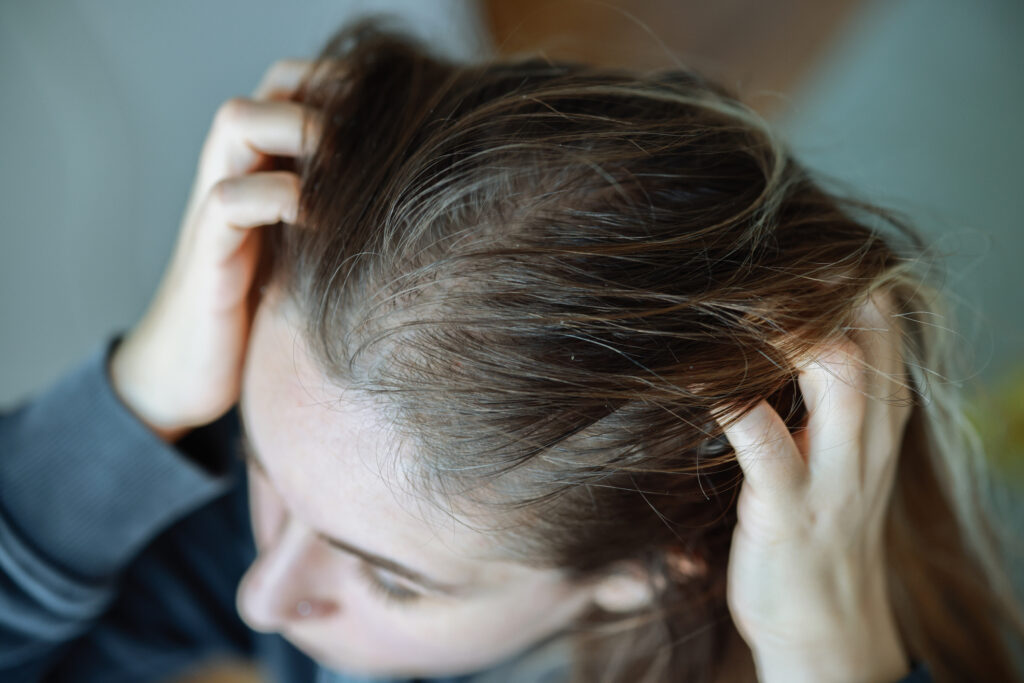
Hair loss in women can be caused by many things, including your genetics, illnesses, nutritional deficiencies, physiological stress and shifts in hormones. While hair thinning and shedding can be distressing, determining the underlying causes can help slow down, stop or even reverse certain types of hair loss.
We asked dermatologists about three common underlying conditions that can lead to hair loss, what signs to look for and what treatments are available. Here’s what they said.
Thyroid disorders
Thyroid disorders, including both hyperthyroidism (when the thyroid is too active) and hypothyroidism (when it is not active enough), can lead to hair loss, research shows. And they’re common, particularly among women — an estimated 1 in 8 women will develop some type of thyroid problem during their lifetime, data shows.
Thyroid disorders can disrupt the normal hair growth cycle, leading to a typically temporary but excessive form of hair shedding known as telogen effluvium, said Paradi Mirmirani, a dermatologist with Kaiser Permanente in Northern California.
The reason this happens is because the thyroid gland regulates our metabolism, controlling how fast it turns nutrients into energy. “Either the engine is running too hot or it’s not running well enough. And the body’s reaction is for the hair follicle to triage into a resting phase rather than a growth phase” to reallocate important resources, Mirmirani said.
Thyroid-related hair loss does not usually occur without other symptoms. For instance, hyperthyroidism can cause fatigue, weight loss and a fast or irregular heartbeat, while hypothyroidism also can cause fatigue as well as weight gain and a slowed heart rate, among other symptoms. These conditions can be diagnosed with a blood test.
Hair loss may also result from autoimmune thyroid disease or thyroid removal, said Amy McMichael, professor of dermatology at Wake Forest University School of Medicine.
Thyroid-related hair loss can be resolved but requires treatment, time and patience. Once a physician addresses the underlying issue with hormone therapy, medications or surgery, for instance, and your thyroid levels normalize, it can take six to nine more months before excessive shedding stops and your hair starts growing back more normally, Mirmirani said.
Iron deficiency
Iron deficiency is common, affecting about 1 in 3 Americans, and it can progress to iron deficiency anemia, which happens when your iron levels are too low for your body to make enough hemoglobin, the protein in red blood cells that carries oxygen through your blood. Low iron, which is more common in women, can stem from heavy menstrual bleeding, iron absorption problems, inadequate iron in the diet and other things. And it can lead to hair loss.
“Your body says, ‘I’m using all this energy to grow hair, but in the current state, it is going to be more important for me to shift energy and deal with this anemia than it is for me to grow hair at the moment,’” McMichael said.
Research suggests that low ferritin, a protein that stores iron inside your cells, is associated with different forms of hair loss, including telogen effluvium, in women. In fact, a 2025 study found that 28 percent of people with telogen effluvium had reduced ferritin levels, while no one in the control group had a deficiency.
The American Society of Hematology recently set new standards for diagnosing iron deficiency. If you have serum ferritin levels lower than 30 nanograms per milliliter, then you don’t have enough iron in your body. For people with heavy menstrual cycles and those who are pregnant with anemia, the threshold is 50 ng/mL, and for those with certain inflammatory diseases and cancer, it’s 100 ng/mL.
“I want ferritin above 30,” said Antonella Tosti, a professor of dermatology at the University of Miami. “Definitely when it’s lower than 15 nanograms per milliliter, it’s associated with excessive shedding.”
Women who have a restricted diet and may not get enough iron-rich foods, those who have absorption issues or those who have particularly heavy menstrual cycles may be more likely to have lower iron levels.
Once low iron is addressed — treatments may include oral supplementation or infusion — hair growth should start to normalize, though it can take months to see noticeable improvement. Your doctor may also recommend eating more iron-rich foods, such as red meat, poultry and fish, as well as legumes, leafy greens, seeds and nuts.
Hormonal conditions
Many women may notice hair loss with changes in hormones such as during pregnancy, menopause or even after starting or stopping birth control pills.
But hair loss is also a potential symptom of PMOS, which stands for polyendocrine metabolic ovarian syndrome, a common hormonal disorder that affects about 5 to 6 million women in the United States. People who have PMOS may experience an overgrowth of facial or body hair — such as dark coarse hair on the chest, abdomen, upper lip or chin — but at the same time, they may get thinning hair on the scalp.
PMOS, formerly known as polycystic ovarian syndrome (PCOS), doesn’t cause a lot of hair shedding. Instead, excess testosterone is converted into dihydrotestosterone (DHT), which causes the hair follicles to become smaller and then the hair strands to become thinner. This is the thinning characteristic of female pattern hair loss, Mirmirani said.
In addition to hair-related changes, PMOS can cause acne, irregular periods, infertility, obesity and more.
One of the most common treatments for female pattern hair loss is minoxidil, sold under the brand name Rogaine. However, because it may cause hair growth in other places, such as the face or body, it’s used with caution in people with PMOS.
Oral spironolactone, a hypertension drug, is often used off-label to block male hormone receptors, which can help with hair regrowth. Additionally, Mirmirani said she sometimes prescribes finasteride, an oral medication approved to treat androgenic alopecia in men, off-label for female pattern hair loss because it prevents the conversion of testosterone to DHT, which can prevent the shrinking of hair follicles. However, because the Food and Drug Administration has warned about a potential for birth abnormalities, it is not recommended for women who are pregnant or who want to get pregnant.
While this miniaturization may not be completely reversed, with treatment to reduce androgens, you can see noticeable improvement, particularly when you intervene early.
“Think of it as a gradual progression of a big tree trunk to a finer, thinner branch,” Mirmirani said. “It’s much harder to re-enlarge the very fine miniaturized hair to the bigger, thicker, what we call ‘terminal hair,’ once it’s far gone. If you do intervene earlier, you are more successful in the reversal.”
The post 3 common health conditions that can cause hair loss in women appeared first on Washington Post.