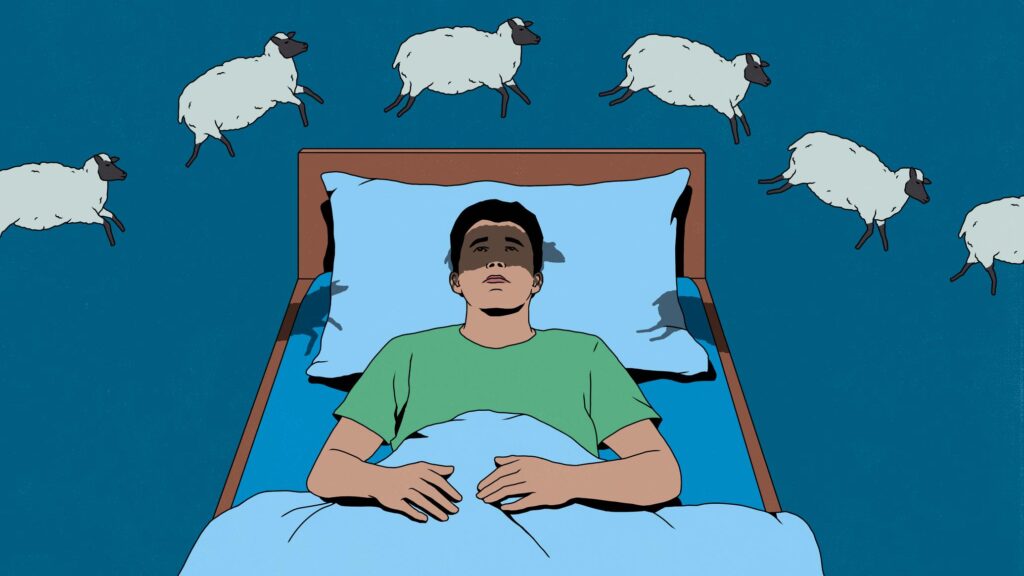
A few months ago, a new patient sat down in my office and started talking before I had finished my hello. She hadn’t slept well in months, and it showed. She was short with her husband, tired at her desk, and dreading her own bed as if it had betrayed her. My patient turned her phone toward me the way you would hand over bad bloodwork. A sleep score: 61 out of 100. “Look how bad it is,” she said.
I see it all the time. An ordinary bad week or two of sleep turned serious by constant monitoring. For a growing number of my patients, rigid discipline and the effort to sleep perfectly can tip a rough patch of poor sleep into a diagnosis of clinical insomnia.
How did we get here? For decades, sleep was an afterthought. It was the first thing people cut when ambition or parenting demanded more. Thomas Edison called sleep “an absurdity, a bad habit,” and believed his lightbulb would free us from needing it at all. Then, over the last decade, we swung hard the other way. Arianna Huffington’s collapse and Matthew Walker’s best-selling book Why We Sleep turned sleep into a public-health alarm. Wearables placed a number on what used to be a feeling, and adequate sleep became a status symbol. Within a few years, the trend bloated further into “sleepmaxxing,” the latest iteration of optimizing sleep as aggressively as a workout.
Sleep clinicians have named what happens when that grading goes too far. Orthosomnia is an unhealthy preoccupation with achieving perfect sleep that produces the insomnia it was meant to prevent. The condition is a parody of itself. You cannot relax your way to good sleep while obsessively checking whether you are relaxed enough to get sleepy.
Orthosomnia doesn’t have one cause. I often see it begin in earnest attempts at improving sleep hygiene. These are the standard sleep rules most of us absorbed by osmosis: consistent bedtime, no screens before bed, no caffeine after noon. These rules are not wrong. The delivery is the problem. Handed over as a checklist rather than a set of leads worth trying, ordinary advice becomes a pass-or-fail test. After one bad night, the panic sets in. What’s wrong with me? Why can’t I fix this? Orthosomnia has taken hold.
Sleep hygiene guidance was built on general associations between behavior and sleep quality, drawn from population averages. Along the way, it calcified into a moral checklist, and a surprisingly rigid one. Patients express genuine shame at “failing” sleep hygiene because they scrolled their phone in bed once, or napped on a Sunday, or had a glass of wine with dinner. None of that failure is clinical. But people start to feel that way when flexible advice is treated as dogma.
Applied uniformly, sleep hygiene ignores an obvious fact. Sleep is not the same for everyone. A rule that calms one person’s nervous system agitates another’s. Some anxious patients sleep better with the TV on. Others, especially shift workers and jet-lagged travelers, need a hard digital cutoff.
The rules were written for the average person who does not exist. They are obsessed over every night by people who very much do.
Even for chronic insomnia, sleep hygiene alone does not solve the problem. British researchers ran a large primary care trial and found that simply providing a sleep hygiene booklet barely moved the needle. A short course of behavioral treatment worked more than twice as well. The American Academy of Sleep Medicine had already reached the same conclusion, advising against using sleep hygiene as a stand-alone treatment for chronic insomnia.
I advise my patients to treat sleep-related lifestyle interventions as a menu instead. Individualize it. Some will work, and some won’t. The only way to find out is to test them one at a time, with nothing riding on the result. Maybe consistent wake times matter more than consistent bedtimes. Maybe a Sunday afternoon nap is harmless. Maybe the phone in bed is fine as long as it’s not the news. What doesn’t work, you cross off. What’s left is your menu, and you don’t order the same thing every night. It changes as your life does.
A sleep menu is a harder sell than a checklist. The certainty of itemized requirements is what anxious sleepers chase. But certainty is a trap. In my experience, what predicts recovery from sleep issues is permission: the willingness to stop treating a bad night as a failure, and to start treating sleep as something worth understanding on your own terms.
My patient with the sleep score did eventually sleep better, in part because she stopped checking her stats every morning like a report card. She discarded her old sleep hygiene rules and adopted a personal sleep recipe that belonged to her.
Sleep isn’t something to master. It’s a menu you keep rewriting, a recipe you keep adjusting, until it fuels the life you actually live.
The post We Turned Sleep Into Homework. Now We’re Losing Sleep Over It appeared first on TIME.