When I first started playing “Dungeons & Dragons” as a tween, my friends christened me with a new good-natured nickname: gamer geek. While we could spend hours in front of a screen with the latest “Zelda” title, the dice-focused tabletop role-playing game was viewed with suspicion, a ’70s-era invention that belonged to a certain subset of nerd.
Times have changed.
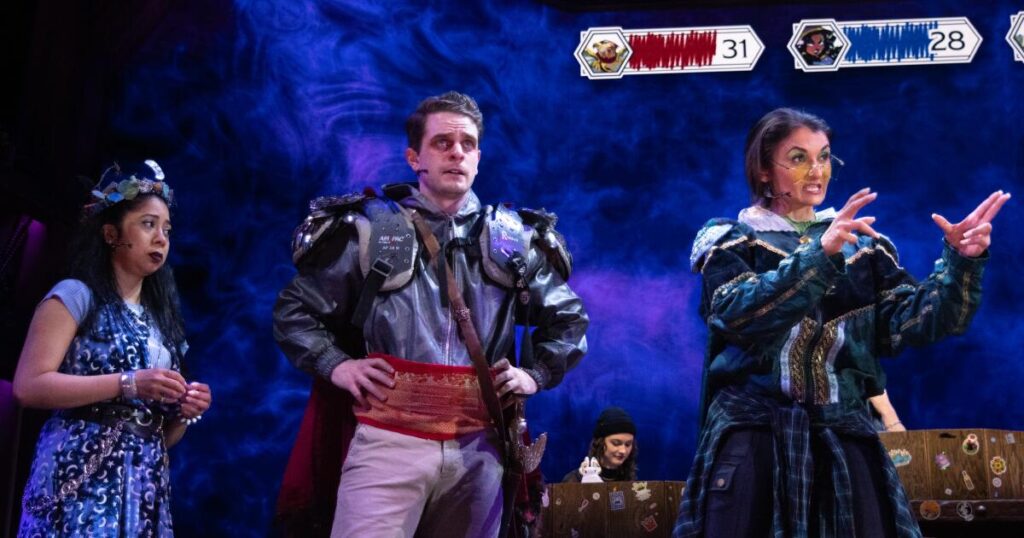
Today, “Dungeons & Dragons” enjoys mainstream recognition, and live game sessions from the likes of Critical Role and Dimension 20, the latter of which last summer enjoyed a date at the Hollywood Bowl, have only further cemented its wide appeal. Now a heavily improvised theatrical production, “Dungeons & Dragons: The Twenty-Sided Tavern” has come to the Montalbán Theatre in Hollywood.
The show, which ran off-Broadway in 2024 after years of development, is celebratory, a victory lap for a game that has endured more than half a century. It invites participation, with actors performing the action inspired by the dice rolls and allowing the audience to influence the direction of the show by making choices via a smartphone.
“Twenty-Sided Tavern” brought me back to days and nights crowded around my family’s living room table. My father was an executive with TSR, Inc., the company that created “Dungeons & Dragons” — there were glass dragons on our fireplace mantle, pewter dragons on our bookshelves, painted dragons on our walls and even a metal dragon that hung from a necklace I wore too often (and that probably didn’t help me with getting dates). As a junior high kid, the game was a refuge, a creative tool where I could envision characters, worlds and fantastical scenarios.
There was a lot of math, too, and quite a bit of rules, not to mention addendums to rules and fine print to those rules, but I discovered early on a key to its personal appeal, one that likely makes many hardcore followers of the game cringe: Story comes first, the rules a distant second. In fact, I discarded any directive that got in the way of a more fanciful tale.
It pleased me that “Twenty-Sided Tavern” does as well. When my showing the other week began not with beholders and battles but instead a yarn about trying to flirt with and seduce a dragon, I couldn’t help but smile. For the best “D&D” games, no matter how serious, tense or dramatic they may get, are always a bit silly, or at least they are to me.
“I know we hear about toxicity in gaming all the time, but when I picked up my first ‘D&D’ set that my brother gave to me when I was 8 years old, what was open to me was not just a world of storytelling,” says Anjali Bhimani, a co-producer of the production as well as a regular performer in it. “It was a world where a halfling could kill a red dragon, where it didn’t matter where you came from. There was always a seat for you at the table.
“I think the sense of belonging that tabletop RPGs and ‘Dungeons & Dragons’ can provide is so, so, so powerful, and I think it really is a means to just bring people together in a way that a lot of other media can’t,” she adds.
“Twenty-Sided Tavern” does have some constraints. It is, after all, staged in a theater. But it also throws the traditional rules of theater by the wayside. Expect, for instance, to be on your phone most of the show. We’ll lightly direct the production, voting, for instance, to explore a castle’s catacombs or the mysterious woods. Many will cheer a good dice roll, and it wasn’t out of the norm at my matinee for the audience to shout suggestions or requests. When, for instance, said storyline about romancing a dragon became a bit risqué, a woman kindly reminded the cast that there were children present. It was toned down, but not before an actor made a joke about the show being educational.
“This doesn’t have to be a stuffy, fourth-wall drama,” says Michael Fell, the show’s creative director. “We can create a sense of community. As much as there is a script — there kind of is — we aim to have engagement with the audience every two pages. That means they’re calling out a name, asked to come on stage or it’s just an election on your phone where you make a choice or play a small mini-game. No engagement on the phone ever lasts more than nine seconds.”
In “Twenty-Sided Tavern,” there are three core actors playing and acting out the game, one dungeon master and a sort of tavern keeper helping to keep score and track of the story. There’s a setup at a bar and a quest involving a threat to the town, but each show is unique. The cast may swap roles, the audience may concoct a monster — my group envisioned a giant, destructive slice of pumpkin pie — and settings will shift based on audience vote, done via smartphone.
It’s a little bit like theater as sport.
“This is gamification of live entertainment. Part of what I’m doing is mirroring what happens in sports entertainment, but in a live theatrical setting,” says David Carpenter, the founder of Gamiotics, which co-developed the show and powers the smartphone tech behind it. “This show has surprised me for years, but one of the early surprises was the entire audience losing their mind when someone rolls a 20. It’s like someone scoring a touchdown. The audience goes nuts because they didn’t see it coming.”
Like the game, “Twenty-Sided Tavern” theorizes that stories can be at their most powerful when they are not passive, when we as audience members have a role to play and invitation to interact.
Carpenter is curious how far the audience choice can be pushed to shift a narrative. He talks in the future of experimenting more with moral or ethical decisions. There are none in “Twenty-Sided Tavern,” where occasionally the audience may influence an action in a way similar to a dice roll. We’ll tap, for instance, to fill up a meter on a screen, and where it lands may indicate a success or a failure. Here, the smartphone gamification is used to prod a narrative rather than define it, a reminder to me that “D&D” is in some ways a story creation tool.
“There are stories that we have told in tabletop games that I have played that I never would have imagined coming up with in the writers’ room because the dice told the story that they did,” says Bhimani.
The large-scale audience participation of “Twenty-Sided Tavern” naturally invites a jovial, party-like atmosphere. It succeeds in extending a hand to the audience, welcoming us into what can be a complex, daunting fantasy world. It argues that “Dungeons & Dragons” is for all, much as I did as a junior high kid who made it something of a mission to convert my name-calling friends with the hopes of showing them the joys of gathering with little more than paper, pencils, dice and an imagination.
“It’s still somewhat intimidating to a lot of people because they think, ‘I have to know all these rules and learn all these spells and read all these books,’” Bhimani says. “Coming to the ‘Twenty-Sided Tavern,’ it’s about telling a great story. Yes, we roll dice. Yes, there are spells. But ultimately, that’s just scaffolding to tell a beautiful, improvised story.”
I remember when I played weekly games in high school, my friends used to joke that I, as dungeon master, would “lose” because I did everything in my power to keep everyone’s character alive and playing, wanting to see a narrative to a conclusion that didn’t end in anyone’s death. They wondered if I was running the game incorrectly because they always succeeded. Yet I saw “Dungeons & Dragons” as a wholly collaborative endeavor, and I felt that way again watching “Twenty-Sided Tavern,” an ode to the idea that “Dungeons & Dragons” is best when shared.
And a reminder, too, that there is no wrong way to play it.
The post The best part of ‘Dungeons & Dragons’ is the storytelling. This L.A. stage show leans in appeared first on Los Angeles Times.