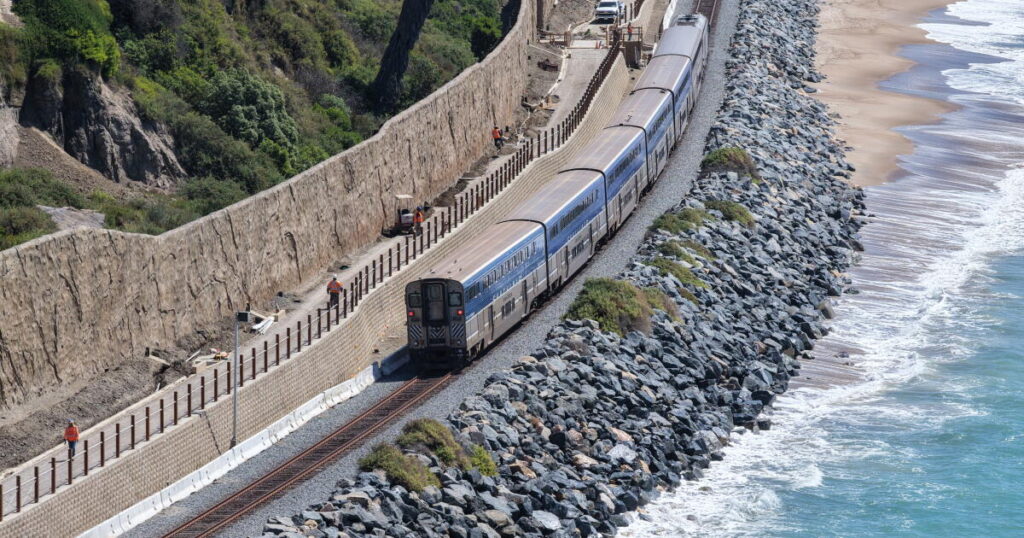
For years, Amtrak’s Pacific Surfliner has been portrayed as the civilized way to travel to and from San Diego.
No gridlock on Interstate 5. Glorious views of the Pacific Ocean. Even the chance to grab a drink and relax.
But the iconic rail line connecting Orange County to San Diego is under threat thanks to coastal erosion — and officials say the situation could get much worse if predictions of an intense El Niño winter come to pass.
Heavy waves and erosion closed the rail line for days this summer. Last year, the line was closed for a month for repairs designed to protect against landslides.
“It’s been a pain in the butt with the delays,” said Shirley Moreno, a SeaWorld San Diego employee in her 30s who takes the Surfliner five times a month to visit family in Los Angeles. “Sometimes they close it down when I need to come out here.”
What makes the Surfliner so appealing — a picturesque view as the train rides right along the water — is also what makes it so perilous.
For years, seas have been slowly rising as a result of human-caused climate change, leading to coastal erosion. It’s led to extreme weather events and the conditions brewing this summer in the Pacific are no exception. The National Oceanic and Atmospheric Administration’s Climate Prediction Center said that there’s a 97% chance of a “strong” or “very strong” El Niño over a three-month period ending in December.
“There’s a race with Mother Nature in terms of trying to protect the line,” said Derrell Johnson, chief executive of the Orange County Transportation Authority, which manages the land under part of the Surfliner’s route. “The rail line has been there since the 1880s but in the last five years, there’s been no other time in history where we’ve had this much impact.”
The challenges the line has faced this summer are evident in its social media posts. In July, rides were canceledbecause of washout risks. In August, high surf necessitated emergency repairs. Earlier this month, a half-dozen trains between San Diego and Los Angeles were canceled.
Two years ago, the OCTA identified four hot spots of “significant concern” along the coast that needed improvements, Johnson said. The agency secured $308 million in state and federal emergency funding to begin but hasn’t been able to secure all of the permits in time from the California Coastal Commission, California State Lands Commission and the Army Corps of Engineers to complete the work.
“What we had hoped to be done in two years, looks to be at least another year and a half away,” Johnson added.
While OCTA is responsible for managing the land under the rails for 40 miles of coastline, which means maintaining the sand and boulders that help buffer the tracks from the surf, there’s a seven-mile stretch in San Clemente that’s considered particularly vulnerable and “high risk,” Johnson said.
That’s where much of the focus has been this summer.
San Diego Coast District Deputy Director Karl Schwing of the state Coastal Commission said that the agency has received an uptick in the number of emergency permit requests over the last month because of the hurricane-induced storms and the high tides.
“It speaks to the climate change and that sea-level rise, which are real issues,” said Shannon Vaughn, coastal program manager for the California Coastal Commission. “There’s development in these areas that are subject to wave action and high tide events. With the increase in erosion, it then increases potential damage.”
If things continue to deteriorate over the winter, things could get complicated for 19-year-old Julian Brannon, who lives in Los Angeles and uses the train to get to night classes at San Diego State at least once a month.
Aboard the Surfliner from Los Angeles to San Clemente, about 50 passengers moved about the train car with capacity for about 90 people Monday morning. As the train arrived in San Clemente, passengers peered through the train windows to take in the crashing waves, sandy shoreline and beachgoers relaxing underneath umbrellas.
In August, when service was disrupted, Brannon sat on the train for more than three hours before getting off and requesting an Uber, which costs significantly more money.
Brannon would have to take a car or bus if the Surfliner is shut down or delayed long term. He said it’s too expensive for him to make the drive from Los Angeles to San Diego.
“If I had the opportunity to drive, I probably would, but also with the rising gas prices and the cost in owning a car in general, the Amtrak has been really convenient for me traveling back and forth,” he said.
The post El Niño threatens the beloved Pacific Surfliner. Can the iconic train survive the winter? appeared first on Los Angeles Times.