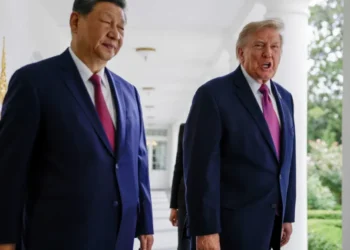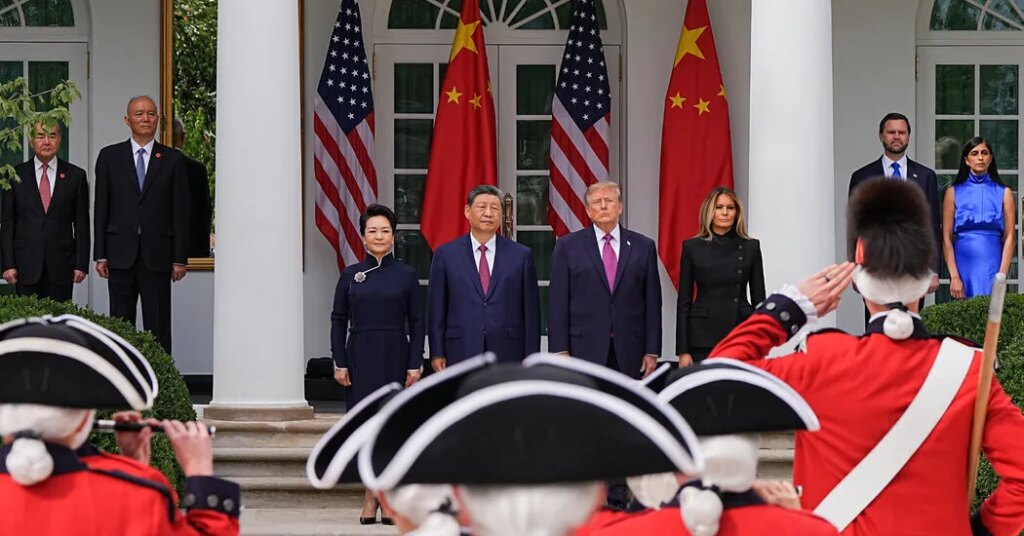
At the White House gate, a throng of Chinese journalists was being admitted onto the grounds of the Executive Mansion to cover the visit of President Xi Jinping. Out on the street, several American journalists were blocked from entering the White House on the orders of President Trump.
The scene on Pennsylvania Avenue on Thursday morning captured a surreal week in the life of Washington. The president of the United States barred American reporters because he labeled them a threat to national security, while welcoming Chinese reporters who answer to the communist dictatorship in Beijing.
This would be the same president who is running government-paid television advertising vowing to stop the United States from becoming socialist or communist in the same week that he held a friendly meeting with the democratic socialist mayor of New York and rolled out a literal red carpet for the communist president of China. The same president who is waging economic war against the prime minister of Canada while inviting the president of Russia to visit his Florida golf club.
In the epic contest between democracy and autocracy, Mr. Trump has long given the impression that he may be on the other side. But rarely has that been brought home as starkly as this week, as he punishes news outlets for being too “negative” about him while embracing Mr. Xi and President Vladimir V. Putin of Russia, two of the world’s leading authoritarians whose governments brutally suppress free speech.
Mr. Xi’s arrival at the White House was celebrated with pomp and circumstance that were not covered by American television networks, which were still boycotting the White House press pool until Mr. Trump’s staff commits in writing to letting CNN cameras back into the rotation. Reporters from CNN, MS NOW and Politico who were initially barred from entering the White House on Thursday morning despite a court order were allowed in later in the day, but by late afternoon Mr. Trump’s staff had still not permitted CNN back into the pool that provides footage of the president every day.
Even as Mr. Trump fumed that his carefully orchestrated day of pageantry was not shown on air, he basked in Mr. Xi’s presence and lavished him with praise, making no mention of human rights issues that past presidents raised when meeting with Chinese counterparts.
“From the time of my first election in 2016, President Xi and I have forged a friendship, a truly great friendship, actually, built on mutual respect and the vital interests of our people,” Mr. Trump said in the Grand Foyer of the White House. He later delighted in taking his great friend on a tour of the new White House ballroom that is under construction and showed off his taunting photograph of an autopen meant to represent his predecessor, former President Joseph R. Biden Jr.
Mr. Trump hopes to similarly host Mr. Putin soon. Secretary of State Marco Rubio announced this week that Mr. Trump had invited the once-ostracized Russian leader to attend the annual Group of 20 meeting in Miami in December, which would be his first appearance at the annual gathering since 2019, before his full-fledged invasion of Ukraine. The summit is scheduled to be held at Trump National Doral Miami, where the president tried to host a Group of 7 meeting in his first term only to back down after Republican complaints that it was too self-dealing — complaints not heard this time.
While Mr. Putin was kicked out of the G7 and other groups because of his seizure of Crimea in 2014, Mr. Trump has been eager to bring him back into the international fold. The International Criminal Court issued an arrest warrant for Mr. Putin on war crimes charges in 2023, but Mr. Trump ignored that by inviting the Russian to Alaska last year — and just this week denounced the court in an address to the U.N. General Assembly as “an evil group of people” as his administration attempts to dismantle the body.
Mr. Trump’s affinity for despots, tyrants and autocrats has baffled democratic leaders and diplomats and reoriented American foreign policy for some 10 years now. He gushes over the likes of Kim Jong-un of North Korea (“we fell in love”), Abdel Fattah el-Sisi of Egypt (“my favorite dictator”), Mohammed bin Salman of Saudi Arabia (“I like him too much”), Recep Tayyip Erdogan of Turkey (“a very good friend of mine”) and Nayib Bukele of El Salvador (“one hell of a president”).
By contrast, he regularly feuds with leaders of traditional allies like Canada, Britain, France, Germany and Italy. He derided the democratically elected president of Ukraine, Volodymyr Zelensky, last year as a “dictator without elections” while offering no concerns about Mr. Putin, whose elections have been documented as thoroughly rigged. He had the United States vote along with North Korea, Belarus and Sudan last year against a U.N. resolution condemning Russia’s invasion of Ukraine and lately has been courting Belarus’s dictator Aleksandr G. Lukashenko.
At home, Mr. Trump regularly battles the domestic news media, denouncing journalists as “enemies of the people,” a phrase used by Stalin to condemn dissidents to the gulag. More than any American president in modern times, Mr. Trump has mounted a wide-ranging campaign against independent media through multibillion-dollar lawsuits, Federal Communications Commission pressure, subpoenas to reporters, the eviction of The Associated Press from the White House press pool and restrictions that effectively forced reporters out of the Pentagon.
Mr. Trump seemed unbothered on Thursday by any mixed messages sent by welcoming Chinese state reporters at the same time he was trying to throw out American news outlets as part of what he called his “ban on the free press.” On the other hand, he did seem bothered by the fact that the still-unresolved showdown meant that boycotting network television cameras did not beam the festivities to the nation.
In a social media post late in the day, Mr. Trump praised Mr. Xi as “the Highly Respected President of China” and flattered “his beautiful wife, Madam Peng” while accusing CNN and MS NOW of having “NO CREDIBILITY” and being “Fake News.” A White House pool report indicated that at one point during the day Mr. Trump “made a joke about how the Chinese had the friendliest press corps.”
Which of course depends on the definition of friendly. China exercises iron-fisted control over its press corps and has at least 111 journalists and media workers locked up, according to Reporters Without Borders, making it “the world’s largest prison for journalists.” Of the 180 countries that the group ranks on freedom of the press, China ranks almost at rock bottom at 178th place, above only North Korea and Eritrea. (The United States has fallen to 64th under Mr. Trump.)
“Trump doesn’t just want to meet with Xi — he wants to copy him,” Senator Chris Coons, Democrat of Delaware and a senior member of the Senate Foreign Relations Committee, wrote on social media, citing attacks on the press, politicizing the justice system and purging the civil service.
Even some Republicans, while not openly questioning Mr. Trump’s media ban, expressed disappointment that the president, in courting the leader of one of America’s largest trading partners, was so willing to flatter and fete Mr. Xi while overlooking China’s record of government oppression.
“During every minute of dialogue, our commander in chief should keep in mind that his guest is a brutal, unelected and oppressive dictator who seeks to dominate his neighbors and whose massive military arsenal is aimed directly at the United States of America,” said Senator Roger Wicker of Mississippi, the Republican chairman of the Senate Armed Services Committee.
That was not, however, the message being emphasized at the White House, where the president’s aides this week sought to replace the news outlets he tried to bar by kicking off their own online “Trump TV,” a form of state television that Mr. Xi might recognize. That is certainly one way for Mr. Trump to have his own friendliest press corps.
The post In Trump’s White House, China’s Dictator Is Welcome. American Media, Less So. appeared first on New York Times.