This week’s Pollwatcher looks at global opinions on artificial intelligence, a spike in searches on how to vote and guide to telling if poll invitations are legit. But first …
Election polls are piling up after Labor Day, with many showing large or growing advantages for Democrats. The movement matches a historical pattern of polls shifting against the president’s party during midterm years. But why does this happen? How do voters actually decide whether and for whom to vote in midterm elections, and why do some voters seem to take so long to make their choice?
Let’s start with one of the most common theories: Midterms are a referendum on the president’s performance. There is ample support for this in Election Day exit polls finding about 9 in 10 voters who approved of the president’s performance supported congressional candidates from the president’s party, while about 9 in 10 of those who disapproved of the president supported the other major party.
But the referendum explanation is incomplete. One study of midterms from 1946 to 2006 found “the effect of presidential approval as measured in October is already mainly absorbed by polls as measured in February.” Because approval ratings are baked into the midterm election pie by February, they can’t explain why polls shift against the president’s party as the election gets closer. In addition, the study found that even popular presidents lose seats in midterm elections. This means that something else must dragging the president’s party.
Want this in your inbox?
Sign up for The Pollwatcher newsletter here.
One intriguing explanation is “balancing theory,” proposed in the same long-term political science study. The authors suggested that some voters who are ideologically in between the Republican and Democratic parties vote against the president’s party to bring policy closer to their own preferences. A 2024 study found voters punish Democrats when Congress passes more liberal laws and punish Republicans when they pass more conservative laws, another sign that voters try to push Congress to the middle.
Christopher Wlezien, professor of government at the University of Texas at Austin.
The electorate votes against the presidential party to give more power to the other party, but does not incorporate this motivation in its thinking until Election Day approaches.
Most voters develop firm opinions on a president during their first year in office, but during midterm elections “they’re taking stock” and steadily moving toward a decision all year, said Christopher Wlezien, a co-author of both studies who spoke with The Post by phone Tuesday. “The simplest way to think of it is that some people start edging closer … ‘Yeah, I’m probably going to vote Democrat.’ There’s probably people moving in the Republican direction [in 2026], just fewer.”
A New York Times-Siena College national poll this month showed a glimpse of this dynamic, with 49 percent of likely voters saying they would rather vote for a candidate who “wants to provide a check on Donald Trump,” rising to 59 percent among political independents. A far smaller 26 percent of all likely voters said they want a candidate who supports President Donald Trump, while 21 percent said it doesn’t matter either way.
How can you tell if a poll invitation is legitimate?
Numerous Pollwatcher readers have asked how they can distinguish real survey invitations from spam and scams, especially for text-message and email surveys. I put the question to members of the American Association for Public Opinion Research, and below are some of the most common answers:
- Real polls won’t ask you for money, Social Security numbers or bank info. One of the most common illegitimate poll requests is “frugging,” short for fundraising under the guise of research. It’s an unfortunately common practice for political groups and other organizations to send blast emails or texts with a poll question — “click if you support our cause!” — then ask people who click an answer to donate money. These are not legitimate polls and can often be spotted by partisan or emotional appeals in an email or text survey request.
- Look closely at the poll link. Kevin Collins at the text-focused survey Survey160 recommends looking at the root URL in a poll invitation, which is the part of a link that appears just before the “.com” in a link such as washingtonpost.com. Collins writes that “Actual surveys are likely to include either a branded link-shortener where the base url is specific to the survey firm, or alternatively a URL for a web survey platform like qualtrics.com or alchemer.com.” Collins’s has a useful guide on telling if text-message surveys are real.
- Look up the polling firm or sponsor’s website. If you receive a request from an unfamiliar group, searching their website for the poll’s sponsor or research firm can shed light on its legitimacy. Look for firms that name staff with research experience, pages that highlight specifics of their work with documentation, list actual clients and provide contact information.
- Ask questions. “People should feel comfortable asking questions and doing some homework on who’s behind the survey,” wrote Patti Morris and Todd Sheffer of Tigre Strategies, a firm that specializes in text-message surveys. Text back or reply to the email with any questions about the survey you have, or use contact info on a firm’s website.
- Some legit polls name the sponsor, but others do not. Many polls identify the group sponsoring the survey up-front, which can help establish trust and legitimacy. The Pew Research Center includes its name on letters inviting people to join its American Trends panel, and sends emails to respondents from an “@pewresearch.org” address, Pew told The Post in an email.
But some genuine polls won’t report a sponsor’s name to avoid biasing participation, which can undermine accuracy. A 2017 Washington Post-Schar School poll before Alabama’s U.S. Senate election did not disclose The Post’s sponsorship at the start of the survey because The Post had broken stories about allegations that Republican candidate Roy Moore had sexually assaulted teenage girls when he was younger, as the story described:
“To avoid influencing the answers of respondents who have opinions about The Post’s coverage of allegations against Moore, interviewers disclosed The Post’s sponsorship of the survey only at the end of the interviews.”
What do you want to know?
Send your questions, comments and ideas to [email protected].
What the polls agree on
AI concern is higher in the U.S. than other countries — A Gallup pollconducted from April to July found 36 percent of Americans who were aware of artificial intelligence think it will mostly help people in the U.S., ranking fourth-lowest among 37 countries surveyed. A separate Pew Research survey found the U.S. ranking second among 37 countries in general AI concern, third in concern about both job losses and increasing the gap between the rich and poor. Gallup found countries with the heaviest use of AI were more worried about it, even though individuals who use AI more often are somewhat less worried.
Worth your attention
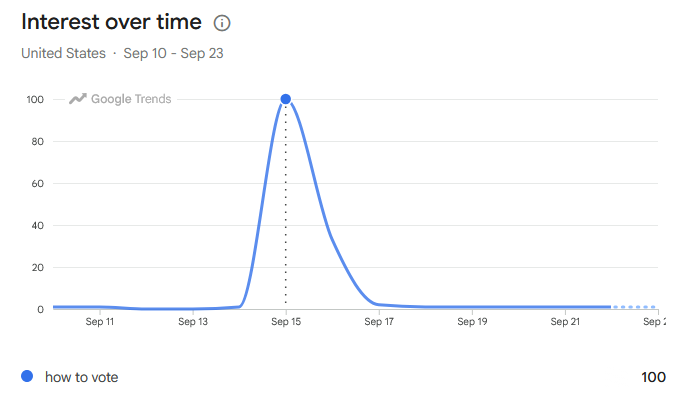
Many Americans just Googled how to vote — Like clockwork, Google searches for “how to vote” spiked on Sept. 15 this year before dropping sharply in the days afterward. Past election years have also seen a surge in searches about how to vote in mid-September before presidential and midterm elections.
AI still ranks as a secondary midterm issue — A CNN poll released this week finds 36 percent of registered voters said data centers and AI are “extremely important” in their vote for Congress. That’s not a small group, but it is far smaller than the percentages of voters prioritizing the economy (68 percent), voting rights and election integrity (61 percent), inflation (60 percent), health care (54 percent) and immigration (50 percent). AI ranks even lower in polls asking voters to name their top problem facing the country or the most common reason for their midterm vote.
The post The Pollwatcher: The big, unseen factor in how voters decide midterm elections appeared first on Washington Post.