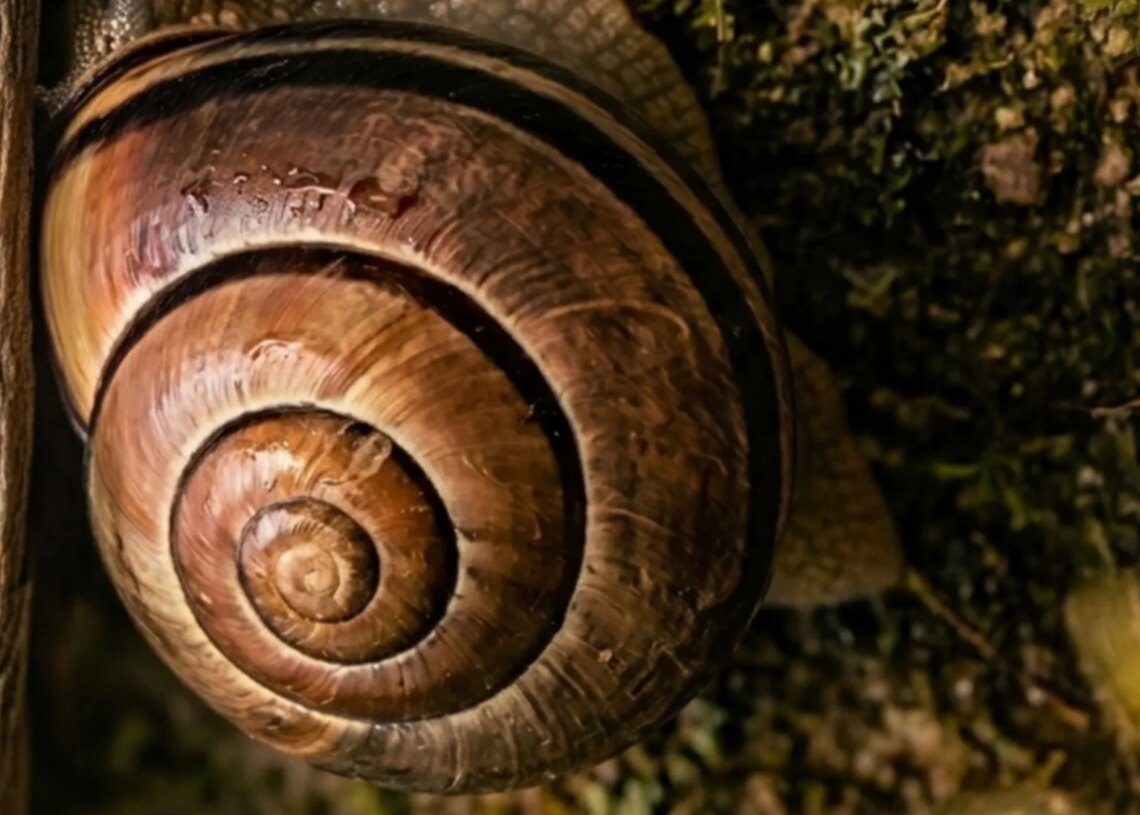
Some of the best keepers of the past’s weather events might be the brainless mollusks crawling through the dirt, occasionally getting crunched with a sickening crackle beneath your shoe.
According to a study published in the journal The Holocene, researchers at the University of Queensland discovered that land snails carry a detailed, indestructible weather log permanently etched right onto their backs. Pretty dope, right?
The team, led by Dr. Nicholas Patton, looked into the shell of a Biggenden Banded Snail (Figuladra bayensis) collected from Queensland’s Coalstoun Lakes National Park. By drilling 200 microscopic samples along the shell’s spiral, the scientists used radiocarbon dating and isotope analysis to read the mollusk’s growth rings like tree rings.
Snails Have Been Carrying Weather Records on Their Backs. Scientists Just Decoded One.
The researchers found elevated radiocarbon levels from 1960s nuclear tests that helped them pinpoint the snail’s 4 ½ year long lifespan. At first, the researchers expected the shell to show steady growth during wet years when there was plenty for the snails to eat. Instead, they saw data showing a series of erratic growth spurts. Sometimes they’d grow by a modest 23.7 millimeters and at other times by a staggering 144.3 millimeters after huge torrential downpours.
The goo that makes up the actual snail disappears shortly after it’s gone, but its shell sticks around in sediment layers for so long that scientists can use fossilized shells to map the paths of extreme cyclones all the way back to prehistoric times, way before humans came along and eventually invented barometers and satellite radar.
The biggest growth spurts lined up perfectly with the biggest storms on record in the area: Tropical Cyclone Marcia in 2015 and Tropical Cyclone Debbie in 2017.
Studying a snail’s shell to determine the severity of past wet and dry seasons isn’t going to be the end-all, be-all of weather forecasting. But it’s another fascinating tool in the toolkit, because who would’ve thought the humble, extremely slow-moving pest that munches away at our gardens has been tracking some of Earth’s most extreme weather, seemingly waiting for scientists to come along and decode it.
The post How Snail Shells Could Help Scientists Track Storms From Prehistoric Times appeared first on VICE.