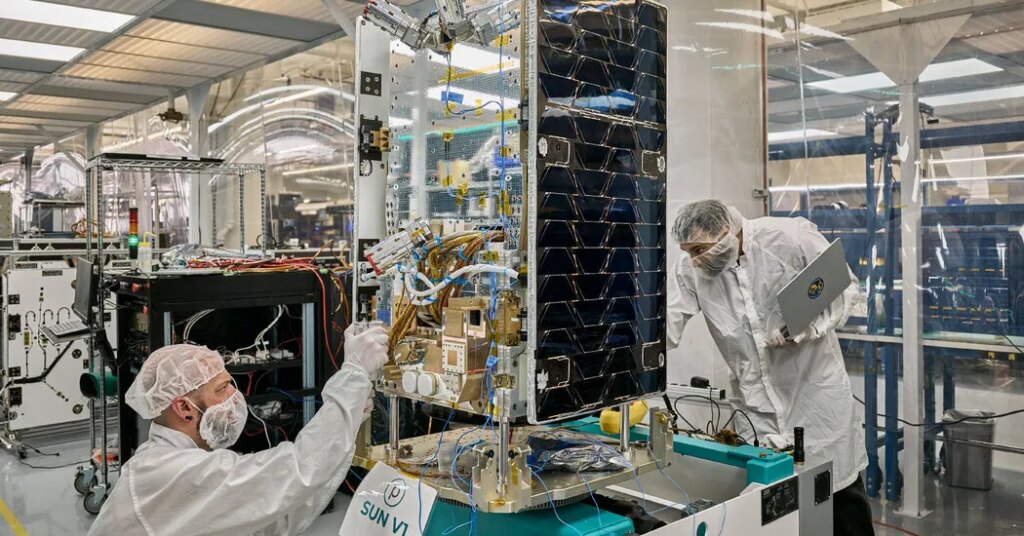
On Oct. 1, Google is scheduled to launch a satellite that can run its artificial intelligence technologies in space. Others say they are not far behind.
Elon Musk, founder of the rocket company SpaceX, recently said that “A.I. in space” will be the cheapest way of powering the technology “not more than five years from now.” Other tech titans, including Jeff Bezos, founder of SpaceX rival Blue Origin, Sam Altman, chief executive of OpenAI, and Nvidia boss Jensen Huang, have also backed this vision, hoping to put data centers in space and fuel them with the rays of the Sun.
But many experts question how feasible this will be. Here is a guide to Silicon Valley’s latest big idea.
Is Google really launching a data center into space next month?
Not exactly. With help from SpaceX and the satellite company Planet Labs, Google is launching a satellite that carries the equivalent of a single data center server. The launch is an early test of what Google hopes to do on a much larger scale in the years to come.
That single server is a lot like the thousands of machines that Google typically packs into its giant data centers down here on Earth. It is equipped with four specialized computer chips, called tensor processing units, or T.P.U.s, that the company uses to build and deliver its chatbots and other A.I. technologies.
The plan is to put many of these computers into orbit and allow them to communicate, so that they can operate like a giant data center.
“When people hear ‘data centers in space,’ they imagine taking something the size of an Amazon fulfillment center and somehow magically strapping it to a rocket ship. That is never going to happen,” said Brandon Lucia, a professor of electrical and computer Engineering at Carnegie Mellon University who has explored similar technology.
“This is about smaller satellites that are independently equipped with extremely efficient computers and radio links connecting them.”
Why do tech companies want to put data centers in space?
Down here on Earth, Google and the other leading A.I. companies are spending hundreds of billions of dollars a year on the data centers needed to power their A.I. technologies. They are spending so much money, and taking on so much debt, that many experts worry these companies are creating a massive economic bubble that will eventually pop.
Companies like Google also worry they will not have the real estate or the electrical power needed to continue building these enormous computing facilities. Google vice president Blaise Agüera y Arcas, who initiated Google’s data-centers-in-space project, is particularly worried that companies will damage the environment as they work to generate more electrical power.
“If you look at the exponent — how this is going to go over the next decade or two — it starts to look alarming,” he said.
By putting data centers in space, companies like Google can theoretically solve both the real estate problem and the electricity problem, but the financial problem remains. Though companies like Google believe that they can push the cost down over time, putting all this equipment into orbit will not be cheap.
How might it solve the electricity problem?
The plan is to put these data centers into what is called a sun-synchronous orbit, which means that Earth never passes between the satellites and the Sun. That allows it to shine consistently on solar panels attached to these satellites, and the panels will provide power to the computer servers.
And there’s more room in space for data centers?
Correct. Thousands of satellites are already orbiting Earth, but there is plenty of room for more — many, many more. “Space is really big and satellites, even large ones, are relatively small by comparison,” Dr. Lucia, of Carnegie Mellon, explained.
That said, astronomers have already shown how such satellites can interfere with research telescopes and could potentially cause collisions. As they provide internet access to people and businesses down on Earth, Mr. Musk’s Starlink satellites must actively maneuver themselves to avoid colliding with other satellites and additional objects in orbit.
Once its satellites have outlasted their usefulness, Google plans to destroy them by dropping them into Earth’s atmosphere, where they will burn up. Scientists say this method is only partly effective.
“They don’t completely burn up,” said Patrick Seitzer, an astronomer at the University of Michigan who studies orbital debris. “They leave a residue that pollutes the upper atmosphere.”
Why doesn’t Google just start launching as many satellites as it can?
Putting computers in space may sound easy. But it is not.
When Google and its partners pack the company’s server into a rocket and send it hurdling skyward at more than 17,000 miles an hour, they can damage the hardware, particularly the specialized computer chips at the heart of the server.
Even if the chips survive the launch, they will face much bigger problems in orbit. Once they leave the protection of Earth’s atmosphere, radiation from the Sun and stars and other heavenly bodies can alter their mathematical calculations. And those calculations are the driving force behind today’s A.I. systems.
“You get a lot of weird particles out in space — high energy radiations that we are just not exposed to on Earth,” Dr. Lucia said. “Sometimes, you get a random high-energy particle strike that is like someone throwing a dart at the insides of your computer chip.”
On top of it all, Google must find ways of cooling its computer hardware. As these chips churn through trillions of calculations with each passing second — yes, trillions — they get very hot. And if they get too hot, they stop working.
But space is very cold, right? What’s the problem?
Yes, space is cold. But it is also a vacuum. And that means Google can’t use the methods it typically uses to dissipate heat down on Earth.
Inside a data center, companies like Google cool their machines by running cold air or cold liquid alongside them. The heat naturally moves from the chips into the cold air or liquid through the process called convection.
But convection does not work in a vacuum. It only works with physical matter. So, Google must build specialized devices that can radiate heat away from the hardware, in the form of electromagnetic waves.
“This cooling problem is actually quite difficult,” Dr. Lucia said. “These computers will be basking in the Sun all day, because you want to collect all that sweet, free photovoltaic power.”
All that sounds doable, yes?
Maybe. Even Google admits that engineers do not yet know how to make all this work. And even if they can make it work, they are not sure when all of this will be economically viable.
“There is still a lot of science and engineering to be done,” said James Manyika, Google’s senior vice president for research.
Some experts believe that putting a sizable number of data centers in space could take a decade. Or more.
The post Can Tech Companies Really Put Data Centers in Space? appeared first on New York Times.