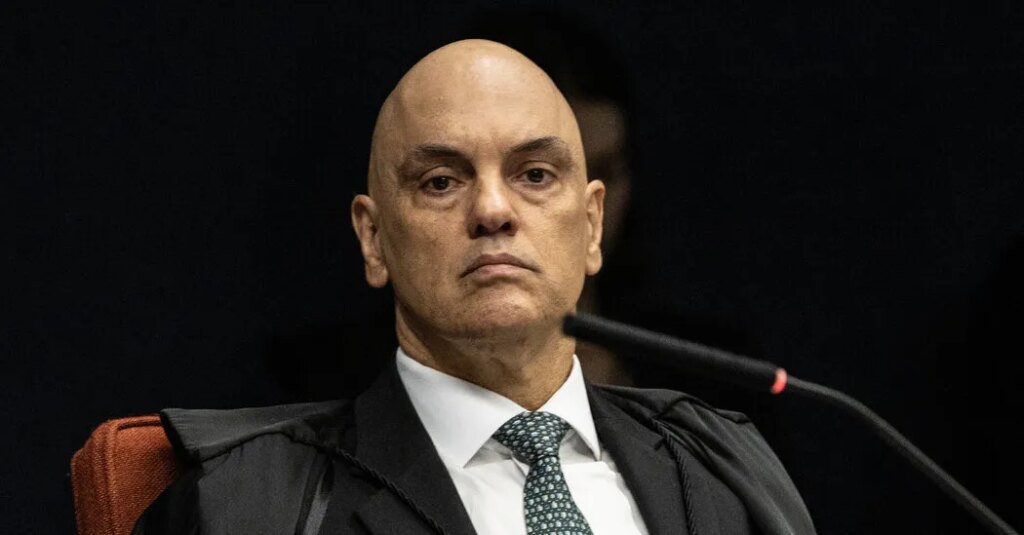
He cracked down on a deluge of online lies. He punished rioters falsely claiming a stolen election. And he jailed a former president who tried to stage a coup.
Depending on whom you ask, this made Supreme Court Justice Alexandre de Moraes either a hero who protected Brazil’s democracy or a villain deploying authoritarian means to target the far right.
His decisions have turned him into a polarizing figure in the complicated global debate over the limits and policing of what can be said online — and drew the ire, and sanctions, of President Trump.
Now, an explosive scandal linking Justice Moraes to a disgraced banker at the center of a multibillion dollar fraud scheme has plunged Brazil’s highest court into a crisis, reshaping a narrow presidential election just weeks away.
The crisis began when another justice made public a damning police dossier suggesting that Justice Moraes may have exchanged dozens of messages with the banker, Daniel Vorcaro.
In texts apparently sent to Justice Moraes, Mr. Vorcaro asked for help avoiding arrest. In other exchanges with associates, Mr. Vorcaro mentioned paying millions to a law firm run by the justice’s wife.
The police have not determined what Justice Moraes texted back or whether he aided Mr. Vorcaro in any way. But, overnight, the revelation has become a major electoral issue, outraging Brazilians and setting off calls to hold Justice Moraes and the Supreme Court accountable.
The scandal has also energized the Brazilian right, rallying support for the right-wing presidential candidate, Flávio Bolsonaro, because Justice Moraes jailed his father, Jair Bolsonaro, on charges of trying to retain power after losing the last election.
President Luiz Inácio Lula da Silva, a leftist, has been saddled with the fallout of an institutional crisis unfolding on his watch and blemishing the reputation of Justice Moraes, an important ally.
Flávio Bolsonaro, who is challenging Mr. Lula in next month’s vote, has rushed to link his rival to the justice at the center of the scandal. “To vote for Lula is to vote for Alexandre de Moraes,” Mr. Bolsonaro recently told a crowd of supporters.
“It gave Flávio’s campaign a simple slogan,” said Luciano da Ros, a Brazilian political scientist. “And it united different segments on the right around a powerful common enemy.”
The crisis engulfing the judiciary has provided another advantageous twist for Mr. Bolsonaro. It has eclipsed revelations that he himself is being investigated by the authorities for raising millions of dollars from Mr. Vorcaro to finance a biopic about his father.
Mr. Lula, eager to shield his campaign, has tried to distance himself from Justice Moraes. “Nobody is above the law,” he said in an interview, urging an investigation into the justice’s conduct.
Though he did not appoint Justice Moraes to the Supreme Court, Mr. Lula has lauded his tough stance aimed at protecting Brazil’s institutions. “I can assure you that Alexandre de Moraes is a serious person,” he told The New York Times last year. “I place full trust in the judiciary to do its job.”
During the last presidential election, Mr. Lula faced off against Mr. Bolsonaro’s father in a major test for the nation’s democracy. The judiciary, led by Justice Moraes, played a key role in defending the vote’s integrity and ensuring a peaceful transfer of power.
Now, ahead of another showdown between Mr. Lula and a Bolsonaro, the court may again be called on to play a defining role in an election, which could gauge whether the left can stop the right’s momentum in capturing presidencies in multiple Latin American countries.
“The court has revealed itself to be fragile,” said Thiago Amparo, a professor of law and human rights at the Getúlio Vargas Foundation, a Brazilian research institute. “And that makes it vulnerable to new challenges that may arise.”
An enemy of the right
Justice Moraes, who did not respond to a list of questions for this article, has not yet explained his relationship with Mr. Vorcaro.
Without offering evidence, he has suggested the documents implicating him may be the handiwork of foreign actors looking to meddle in the elections. And he has accused a colleague, appointed by the older Mr. Bolsonaro, of trying to sway the vote.
That justice, André Mendonça, has come under fire for sidestepping protocol to release the dossier implicating Justice Moraes, even as he kept secret for months a police investigation into Flávio Bolsonaro for potential corruption and money laundering.
Justice Mendonça, who did not reply to a request for comment, has rejected accusations of political bias in his handling of a sprawling fraud investigation involving Mr. Vorcaro that has ensnared a vast swath of Brazil’s elite.
As part of this investigation, the police seized Mr. Vorcaro’s cellphone and recovered over 50 messages suggesting he may have sought assistance from Justice Moraes to avoid investigation and, later, arrest.
Mr. Vorcaro also made reference in the dossier to payments made to a law firm partially owned by the justice’s wife, which he had hired to consult his bank in a contract worth more than $25 million. Digital data shows that Justice Moraes had edited that contract, according to the police.
Justice Moraes has drawn right-wing wrath by aggressively investigating, prosecuting and censoring anyone the court deemed a threat to Brazil’s democracy. Mr. Bolsonaro’s movement has been the prime target.
When Jair Bolsonaro and his allies attacked the integrity of Brazil’s voting machines, Justice Moraes ordered social media platforms to take down thousands of posts and accounts spreading baseless claims of fraud.
When Mr. Bolsonaro’s supporters stormed government buildings in January 2023, upset that he had lost and echoing his claims of a stolen election, Justice Moraes ordered the arrest of state security officials and sentenced rioters to years in prison.
And when the court’s investigation found Mr. Bolsonaro and his inner circle had planned a coup and plotted to assassinate Mr. Lula and Justice Moraes, the justice oversaw the trial, conviction and sentencing of the former president to 27 years in prison.
“With all the errors and successes typical of an institution made up of human beings, the Supreme Court has been, and will continue to be, a barrier against attempts to undermine the democratic rule of law,” Justice Moraes said at an event in 2023.
Yet in his quest to protect democracy, Justice Moraes has also jailed people without trial and censored online speech, with little transparency or room for appeal.
Justice Moraes and his defenders have claimed his actions were necessary in the face of an extraordinary threat to Brazil’s democracy. Others have argued his heavy-handed tactics represent their own antidemocratic threat.
Last year, that debate reached Washington: in an effort to help Mr. Bolsonaro avoid prison, President Trump targeted Justice Moraes with harsh sanctions. They were later lifted, though Mr. Bolsonaro’s allies are lobbying Washington to reinstate them.
A court in crisis
In Brazil, the revelations linking Justice Moraes to the banker have prompted calls for an investigation and even impeachment. And, among many Brazilians, they have raised questions about the health of a vital institution.
Supreme Court justices are nominated by Brazil’s president and approved by the Senate. While presidential appointments can influence the court’s ideological leaning, justices are meant to remain independent from other branches of government.
But, increasingly, the court has been seen as taking political sides.
For one, the court played a key role in Mr. Lula’s political comeback when it tossed out corruption convictions barring him from holding office, paving the way for his victory over Mr. Bolsonaro in 2022.
And when the court convicted Mr. Bolsonaro, it effectively made the nation’s most popular right-wing leader ineligible to run for office ever again.
Now the court itself has landed at the center of a political firestorm.
Under pressure, the court’s chief justice swiftly curbed the vast judicial powers that Justice Moraes employed for years to wage war on internet falsehoods. The court also held a dramatic session that transfixed the nation last week to decide whether to investigate Justice Moraes, an unprecedented move for the judiciary.
After hours of heated debate and finger-pointing, allies of Justice Moraes postponed the decision until after the elections.
Since then, new revelations have linked Mr. Vorcaro to other Supreme Court justices, including the justice now overseeing the nation’s electoral authority, deepening the crisis.
With Justice Moraes sidelined and public trust in tatters, experts worry the court may struggle to rebuff new attacks on Brazil’s institutions such as electoral meddling by the United States, A.I.-powered disinformation, or a contested vote if Mr. Bolsonaro loses.
Other, less assertive justices now at the helm are unlikely to be as “swift and decisive” as Justice Moraes, Mr. Ros said.
“This represents a fall from grace,” he added. “And that means every decision they make is more likely to be questioned.”
Thayz Guimarães and Alice Maciel contributed reporting from Brasília.
The post The High-Stakes Corruption Scandal Shaking Up Brazil’s Election appeared first on New York Times.