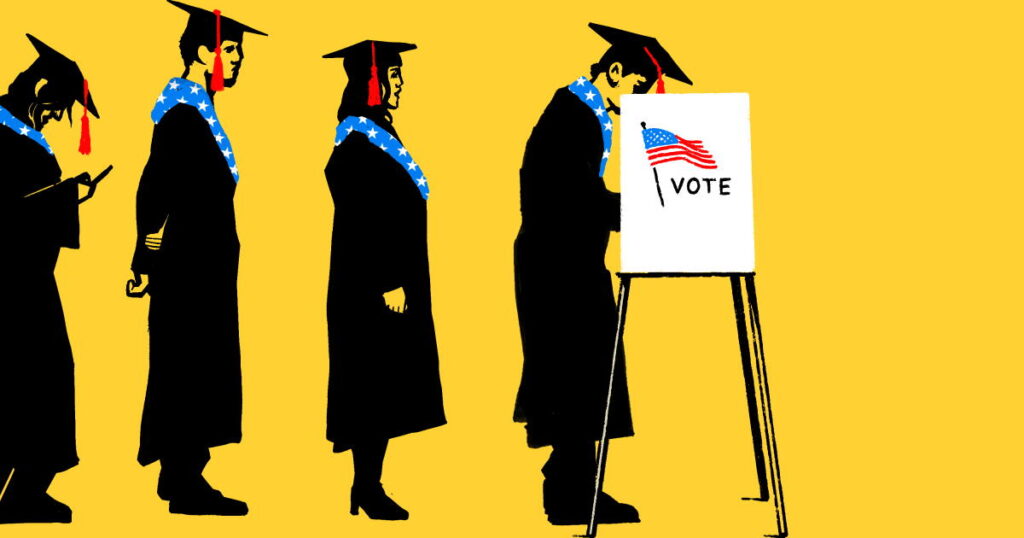
The ballots Californians cast, or fail to cast, this November will say more about the republic’s health than any of the 250th anniversary commemorations could.
Generation Z accounts for roughly 1 in 5 of the state’s eligible voters, yet its members register and turn out far below every older cohort: In the 2024 general election, 42.5% of eligible Californians ages 18 to 24 cast a ballot, compared with 62% of eligible voters overall. Likewise, the Sacramento Bee reported that 57% of California’s 18-year-olds are unregistered, a gap traceable in no small part to classrooms that never covered how to participate or why it matters. The generation with the largest stake in the future currently has the smallest say over it. (The deadline for Californians to register to vote in the Nov. 3 election is Oct. 19.)
The temptation is to read those numbers as indifference. The young Californians themselves tell a different story. This summer, Power California released a survey of 1,567 residents between the ages of 18 and 30, and the findings amount to a verdict on the institutions around them. Asked why their generation votes at lower rates, 40% of respondents said they believe nothing changes, and another 40% cited outright distrust of politicians.
Thirty-eight percent said they are simply too busy trying to survive — a claim the rest of the poll bears out, with 80% reporting that the cost of living is outpacing their wages and 71% enduring at least one concrete economic hardship in the past year.
Notably, the trust these young people still hold is close to home: They place far more confidence in parents, friends and local organizations than in parties or politicians. As Power California leader Saa’un Bell put it, “young voters aren’t losing hope, they’re losing patience.”
That distinction matters, because patience can be rebuilt, and the poll points to where. Young people’s remaining trust runs through the people they see every day, and no public institution places them alongside familiar adults and peers more reliably than school. The classroom, then, is where democracy should reintroduce itself.
Sacramento has two items on its to-do list: an immediate step that registers young voters before they leave high school, and a lasting investment in civic education that provides them with an understanding of why participating in our democracy is important, along with the civic skills necessary for this participation.
On registration, the Legislature has come close two years in a row recently to enacting legislation to ensure that every 11th grader learns the mechanics of preregistering to vote. The failure to sign this into law has a clear cost: the 57% unregistered rate among California’s 18-year-olds.
The deeper repair, the longer-term one, fared no better when proposed by a Republican and a Democrat in the state Senate.
None of this is confined to California. The state’s youth disengagement mirrors a national condition, with surveys of young Americans charting years of sliding trust in democracy. The erosion cuts deeper still: According to the Democratic Knowledge Project, 1 in 4 young Americans do not consider it important to choose leaders through free elections, and fewer than 30% of Americans under 40 consider it necessary to live in a democracy. Capitalizing on these trends, states and the Trump administration have rushed to restrict ballot access. The franchise, it turns out, is revocable, providing an argument for exercising and defending it, and for preparing the next generation to do both.
California could make itself the counterexample. While others restrict, California could guarantee that no student graduates without knowing how to register and why to vote, demonstrating national leadership in resisting democratic backsliding. Authoritarianism feeds on disengagement, and every 18-year-old who registers, votes and sees the system respond is one fewer citizen willing to shrug when someone proposes doing without elections.
Young Californians, your skepticism is understandable, but a ballot remains the most direct pressure a citizen can put on power — even more worth casting while forces elsewhere work to limit it. And legislators, bring these worthy bills back and see them through.
Members of Gen Z have explained exactly why their patience is wearing thin. The answer is already sitting in Sacramento’s files waiting to be enacted.
Conner Huey was a Fulbright scholar in the Netherlands researching education policy and democracy.
The post Young people aren’t voting. Sacramento knows how to change that appeared first on Los Angeles Times.