Oil prices and bond yields continued to rise on Thursday, a day after markets were jolted by a sharp sell-off in government debt.
Bond yields in Japan and Europe moved higher as investors remained wary of debt. Yields, or the interest paid on bonds, rise when their prices decline, indicating diminished investor demand.
The war in Iran, which has interrupted crucial supplies of energy from the Persian Gulf, has pushed energy prices higher and stoked inflation concerns. Central banks around the world have responded by raising benchmark short-term interest rates to slow growth and contain rising prices.
On Wednesday, a stronger-than-expected report on the American economy signaled that the economy was far from cooling, adding to inflation worries. That in turn spurred some bond yields to their highest levels in decades. The yield on the 10-year U.S. Treasury note, which underpins corporate and consumer borrowing across the globe, recorded its biggest one-day jump since last year. The five-year Treasury yield rose above 5 percent, to its highest since 2007. Stocks followed with declines.
Policymakers at central banks are scrambling to catch up as the market drives bond yields higher. Last week, the Federal Reserve raised rates a quarter of a percentage point, to a range of 3.75 to 4 percent, citing the need to counter inflation. It was the first increase in rates in more than three years. Central banks in Japan and Europe also raised rates this month.
While higher yields can signal economic strength, they make it more expensive for businesses and consumers to borrow money. The rates of mortgages are particularly sensitive to the increase in certain bond yields. A benchmark of mortgage rates in the United States is approaching 7 percent, a level not seen in nearly two years.
Oil prices jump.
-
The price of Brent crude, the global benchmark for oil, rose over 2 percent, to about $105 a barrel on Thursday. The Brent price had fallen below $100 on Tuesday.
-
West Texas Intermediate crude, the U.S. benchmark, was trading around $94 a barrel.
-
Ship operators in the Persian Gulf remain wary of sending vessels through the Strait of Hormuz, the vital waterway between Iran and Oman. Advances by the Iranian-backed Houthi militia in Yemen have threatened oil shipments through the Red Sea, an alternative route to the Persian Gulf used by Saudi Arabia to get oil out to global markets. Saudi authorities had to temporarily shut the critical East-West pipeline that shuttles oil from the Persian Gulf to the Red Sea, blaming a drone attack by an Iranian-backed Iraqi militia.
Stocks edge down.
-
Futures on the S&P 500 pointed to a decline of about half a percentage point when stocks resume trading in the United States on Thursday.
-
Stocks in Asia were mostly down, with stocks in China among the worst performers.
-
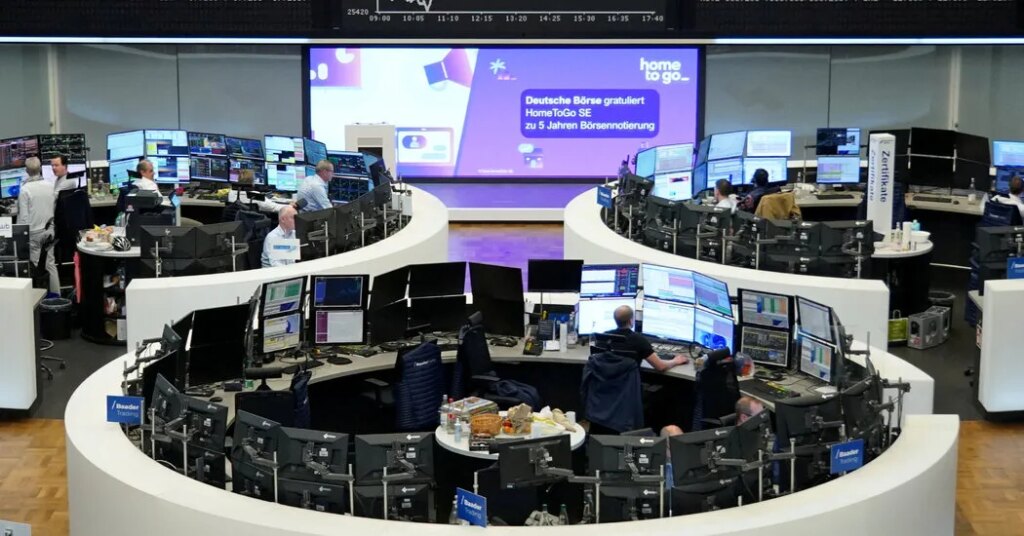
In Europe, the Stoxx 600, a broad-index that tracks the region’s largest companies, was trading lower.
Gasoline prices tick up slightly.
-
U.S. gasoline prices were at a national average of $4.48 a gallon on Thursday, about a cent more than the day before, according to the AAA motor club. The cost of gas for drivers has risen by 50 percent since the war began.
-
Gas prices don’t move in lock step with crude, usually trailing increases or drops by a few days.
-
The average price of diesel was little changed on Thursday, at $6.51. Diesel, which is used by farmers and other businesses to power trucks and equipment, has surged 73 percent since the start of the war in Iran to its highest level.
What they are saying: Higher bond yields are stressing eurozone governments
-
Higher bond yields are likely to weigh heavily on European governments, which already have strained budgets, according to a note by Oxford Economics, a forecasting and advisory firm.
-
The rise is likely to be temporary, according to the note, but may require governments to tighten budgets in the future, including by raising taxes and cutting spending.
The post Oil Prices Rise and Bond Markets Remain on Edge appeared first on New York Times.