In today’s edition … the best season … a plan to slash diesel prices … but first …
Could this Republican candidate weigh down others in Pennsylvania?
Pennsylvania Republicans are starting to worry that the state’s lopsided race for governor is directly affecting four of the nation’s most competitive House races.
Pennsylvania is the definition of a battleground state. Voters there have correctly picked the presidential winner since 2008. Democrats hold a narrow 200,000 edge in voter registration. And Pennsylvania races are often decided by notably thin margins.
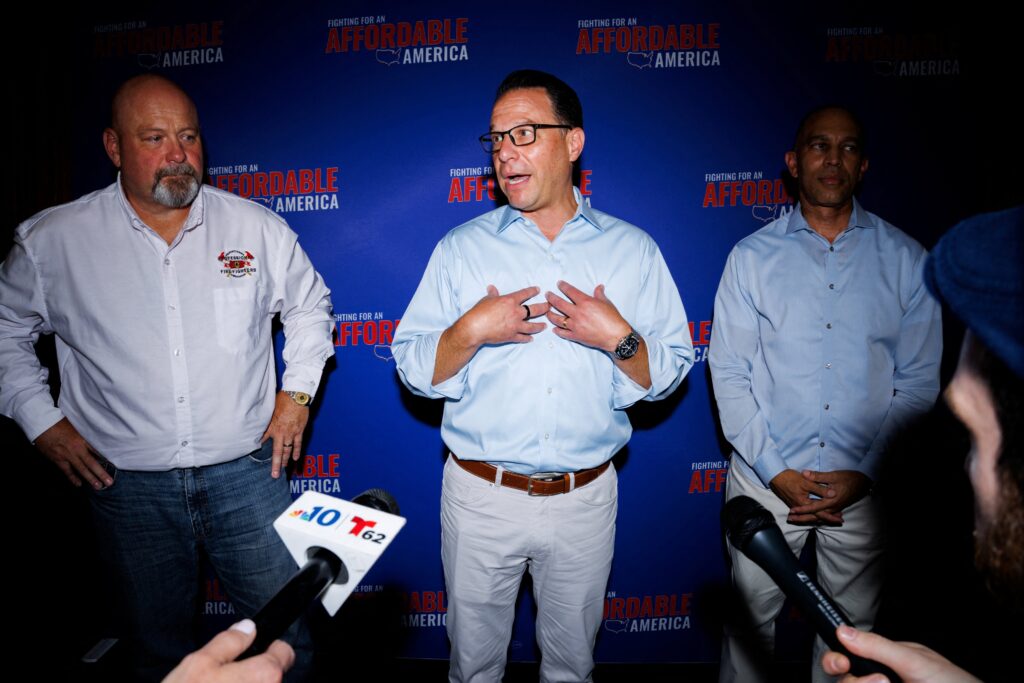
But Democratic Gov. Josh Shapiro’s run for reelection against Republican state treasurer Stacy Garrity has been an outright romp so far.
Every poll has shown Shapiro with a large lead, some approaching 30 percentage points. The Democratic governor outraised Garrity by $11.5 million this summer, bringing in $13 million compared to Garrity’s $1.8 million. And Shapiro’s campaign, according to ad tracker AdImpact, has either spent or plans to spend nearly $28 million on ads in the state, dwarfing the $750,000 Garrity has either spent or reserved.
That is a mercy-rule level of campaign disparity, even though Garrity was seen earlier in this campaign as a top-level recruit because she won 3.5 million votes in 2024 when she ran for reelection as treasurer. And while it seems increasingly likely that Shapiro will have four more years as governor, Republicans are concerned that Garrity’s struggling campaign could weigh down other Republicans on the ballot.
“Maybe Garrity’s strategy is to run such an uninspiring campaign that the race is so much of an ass-kicking that Democrats don’t feel the urgency to turn out on Election Day,” quipped a Republican strategist who has worked on statewide races in the state and was granted anonymity to speak frankly about his concerns.
Neither a Garrity spokesperson nor a spokesperson for the Republican Governors Association responded to our requests for comment.
As we have written about before in this newsletter, races in Pennsylvania could decide control of the House next year. The four races to watch are:
- PA-10: Former TV anchor Janelle Stelson, a Democrat, is running to oust incumbent Republican Rep. Scott Perry in a district spanning central Pennsylvania. The race is a pure toss-up, and polls show it is tight.
- PA-8: Scranton Mayor Paige Cognetti (D) is running against freshman Rep. Rob Bresnahan (R) in a Northeast Pennsylvania district that typifies Pennsylvania’s battleground status.
- PA-7: Firefighter Bob Brooks (D) is looking to unseat freshman Rep. Ryan Mackenzie (R) in the Leigh Valley. The race is a toss-up and will undoubtedly be close. Mackenzie won in 2024 by the narrowest margin in the state.
- PA-1: Rep. Brian Fitzpatrick, a consistently vulnerable Republican in suburban Philadelphia, is running for reelection against Democrat Bob Harvie. Fitzpatrick has broken with President Donald Trump a few times to burnish his more independent credentials in the race. Nonpartisan prognosticators have this race as the least competitive of the four Pennsylvania battlegrounds.
Sam Reposa, a spokesperson for Shapiro’s campaign, said the governor “is leading the fight to win these critical races, flip the House, and put a check on Donald Trump.”
Garrity is atop the ballot for all these Republicans this year. So a struggling Republican campaign will require downballot Republicans — including Perry, Bresnahan, Mackenzie and Fitzpatrick — to find enough crossover Shapiro voters to defy the downward pressure Garrity is putting on their campaigns.
It’s certainly possible. In 2022, Shapiro faced an equally anemic campaign from Pennsylvania state Sen. Doug Mastriano and won his first term by 15 percentage points. But Republicans like Fitzpatrick and Perry both held their districts.
Sam Chen, a Republican strategist in the state, said that while Garrity has “not run a good campaign” and is “going to lose,” Pennsylvania voters in these battleground districts are known for ticket-splitting, and that could help downballot. Chen argued that Trump, who is deeply unpopular nationwide, is the biggest drag on Republicans in the state.
“What is going to hurt the downballot is the president, and specifically that he is not on the ballot,” Chen said. “The president does this weird thing: When he is on the ballot, he has his own secret sauce. … When he is not on the ballot, it is like his baggage is on the ballot and his coattails are not.”
The Shapiro money may be the real difference here.
To date, Shapiro has transferred nearly $6 million from his campaign account to Democrats’ coordinated campaign in Pennsylvania — allowing the party to use that money to boost candidates like the four Democrats in these House races and state legislative candidates who Shapiro hopes will deliver him control of both the state Senate, which is currently controlled by Republicans, and the state’s House of Representatives.
Then there is the 2028 of it all. Shapiro has been coy about his presidential ambitions, simply saying he will “be a part of that conversation” about who Democrats should nominate for president. But, as we have written in this newsletter, significant wins in Pennsylvania in 2026 will be a notably powerful springboard for Shapiro if he runs in 2028.
“Governor Shapiro seems to understand the importance of showing the country that Democrats can both win and govern, which is a huge hurdle for improving the Democratic brand nationally ahead of 2028,” said J.J. Abbott, a Democratic strategist in Pennsylvania, who argued that wins this November could help cast him as a bulwark to Trump and deliver him real power to get things done in the state. “There’s no better state to do that in PA, the largest and most visible battleground state.”
Want this in your inbox?
Start your day with The Washington Post’s flagship political newsletter. Sign up here.
From across the newsroom
- Asylum seekers thought they had a haven in the U.S. Then Trump returned, from Ted Hesson.
- On the campaign trail with Pete Buttigieg as he weighs another presidential run, from Erin Cox.
- Trump gives Xi Jinping rare airport welcome as summit visit begins, from Cat Zakrzewski and Michael Birnbaum.
- Hacking group claims to have stolen thousands of FBI employee records, from Jeremy Roebuck.
- Camp Mystic owners face homicide investigation over flooding deaths, from Molly Hennessy-Fiske.
- Troy Jackson isn’t polished. In Maine, that may be the point, from Ian Ward.
- Iran’s president tells U.N. his country ‘must be powerful so as to avoid being threatened’, from Susannah George and John Hudson.
What I’m watching
Republicans have recently coalesced around a response to record diesel prices and the political problems those prices have caused: a ban on diesel exports.
But is this good policy? Many experts say no.
That is the topic of a great new piece by my colleagues Rachel Lerman and Federica Cocco, who reported yesterday that “economists and oil experts say the plan could backfire — and lead to higher costs at the pump for Americans.”
The thinking is pretty simple: The United States is the largest exporter of diesel, producing 1.4 million barrels of distillate fuel a day that largely goes to Latin America and Europe. A ban would imperil allies and likely push domestic refineries to cut production, decisions that may initially lead to lower prices but would, over time, likely lead to higher diesel prices.
“It’s very, very temporary,” Debnil Chowdhury, head of Americas and Europe fuels and refining at S&P Global Energy, told my colleagues. “It would lead to higher gasoline prices for everyone.”
The political reality here is that Republicans need something they can say when pressed on sky-high diesel prices caused by the war with Iran that Trump has pursued. And putting American consumers ahead of allies in Latin America and Europe fits with broader Republican messaging on energy independence.
Senate Majority Leader John Thune (R-South Dakota) said the Senate is looking at any proposal that is a “viable solution” to bring down prices.
“If that [export ban] would take pressure off of prices, you know, I’m open to exploring it,” he told reporters last week.
But this idea, as Rachel and Federica say, is more of a short-term salve than a long-term fix. Their full piece is worth your time.
In your local paper
Washington State Standard: Washington began offering electric truck vouchers five months ago. So far, small businesses have been slow to take up the program.
Seven Days (Vermont): Interested in a free bridge? This is not a joke; the historic Burlington-Winooski Bridge was posted on Craigslist — for free.
Missouri Independent: Third time’s a charm? Proponents of a partisan redistricting effort in Missouri are seeking to go back to the Supreme Court. A key issue is that ballots using the 2022 map have already been printed and mailed and early voting has begun.
From you
I asked what the best season is. My answer first: Fall. Full stop.
And it seems like many of you agree!
“Lawn and garden chores are diminishing. Coolness in the air is a great respite to summer’s heat, a welcome treat to sleeping without AC and a harbinger of and preparation for the cold of winter,” wrote Dale Marchand.
“Fall by far,” added Jim Sefcik.
Some of you said summer.
“Summer harvest of apples and pears for cider, quince to bake with lamb, honey from my bees, and watching the kiwi in the front yard grow larger in anticipation of their November harvest. Plus enough warm days to enjoy and chill rains to bring you back to reality,” wrote William Warwick.
And while a few wrote in spring — allergies be damned — only one person said winter.
“I like snow, ice hockey, mulled cider, football, clean crisp mountain air, a fire in the fireplace and snuggling,” said Bob Miller. “And I get to wear an extra layer of clothing for warmth and to hide the weight I might have put on from too many sweets!”
Send a reply
Not to look to the next election, but the shadow campaign for who Democrats will nominate in 2028 is heating up. Kentucky Gov. Andy Beshear hinted that he is eyeing the White House at an event with Maryland Gov. Wes Moore earlier this week. Two questions: Who would you like to see as the Democratic presidential nominee in 2028? And who do you think will be the nominee? Let me and your fellow Early Brief readers know at [email protected].
Thanks for reading. You can follow me on X at @merica.
The post One Republican could hold back the party’s candidates in Pennsylvania. And it’s not Trump. appeared first on Washington Post.