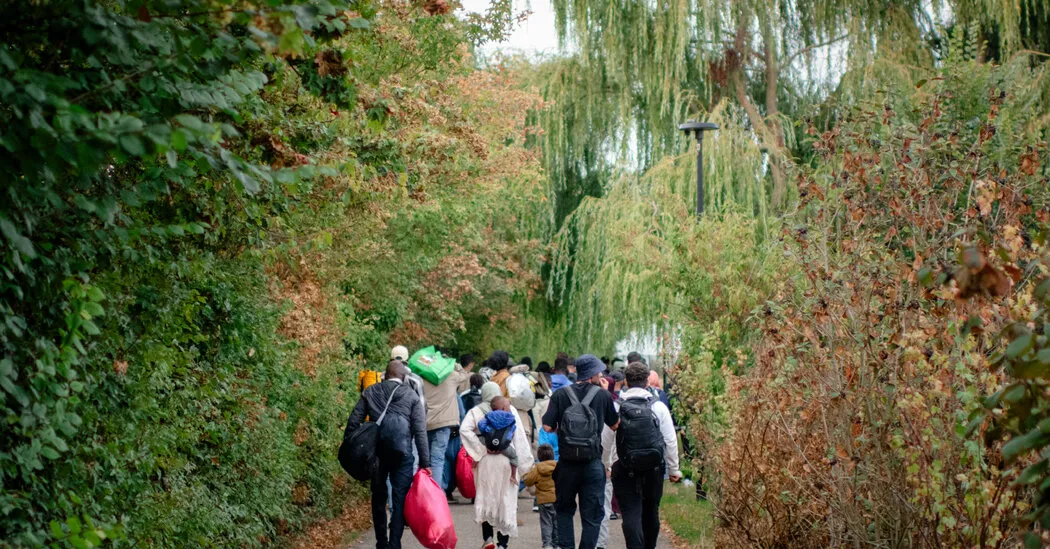
On a warm, windless evening last month, some 40 African migrants gathered at a bus stop in Dunkirk, on the northern coast of France. Many carried plastic bags stuffed with life jackets. One couple with young children struggled to push a stroller, before leaving it at the side of the road.
They had come from a rundown camp on the city’s industrial outskirts and were making their way to one of Dunkirk’s beaches, famous as the place where nearly a century earlier, an armada of small boats helped British troops escape the advancing Nazis.
These migrants, too, were desperate to catch a small boat to cross the English Channel.
But on this night, their journey stopped short of the water’s edge. Near the shore, they were surrounded by the police after taking shelter in an agricultural greenhouse. They huddled in the darkness for hours, but were deterred by more officers on the beach and unable to reach the sea.
This cat-and-mouse game, so routine that local residents scarcely notice it, is the latest front in a decades-long struggle between the French authorities and migrants. Since the 1990s, illegal crossings of the channel have become a chronic political challenge in Britain and a recurring source of tension between London and Paris.
There are signs that new cross-border policing efforts to curb this clandestine flow are working. The number of people arriving on small boats was down 43 percent through August of this year compared with the same period in 2025, to 16,500 from roughly 29,000, according to data recorded by the British government. Some of that, French officials said, is thanks to the heightened police presence on France’s side, a deployment that is funded largely with British money.
“The strengthening of Franco-British cooperation, relaunched on the fight against irregular immigration in the North, is bearing fruit,” France’s interior minister, Laurent Nuñez, wrote on social media last month.
And yet, the day after the migrants in Dunkirk were thwarted, nearly 500 others landed in England in small boats. Several who could not clamber onto the vessels had to be rescued. A day later, a man died during a failed crossing. And migration levels, though much lower than last year, are still far higher than before the pandemic.
The numbers illustrate a complex truth. Increased law enforcement often reduces migration, but rarely ends it entirely. Other factors — such as the weather, hostility toward asylum seekers elsewhere in Europe and the pace of foreign conflicts — mean that pipelines like the channel cannot be blocked by border guards alone, according to immigration experts.
Aggressive policing also encourages human traffickers, who charge each migrant several thousand euros per crossing, to find new ways to evade the police. In France, it has prompted them to use different beaches and deploy “water taxis,” which sail down the coast, picking up passengers who wade into the surf, where it is harder for the police to intercept them.
Elsa Faucillon, a French lawmaker who compiled a critical report on the history of British-French initiatives to stop cross-channel migration, acknowledged the decline in numbers. But she argued that the increased French patrols made the crossings “more dangerous.”
“People will try to go back — sometimes eight times, sometimes 10 times — and they will end up getting there,” she said. “Or they will end up dying.” Mr. Nuñez, the interior minister, said in Parliament this summer that said the police’s priority was to “save human lives” by preventing people from entering the water.
Hafez Abdul knows the perils of repeat efforts. A 23-year-old from Eritrea, in eastern Africa, Mr. Abdul escaped death narrowly last month on his third attempted channel crossing, when an inflatable boat carrying him and more than 160 other migrants caught fire. It put a spotlight on the smugglers’ growing use of so-called mega-boats, which carry many more passengers than the boats they previously used.
“It was terrifying, and I swore it was the last time I tried to cross,” Mr. Abdul said in an interview.
Having fled Eritrea to avoid conscription, he said, Mr. Abdul crossed Sudan before flying to Russia and then voyaged across Belarus, Latvia and Belgium, ending up in France. He said he applied for asylum there, but his application was rejected. Under European Union law, Mr. Abdul should have stayed and applied for asylum in the country where he first entered the bloc, Latvia.
Now, Mr. Abdul fears being deported back to Latvia — hence his desire to reach Britain, which is not part of the European Union.
“I want nothing but security, stability and protection,” he said.
Like many in his situation, Mr. Abdul was whiling away the afternoon at a shelter operated by a Catholic charity group, Secours Catholique, where he could charge his phone, get some food and kick a soccer ball with friends. Up to 800 people come in every day, most young men fleeing the Sudanese civil war, according to the center’s manager, Léa Biteau.
Many have stories similar to Mr. Abdul’s. But a new profile has emerged in recent months, according to Ms. Biteau: people who were granted temporary asylum in Germany and started a new life there several years ago, but whose asylum was not renewed. Migrant children can be heard speaking German, even as their parents speak Arabic.
For Mr. Abdul and more than 2,000 others in dingy camps along the French coast, Britain has become a country of last resort. Some foreigners think it will be easier to stay on British soil because Britain left the European Union and cannot easily deport scores of migrants to E.U. countries.
Still, as migration roils Britain’s politics, the country has cracked down as well. The government has pledged nearly $900 million to subsidize patrols on French beaches until 2029. And it has cut grants of asylum, from a high of 76 percent of applicants in 2022 to just 42 percent last year.
Among those whose application was denied was Muhannad Ali, 42, a Libyan who said he left his country in 2023. Mr. Ali passed through Tunisia and flew to the Netherlands before reaching France. Then he headed to Britain, where, he said, he was disappointed by the lack of economic opportunity.
Mr. Ali said he left voluntarily. But he would have been a candidate to be deported back to France through a “one in, one out” agreement between London and Paris. Under the deal, Britain is allowed to return a migrant who crossed the channel illegally in exchange for a migrant in France who has applied to enter legally.
Britain’s hope is that the arrangement will make migrants think twice about crossing covertly, which, in turn, might calm passions in the country, where media coverage of channel crossings reliably stirs voter anger.
“If a significant share of those people were returned to France swiftly, theoretically, people would not get into a boat,” said Mihnea Cuibus, a migration expert at the University of Oxford. “In practice, it’s more difficult.”
Conditions to apply from French soil are extremely restrictive. Applicants must have identification documents, which many have misplaced while journeying to Europe. They must carry cellphones and be ready to answer a call from officials at any time, over three months.
By September, more than 1,400 people had been returned to France under the policy — a fraction of the more than 41,000 people who reached Britain after crossing the channel last year. (Tens of thousands of other immigrants are deported annually to other countries.)
Such numbers are a powerful weapon in the hands of British and French far-right leaders. Jordan Bardella, the president of the French far-right party, the National Rally, was a star attraction at a recent conference of Reform U.K. To cheers, Mr. Bardella vowed that if his party gained power, it would “ensure that France is no longer the gateway for illegal migration into the United Kingdom.”
France, however, will have to overcome a resilient adversary: the smugglers. In addition to “water taxis,” smugglers now use boats capable of carrying more passengers than before. The average number of people per boat is 65, up from 26 in 2021, according to the French maritime authorities.
Régis Holy, the head of the Calais branch of the Sauveteurs en Mer, a private rescue service, said his crew, which can rescue up to 80 people, recently monitored a boat carrying 230, the most that they had ever encountered.
Departures used to be concentrated on beaches in Calais. Now they happen all along France’s northwestern coast, and increasingly from Belgium.
“If we really wanted to prevent migrants from crossing, we’d have to station police every 100 meters along the coast,” said Nicolas Laroye, a police union representative who spent more than a decade patrolling the border. That would require 15,000 officers, or about 10 percent of France’s national police, he said, adding, “That’s not possible.”
Nor would it fix the underlying conundrum: France can prevent migrants from leaving, but it also does not want them to stay.
Bushra Alzoubi contributed reporting.
The post Inside France’s Push to Stop Migrant Boats to Britain appeared first on New York Times.