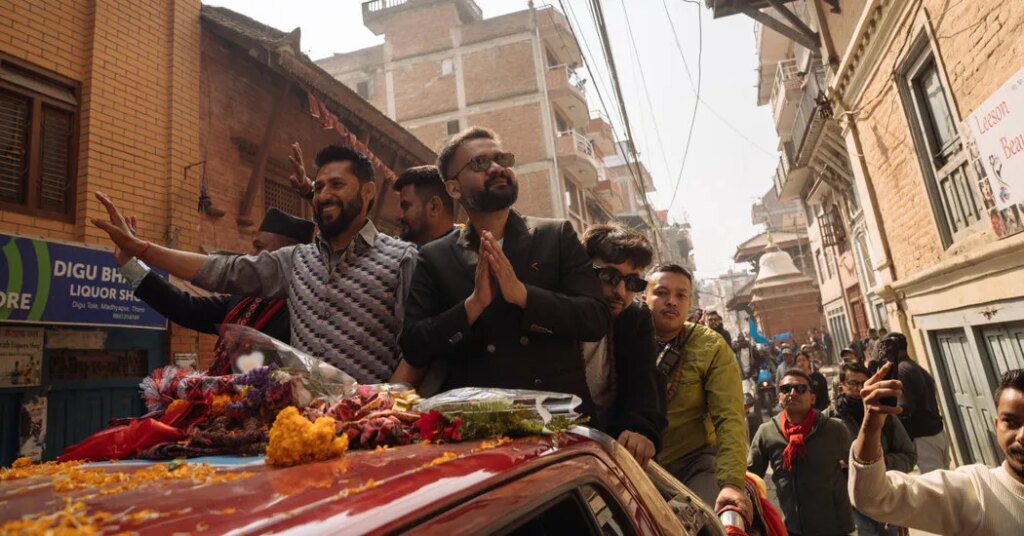
He hides behind dark sunglasses, skips Parliament meetings and communicates mostly through social media posts. But in his six months in office, Balendra Shah, the 36-year-old prime minister of Nepal, has transformed into an avatar of politically engaged youth worldwide.
On his first trip overseas since taking office in March, Mr. Shah will address the United Nations General Assembly on an issue vital for many young people: climate reparations. Low-income countries have been battered by the effects of a global warming not of their own making. Last month, floods in Nepal caused by a glacial collapse left thousands of people dead or missing. Some scientists believe the deluge was exacerbated by climate change, and in his speech on Thursday, Mr. Shah is planning to ask heavy industrial polluters to pay up, his advisers said.
“We believe that we can be the voice of not just the Nepali young people, but of young people of the world,” Nepal’s foreign minister, Shisir Khanal, who is accompanying Mr. Shah to New York, said in an interview last week in Kathmandu, the capital.
Mr. Shah, an engineer and poet-rapper who supplied the soundtrack to his own electoral campaign, was propelled to power by overeducated and underemployed young Nepalis who felt that their futures were being stolen by an arrogant and corrupt elite. They seized on Instagram posts by politicians’ families, dripping in luxury, while so many Nepalis worked overseas to survive.
Mr. Shah, popularly known as Balen, rapped about these frustrations. He railed against foreign banks, imperial powers and “predatory leaders.” He was elected mayor of Kathmandu in 2022.
“No stash of big cash, still I don’t fake it,” went the lyrics to one of his songs. “Underrated but understood by undereducated.”
In September 2025, the anger of Nepali youth coalesced on the streets and turned to fury when security forces shot dead young protesters. They unseated Nepal’s political old guard in just two days. Similar Gen Z movements echoed worldwide, but most did not spark a revolution.
Mr. Shah’s critics — and their ranks now include members of Nepal’s Gen Z — whisper that his political mind-set skews more dictatorial than democratic.
As Kathmandu mayor, he cleaned up the city at the expense of vulnerable residents. Since becoming prime minister, he has kept decision-making in a tight circle, leaving some cabinet ministers out of the loop. In an interview, Sushila Karki, the caretaker prime minister who preceded Mr. Shah, said she was worried about the independence of the judiciary. Members of the news media and civil society say they feel threatened.
“People right now are living in a culture of fear because of the prime minister and his people,” said Om Prakash Aryal, a veteran human rights lawyer and a rare critic willing to speak up.
In the interim government that followed the Gen Z revolution, Mr. Aryal served as home minister, in charge of policing and internal security. Before that, he provided legal advice to Mr. Shah as mayor.
“We are living under the rule of one man,” Mr. Aryal said. “One man in sunglasses.”
Binod Ghimire and Sajal Pradhan contributed reporting.
The post From a Nepal in Pain, a Young Leader Makes a Case for Climate Reparations appeared first on New York Times.