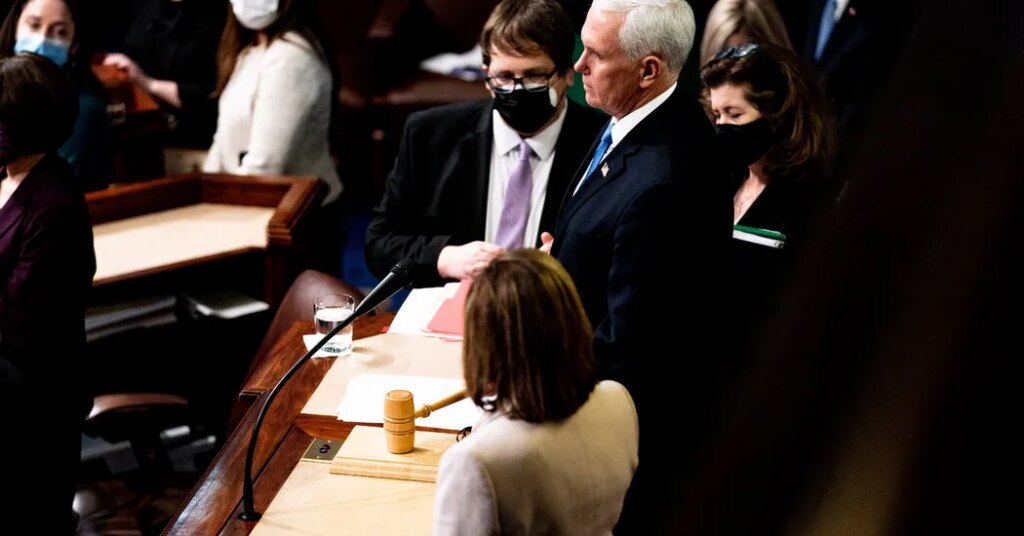
In a previously secret opinion unsealed on Wednesday, two appeals court judges said in April 2023 that Donald J. Trump’s attempt to block a subpoena seeking testimony from former Vice President Mike Pence about Mr. Trump’s efforts to subvert the 2020 election lacked “grounding in the Constitution, the founders’ constitutional design or settled precedent.”
A third judge, dissenting, wanted to allow the legal fight to play out, noting that the case was “the first in American history to compel disclosure” of such interactions. But the majority decision cleared the way for Mr. Pence’s testimony to a grand jury the next day, aspects of which were cited in an eventual indictment.
The opinions were among nearly 600 pages of material about the federal investigations into Mr. Trump made public by the Court of Appeals for the District of Columbia. The disclosure came a day after the House Judiciary Committee released more than 500 pages of transcribed interviews with people who worked for Jack Smith, the special counsel who led the inquiries into Mr. Trump.
The materials add to the public understanding of the investigation that led to Mr. Trump’s indictment for trying to overturn the results of the 2020 election. Some of the records also concern the investigation that led to charges against him for keeping classified documents after he left office and obstructing efforts to retrieve them.
While it was known at the time that Mr. Trump unsuccessfully sought to block the testimony of his former aides and Mr. Pence, the unsealed materials shed new light on the arguments made by Mr. Trump’s lawyers, and on how the courts rejected them.
The court documents were the latest set to be made public from Mr. Trump’s efforts to invoke executive and attorney-client privilege to block subpoenas for testimony from former White House officials. The closed-door fights were ultimately unsuccessful, but helped delay the investigations by months. Neither indictment reached a trial before Mr. Trump won the 2024 election, which effectively scuttled the prosecutorial efforts.
Earlier files from those fights at the Federal District Court level, where they played out before two successive chief judges, Beryl A. Howell and James E. Boasberg, became public after litigation by The New York Times and Politico. A Times reporter then asked the federal appeals court to unseal similar materials, and the Justice Department agreed to make them public.
In most cases, appeals court panels simply denied Mr. Trump’s emergency appeals of district court orders that required various former officials to comply with subpoenas. After witnesses testified, the appeals court judges dismissed the matters as moot.
But the litigation over Mr. Pence — his name is redacted, but the discussion and timing indicate that the case concerned the subpoena to the former vice president — generated more extensive judicial analysis.
In the majority opinion, issued as an unsigned, 10-page order, Judges Patricia A. Millett and Robert L. Wilkins, both Obama appointees, resisted Mr. Trump’s attempt to block Mr. Pence’s testimony by invoking national security, among other things.
They were not persuaded by Mr. Trump’s attempt to stretch a Nixon-era precedent affording strong secrecy protections to a president’s military deliberations. They also said Mr. Trump’s deliberations over the election were protected only by “qualified,” not “absolute,” immunity from disclosure. That protection was overcome by the need for evidence about crimes leading to the Jan. 6, 2021, Capitol riot, which they called an attack “on the peaceful transfer of power.”
The third judge on the panel, Gregory G. Katsas, a Trump appointee and former Trump White House lawyer, dissented. While he agreed that Mr. Trump’s invocation of national security was invalid, he said he would have delayed the testimony to allow for Mr. Trump to litigate more fully the novel question of how much protection from disclosure communications between a president and vice president should receive.
The materials released by the House Judiciary Committee this week were part of a Republican-led investigation scrutinizing the Justice Department’s inquiry into Mr. Trump’s effort to overturn the election. Attorney General Merrick B. Garland appointed Mr. Smith to take over the investigation as special counsel in November 2022 because Mr. Trump had announced that he was running for president again.
Republicans have complained that department investigators, both before and after Mr. Smith took over, subpoenaed phone companies for toll records — logs showing which calls were made, but not their contents — from phones used by several Republican lawmakers Mr. Trump or his proxies had contacted as part of an effort to get them to reject Joseph R. Biden Jr.’s Electoral College victory.
Investigators did not notify the lawmakers that they were seeking the records, and obtained judicial nondisclosure orders that barred the phone companies from doing so. As court filings made public in July confirmed, investigators did not tell the court that the numbers belonged to lawmakers, a disclosure that department policy did not then require. Mr. Garland changed that policy in 2024.
Republicans have complained that this maneuver prevented the lawmakers from asking a court to quash the subpoenas. They have argued that the Constitution’s so-called speech or debate clause, which shields lawmakers from being prosecuted about or forced to testify about legislative activity, protected the records. The Supreme Court has never ruled on whether the clause extends to barring subpoenas to phone companies for call data.
Previously released materials show that Mr. Smith’s team obtained permission from the Justice Department’s public integrity section for the subpoenas. In the transcripts, Molly Gaston, one of Mr. Smith’s aides, said the Justice Department interpreted the immunity that comes from the clause as not applying to the phone data because Mr. Smith was not trying to charge lawmakers.
The section’s advice was that “the use immunity that exists when seeking to use speech or debate clause-protected material against a member doesn’t exist because we would not be using materials against these members,” she said.
The post Newly Public Documents Shed New Light on Trump Investigations appeared first on New York Times.