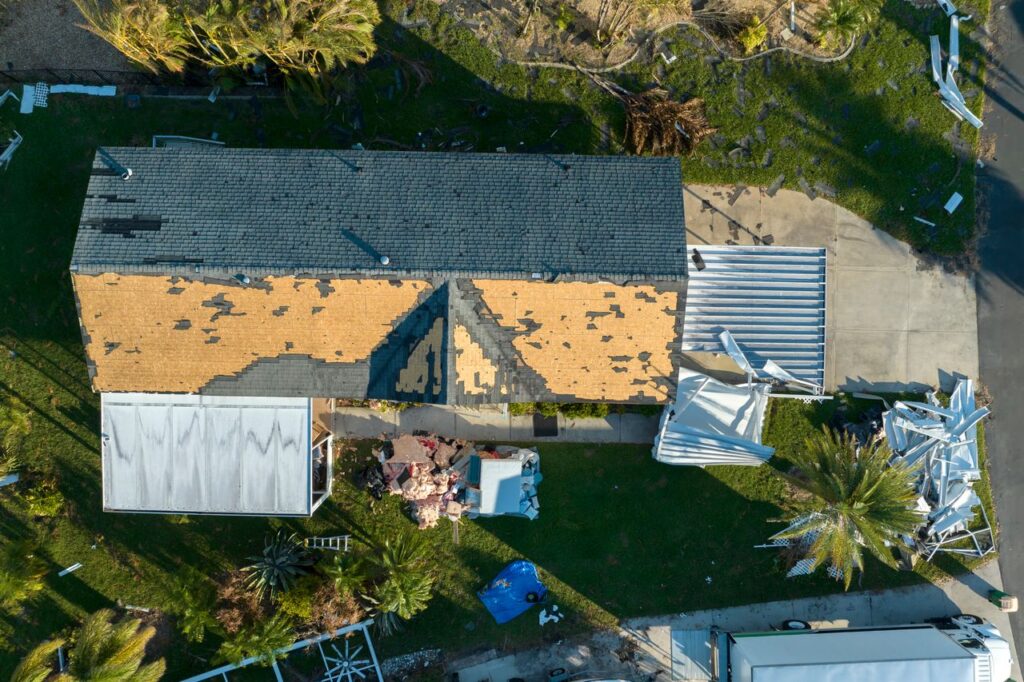
The scars left on houses look like shotgun blasts, sometimes. In the aftermath of major storms, Andrew Shick, owner and chief executive of Illinois-based firm Roofing USA, has driven through suburbs blasted by hail and been left stunned by the damage.
Earlier this year, he visited a farm complex in western Illinois where roofs, even sturdy metal ones, were left pockmarked and perforated after 3-inch balls of ice fell from the sky. “It was nuts,” he recalls. There were baseball-sized holes in the lawn, even. “I’d never seen that before.”
Shick has been in the roofing business for several years now. He says it feels to him as though hailstorms are getting worse. Certainly, the damage caused by hail is increasingly expensive to repair, thanks to inflation. Insurers are adjusting their policies to require higher deductibles from those affected by hail damage. “A lot of the customers that I’m running into have had no idea that their policies changed—until hail hits their roof,” says Shick.
There’s no denying that hail is getting really, really expensive. In 2024, hail damage in the US cost more than damage from hurricanes and floods put together. That year, hail-related expenses were estimated to have reached well into the tens of billions of dollars, probably around $40 billion. Just 15 years ago, the annual cost of hail damage was less than $1 billion, says Tanya Brown-Giammanco, director of disaster and failure studies at NIST, a nonregulatory agency that works on standards and benchmarks for a wide range of products. On top of the inflation problem, more people are moving to hail-prone areas of the US.
Hail forms when currents of rising air in thunderstorms carry raindrops upwards to chilly parts of the storm, where they freeze. The pellets then grow as they come into contact with more moisture, which freezes on their surface. When they get too heavy to be held up by the air, they fall as hailstones.
While data suggests that severe hailstorms have become more frequent in the US in recent years, no one is quite sure if or how climate change will affect hail going forward. And there’s still a surprising amount we don’t know about hail and how it falls through the air. Companies increasingly market hail-resistant roofing products because homeowners are under rising pressure to harden their properties against these meteorological bombardments. But when hailstones the size of your fist are raining down on your roof, is there anything you can do to save it?
Most people would despair if giant hail pummeled their home. Not Becky Adams-Selin. Last summer, 3-inch wide stones smashed into her property in Nebraska, damaging the roof. As soon as the storm was over, Adams-Selin, principal scientist at Atmospheric and Environmental Research, a research company, raced outside to gather up samples. She still has some of the stones she collected in her freezer. “I was like, ‘I’ve got more data!’” she says.
Adams-Selin is one of the principal investigators on ICECHIP, a major project to study hail in the wild, which brought together multiple organizations and universities. Earlier this year, she and her colleagues observed nearly 20 hailstorms during fieldwork across the Central Plains and Front Range regions of the US. The team measured thousands of hailstones—the biggest being an oblong-shaped behemoth weighing 364.5 grams and measuring 6 inches across at its widest point. It fell out of a storm that, just 30 minutes earlier, was producing pea-sized hail.
Adams-Selin says that the shape of hailstones can vary widely, especially for the larger ones. And scientists aren’t sure exactly how fast hail falls, or how it tumbles as it plummets towards the ground. “We still don’t know how to forecast 2-inch hail more than a day in advance,” says Adams-Selin. Plus, weather radar can struggle to distinguish between hailstones once they get to a certain size. For example, people might have little means of knowing whether the hail heading their way will be 2 inches or 5 inches in diameter—a big difference in terms of its potential to cause damage.
Most of all, there is significant uncertainty as to what climate change means for hail. Some studies suggest hailstorms could become less frequent overall as Earth’s atmosphere warms, given that hail may form at higher altitudes and be more likely to melt completely before it reaches the ground. However, larger, more damaging hailstones could become more common in some regions if climate change influences how air behaves. In general, strong updrafts, which bring heat and moisture into storms, can influence the size of hail. This is why severe hailstorms are more likely to happen in the spring or summer, when there’s extra energy in the air. However, research suggests that many different factors, including smoke particles from wildfires, can influence why hail is more common in some areas, such as the Central US, than others.
In some ways, the climate effect—if there is one—may be incidental. “We’re building more things,” says Adams-Selin. “Hailstorms are naturally gonna strike more often because we’re creating a bigger target.”
The ICECHIP project also yielded data about how hail affects roofing products thanks to a collaboration with the Insurance Institute for Business & Home Safety (IBHS). Members of the IBHS team put out small panels with roofing products on them during some of the observed hailstorms, to see how well they resisted the barrage from above. Adams-Selin, given that she had witnessed hail damage to her own roof the previous year, says she was “taking notes” as to which of the products performed better.
At Haag, a forensic consultancy in Flower Mound, Texas, staff fire spherical ice balls, which they make themselves, at building materials in order to investigate how those materials hold up against hail. This could influence whether an insurance company will pay out over a claim that hail—rather than anything else, including general wear-and-tear—has damaged a roof.
Small stones are fired at products with a slingshot-like device. But for tests featuring ice balls more than 2 inches in diameter, Smith and his colleagues use a pneumatic cannon that must be loaded by pushing the ice ball deep inside it with a stick—like readying a musket. Then, the mock hailstone gets shot out at nearly 90 mph. It may deform or crack a roofing sample, or even blast right through it. Now and again, though, the projectile bounces off. “The ice ball came right back at me at the same speed we shot it,” says Smith, recalling one such incident. That’s why there are thick plastic shields protecting the cannon operators. “It happens so fast, you don’t have time to be scared.”
The results of these tests may directly impact whether a homeowner receives an insurance payout for roof damage. “The forensic industry, it’s a battlefield, man,” says Smith as he describes how different parties involved in insurance claims may have very different ideas about who should foot a particular bill. “Our job is to be impartial,” says Smith. “We just want to be right.”
Haag also tests roofing products in order to certify their classification in terms of hail-impact resistance. In the US, there are four such classes, with the highest rating, Class 4, indicating that a product can withstand 2-inch stones, at least under laboratory conditions.
The perfectly spherical ice balls used in lab tests are uniform for a reason—it means consistency across the ice-ball testing industry. But, as mentioned, real hail comes in a range of shapes, and stones may be far greater than 2 inches in diameter. Smith mentions that in some 4-inch ice-ball tests he found that one roofing product was merely dented, not fractured, by the pneumatic cannon-fired projectiles.
Perhaps there should be higher classes of certification, to indicate ultra-resilient roofing tiles and coverings? “I do think it would be scientifically valuable, and for the consumer valuable, to understand they can go a little further,” says Brown-Giammanco. For example, some metal-based roof tiles have gravel-like exteriors bonded to them with a flexible material. “Even if there is a dent to the metal, they do a nice job of masking it,” adds Brown-Giammanco. However, such products tend to be fairly expensive.
Not all homeowners will be able to install hail-resistant roofs. And the severest of hailstorms could still trouble even the toughest materials. Katsu Goda at Western University in Ontario, Canada, has studied costs associated with hail damage on properties. He notes that it’s not just the physical destruction of hail itself that homeowners need to consider—it’s also the fact that holes in a roof can let in significant volumes of water, should heavy rainfall follow icy salvos.
Researchers continue to investigate hail. Adams-Selin’s next project involves 3D-printing plastic replicas of real hailstones, matching their size, shape, and mass. Her plan is to drop them from great heights using a drone—“to get an exact estimate of how fast this thing is falling,” she explains. The imitation hailstones will be unleashed like tiny bombs above large hail pads—soft, thick panels that record the impressions made by hail. Adams-Selin adds that she and her colleagues might have to carry out these unusual experiments at an empty football stadium, or similar. To make sure they don’t hit anyone on the head.
The post ‘It Was Nuts’: The Extreme Tests that Show Why Hail Is a Multibillion-Dollar Problem appeared first on Wired.