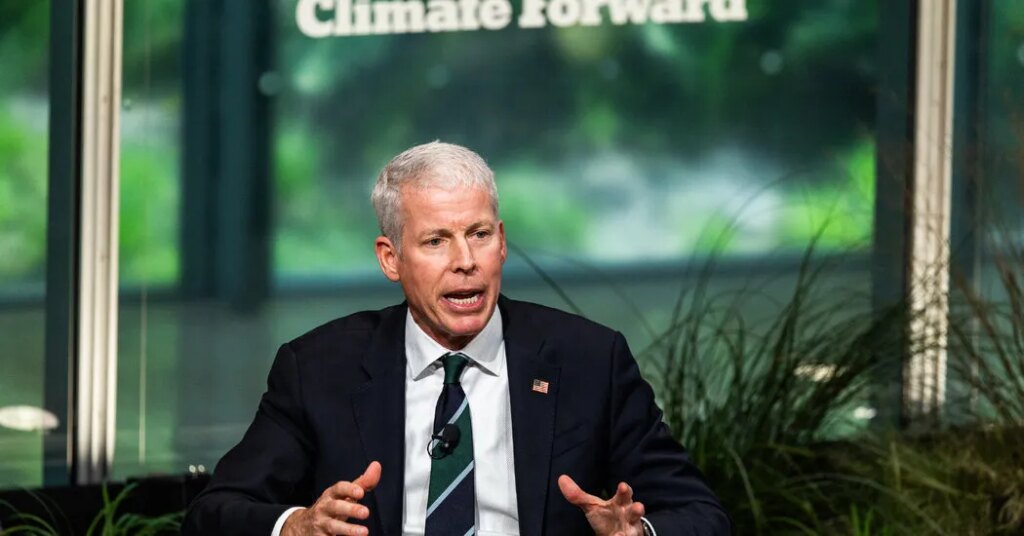
Energy Secretary Chris Wright said on Wednesday that the Trump administration does not want to ban U.S. exports of diesel, an idea floated by some to help curb spiraling costs for households and businesses.
Speaking at The New York Times’s Climate Forward live journalism event, Mr. Wright said that President Trump was reviewing a possible pause on exports as diesel prices hit record highs in the wake of the U.S. war in Iran, threatening a voter backlash over the cost of living before the midterm elections.
“Nobody wants a full blanket ban or zero exports of diesel,” Mr. Wright said. “That’s not being discussed. What’s being discussed is what’s the most efficient way to get more diesel into the United States of America and continue maximum flows of gasoline and jet fuel and all that.”
He spoke as part of a series of wide-ranging interviews with newsmakers that touched on A.I. data centers, new energy technologies, climate activism, deep-sea mining and the Trump administration’s cuts to climate research.
The event underscored how much the administration has shifted the federal government’s focus from fighting climate change — a top priority under former President Joseph R. Biden Jr. — to producing more energy from fossil fuels and managing the fallout from Mr. Trump’s decision to attack Iran this year.
The president has called climate change a “hoax” and pushed to increase domestic production of fossil fuels, the burning of which is the leading cause of global warming. Mr. Wright, a former fracking executive, has been one of the most forceful defenders of the president’s energy policy, which Mr. Trump frequently summarizes as “drill, baby, drill.”
On Wednesday, Mr. Wright defended the Energy Department’s orders to keep five aging coal plants in four states open past their scheduled retirement dates, arguing that it was necessary to prevent people from freezing to death. A federal appeals court this month struck down an order to keep operating a coal plant in Michigan, saying the administration overstepped its legal authority.
Asked why the administration has tried to throttle renewable energy, Mr. Wright criticized solar panels and wind turbines for their inability to produce energy at all hours.
“Every day, actually, the sun goes down, it doesn’t produce power at all,” he said.
While it is true that solar panels only produce power when the sun shines, enormous batteries can store electricity generated during the day for use around the clock.
Mr. Wright also defended Mr. Trump’s full-throated support for data centers, even as voters in both parties express concern about their environmental trade-offs and effects on electricity prices.
“We are not imposing data centers on anyone,” the energy secretary said. “We are saying look at the trade-offs. The positives may be much bigger than the negatives. That’s how we look at all policy. That’s how we look at climate policy.”
Gov. Abigail Spanberger of Virginia, a Democrat whose state has more data centers than any other, said during a separate discussion that states should do more to regulate the facilities and police their effects on air and noise pollution.
“While ultimately the decision needs to live with the locality, as they’re balancing what they’re choosing to approve or not approve, the state has a role in creating the real rules of the road,” she said.
Earlier in the daylong event, Justin Pearson, a Democratic state lawmaker in Tennessee who is running for Congress, accused Elon Musk’s xAI of using dozens of natural gas-burning turbines to power its supercomputer facility in Memphis without proper permits.
“In Memphis, we are facing Elon Musk, the richest person in the world, who has illegally built gas turbines to pollute our community,” Mr. Pearson said. “I’m the only person in the country who is running for Congress who actually lives next to a data center — three miles away from my wife and my home.”
Representatives for xAI did not immediately respond to a request for comment.
In a lawsuit against xAI, the N.A.A.C.P. argued that the turbines were illegally sending noxious pollution into predominantly Black neighborhoods. The Justice Department in June took the unusually aggressive step of asking a federal court to quash the case and others like it nationwide.
As the event unfolded at the Times Center in Midtown Manhattan, about nine blocks east, diplomats and world leaders gathered at the United Nations to discuss efforts to help countries cope with rising seas, stronger storms and other disasters fueled by rising temperatures.
Nepal’s foreign minister, Shisir Khanal, said that deadly floods triggered by a Himalayan glacier collapse last month exposed the “inequities” of efforts to address climate change. He noted that most of Nepal’s energy comes from renewable sources, and the country has contributed a tiny amount to global greenhouse gas emissions.
“These tragedies are not isolated events,” the minister said. “They are symptoms of a global crisis. A crisis Nepal did not create.”
Mr. Trump has withdrawn the United States from the Paris Agreement, the pact among almost all nations to fight climate change, and his administration did not appear to send any officials to the U.N. summit.
Chico Harlan contributed reporting.
The post At a Times Event, Dueling Visions on Climate Change and A.I. appeared first on New York Times.