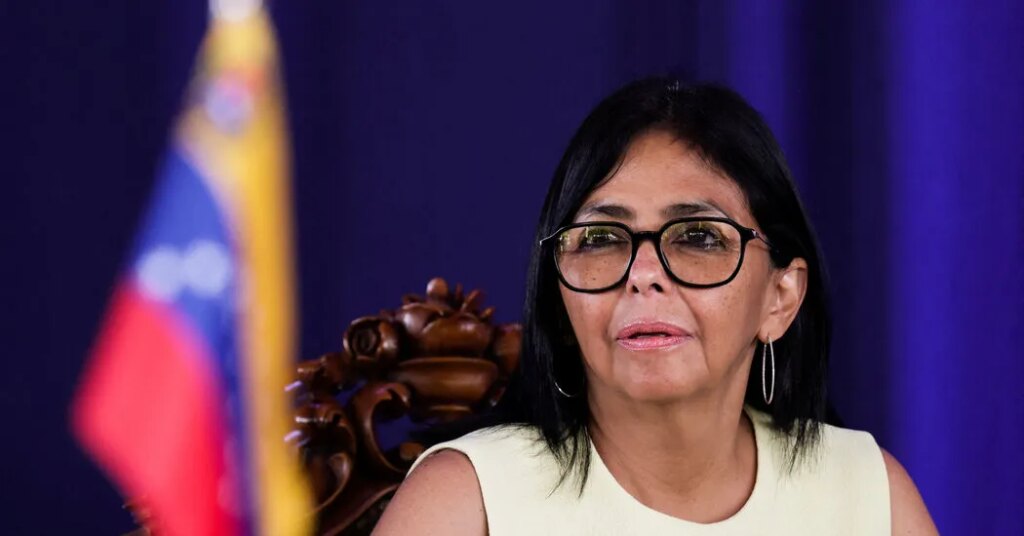
When Venezuela’s interim president, Delcy Rodríguez, takes the stage on Wednesday afternoon to address the United Nations General Assembly, it will be the first time a Venezuelan head of state has done so in person in eight years.
And her speech, which is expected to highlight her interest in international cooperation, is likely to sound radically different from one delivered by her predecessor, Nicolás Maduro, in 2018, when he railed against U.S. sanctions and abuse of power.
It is likely to contrast even more sharply with the most famous speech a Venezuelan leader has delivered at the U.N. — a 2006 appearance in which President Hugo Chávez called President George W. Bush “the devil” who thought he ruled the world.
Ms. Rodríguez’s presence this week at the U.N. in New York in many ways crystallizes the dizzying about-face her government has undergone in the last nine months.
For a generation, her government positioned itself as the political foe of the United States, the socialist counterweight to what it called a capitalist imperialist nation. Then the United States captured Mr. Maduro in January, and Ms. Rodríguez began to build a very public alliance with Washington. Since, Venezuela has become a de facto vassal state, with its finances and much of its resources managed by the Trump administration.
Her one-time ally, Mr. Maduro, now sits in a jail in Brooklyn, awaiting trial on federal charges of narcoterrorism, while Ms. Rodríguez is being greeted with smiles and handshakes in Manhattan. (It is unlikely Ms. Rodríguez will visit him.)
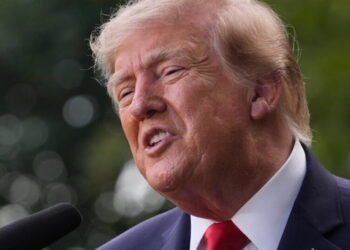
On Tuesday, she met with President Trump, posing with the U.S. leader as he flashed a thumbs up. She called the meeting “historic” in a social media post and said that the two had discussed “strengthening the bilateral relationship” and advancing cooperation on energy, mining and security.
“We expressed our gratitude to President Trump,” she continued, for “steadfast support” following major earthquakes in June.
During the meeting, Mr. Trump called for a new election to take place in Venezuela, according to a U.S. official speaking on the condition of anonymity to discuss the meeting, which the person described as positive and brief.
Ms. Rodriguez responded to Mr. Trump by agreeing to a vote, according to the official.
Representatives from the Venezuelan government did not respond to requests for comment. The White House did not respond to requests for comment.
For years, Mr. Maduro had not attended the U.N. event, the globe’s most important international forum, over concerns that he could be arrested while visiting New York. Instead, he addressed global leaders via video or sent emissaries.
Now, Ms. Rodríguez will take the stage in a speech closely watched by diplomats and business executives around the world. Just last month her government agreed to an oil deal that gave the United States enormous control over 65 billion barrels of Venezuela’s oil, about a fifth of its resources.
Before she became interim president, Ms. Rodríguez played a central role in the government of Mr. Maduro. For years watchdogs have accused that government of egregious human rights abuses.
Just days before Mr. Rodríguez arrived in New York, a U.N. mission charged with investigating those abuses published a report that said that “state institutions responsible for repression, gross human rights violations and crimes against humanity remain fundamentally intact” under Ms. Rodríguez.
Venezuelans in the United States and Venezuela have protested her visit to the United Nations, calling on the Trump administration to pressure Ms. Rodríguez to hold a new presidential election.
While Ms. Rodríguez is being greeted in Washington, Venezuela’s most popular opposition leader, María Corina Machado, says that she continues to be blocked from entering her country. Ms. Machado left Venezuela last year to attend the Nobel Peace Prize ceremony.
Apparently trying to highlight the contrast between her freedom of movement and that of her country’s authoritarian leader, Ms. Machado’s allies said she made three failed attempts to enter Venezuela on Tuesday.
“During the last 24 hours, María Corina Machado has been denied entry into Venezuela three times,” said David Smolansky, a representative. “She has attempted to enter the country by air and sea but has been turned away each time.”
Mr. Smolansky did not specify who had blocked Ms. Machado’s entry.
In New York this week, Ms. Rodríguez has tried to cultivate the image of a soft, personable leader concerned about the state of the world, said Phil Gunson, a Venezuela analyst for International Crisis Group.
Ms. Rodríguez arrived, he noted, wearing a jacket featuring the image of Mafalda, a plucky cartoon character famous in Latin America for being “distressed about all the cynicism and the violence and the censorship,” he said.
The real Mafalda — if she existed — would probably be distressed to see her image used by Ms. Rodríguez, he added.
In her speech, Mr. Gunson predicted that Ms. Rodríguez might make “some nods in the direction of a kind of leftism — but they’re going to be very muffled.”
“Geopolitically, obviously Delcy is now completely bound by the pact with Trump,” he continued. “She’s essentially trying to conciliate the boss.”
Zolan Kanno-Youngs contributed reporting from New York.
The post After Warm Meeting With Trump, Venezuela’s Leader Is Set to Address U.N. appeared first on New York Times.