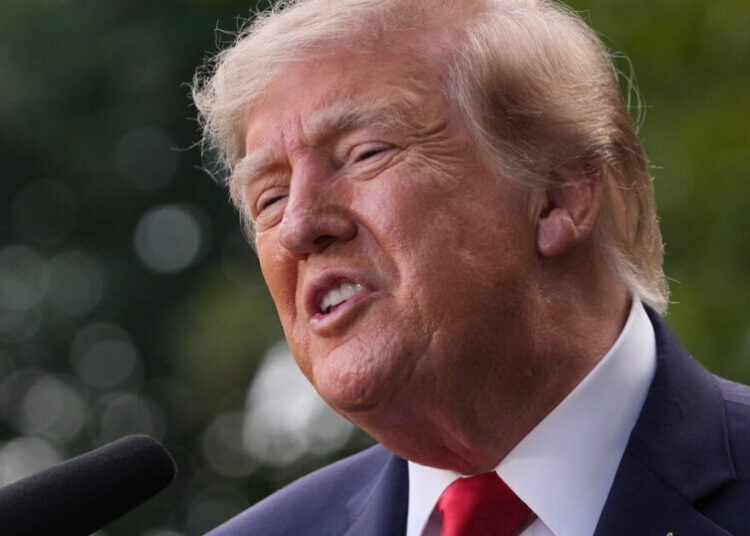
President Trump’s Board of Peace put out a new short-term plan on Wednesday to begin rebuilding the Gaza Strip, even as prior efforts have led to little progress on the ground.
At a briefing in New York, the board — created in January as a central player in Mr. Trump’s plans for the territory — laid out a six-month, $2.45 billion blueprint to decommission weapons in Gaza, clean up debris, provide humanitarian aid and establish a transitional government.
But officials acknowledged that reconstruction funds from international donors have yet to be disbursed. And Israel rejected an earlier plan announced by Mr. Trump and released by the board in July. Prime Minister Benjamin Netanyahu said the proposal, which called for Israel to halt its military operations in Gaza except to defend itself against immediate threats, would jeopardize Israel’s national security. Hamas had agreed to its part of the deal, under which it would gradually dismantle underground weapons depots and relinquish its arms to an interim governmental body under the Board of Peace.
Parliamentary elections in Israel next month, when Israeli voters will decide whether to extend the rule of Mr. Netanyahu’s conservative coalition, have complicated the board’s work, according to Nickolay Mladenov, a member of the board’s Gaza Executive Committee. “Our discussions with Israel right now are not easy, because of the elections there,” he said on Wednesday. “Everything is a bit more emotional, a little bit more politically sensitive.”
The Israeli Embassy in Washington did not immediately return a request for comment on the elections and negotiations with the Board of Peace. Jonathan Harounoff, a former spokesman for Israel at the United Nations, blamed the lack of progress toward a deal on “Hamas’s refusal to demilitarize.”
Israel reduced much of Gaza to rubble in the wake of lethal Hamas-led attacks on Oct. 7, 2023, and has continued launching attacks and restricting humanitarian aid in Gaza despite a cease-fire announced in October of last year. Since then, strikes that Israeli portrays as operations against Hamas operatives have killed nearly 1,400 people in the enclave, according to the latest U.N. report, citing the Gaza Ministry of Health, which does not distinguish between civilians and combatants.
The plan announced on Wednesday would spend more than $1.2 billion on infrastructure redevelopment, including humanitarian shelters and debris clearance, and nearly $900 million for “peace and security” in the first six months after a deal is reached. Board officials stressed the importance of bolstering Gaza’s infrastructure and increasing aid ahead of the winter. And Aryeh Lightstone, a senior adviser on the board, said a fund would be announced “in the very near future” for donors to contribute money toward education, culture and sports in Gaza.
Mr. Trump has framed the Board of Peace as a more effective alternative to the United Nations, but it is facing many of the same challenges that have long hampered the U.N.’s peacemaking efforts in the Middle East. The U.N. Security Council paved the way for the board’s existence in November. Wednesday’s briefing occurred not far from U.N. headquarters during the General Assembly.
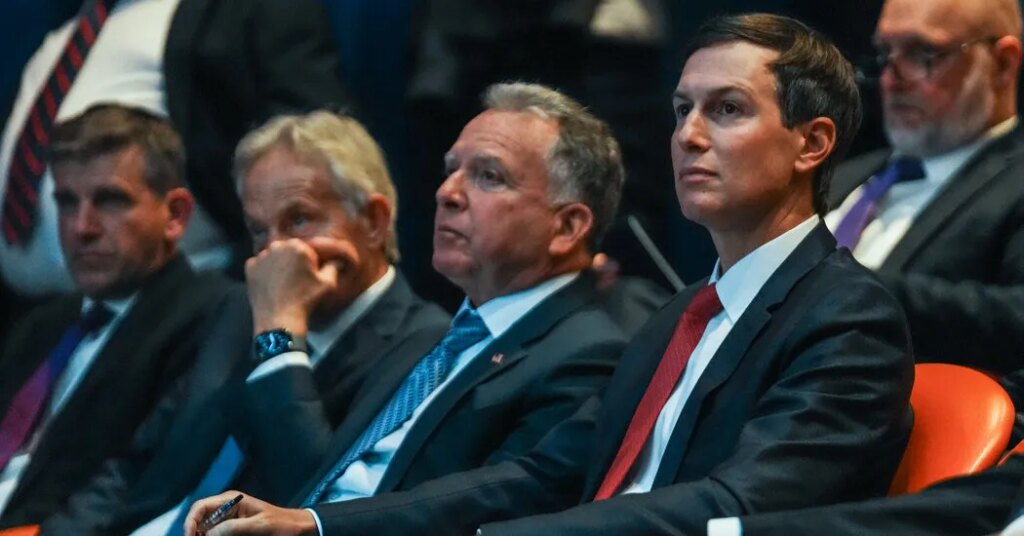
The board, which Mr. Trump may chair in perpetuity according to its charter, includes heads of state — including Mr. Netanyahu — and is led by top Trump administration officials, including Marco Rubio, the secretary of state; Jared Kushner, Mr. Trump’s son-in-law; and Steve Witkoff, the president’s special envoy to the Middle East.
But the real impact of the board so far appears to be limited. “The board seems to facilitate a little bit of communication between Israelis and other people engaged in trying to bring aid to Gaza,” said Max Rodenbeck, a researcher at the International Crisis Group in Brussels. “But they don’t seem to facilitate any actual, clear improvement in the conditions in Gaza.”
Mr. Kushner responded to reporters’ questions about the criticisms of the board’s apparent inaction on Wednesday, saying that preparations were needed to negotiate agreements and plan an effective transition of power in Gaza.
“We’re just refining, sharpening the ax,” he said, “getting ready for when we get the time to cut the tree.”
The post Trump’s Board of Peace Lays Out 6-Month Plan for Gaza That Faces Roadblocks appeared first on New York Times.