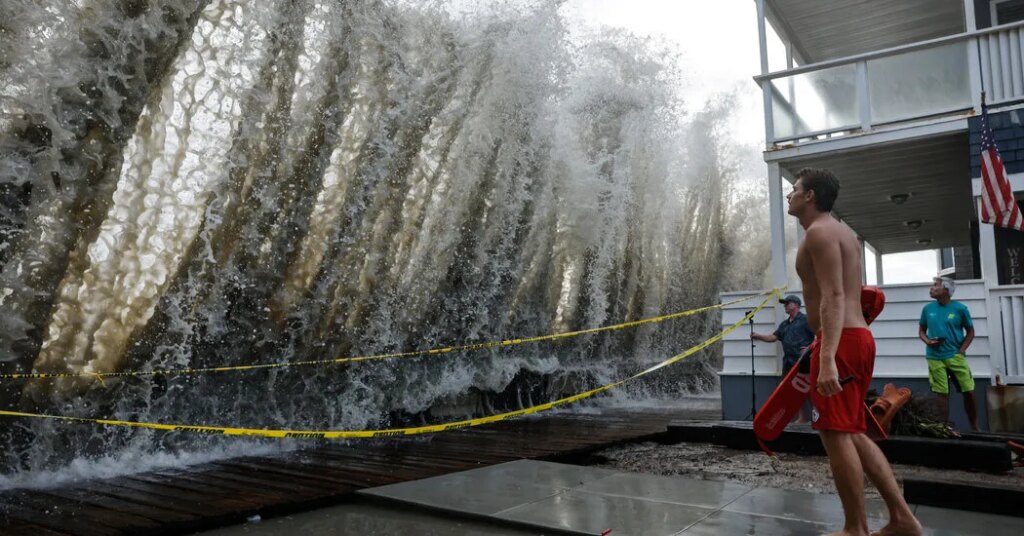
A pair of powerful hurricanes roiling the Pacific Ocean on Wednesday could send big waves to Southern California beaches as soon as Friday, with the turbulent surf expected to continue through the weekend, when tides will be especially high.
While uncertainty remained in the forecast, meteorologists watching the storms said they were confident that the main impact would be surf that could cause flooding and erosion at the coast. The big waves will arrive as some of the region’s coastal cities are still recovering from swells from another offshore hurricane at the start of the month.
Here’s what we know
One of the storms, Polo, is among the strongest hurricanes on record in the Pacific, and on Wednesday it was barreling along the coast of southwest Mexico, where heavy rain had begun to fall. To the west, the less powerful Hurricane Odalys churned over the open sea, 1,200 miles from the southern tip of Baja California.
Neither storm is set up quite the same as Hurricane Marie, which generated waves with a clear path toward Southern California earlier this month, but together they will stir up the ocean and could create surf that hits the coast as hard as Marie did.
“It’s the combination of those two storms that gives us a little more potential for larger surf,” said Ryan Kittell, a meteorologist with the National Weather Service office in Oxnard, Calif. “Even if the numbers don’t tease out like Marie, I think the impacts will be significant.”
It is highly unlikely that Polo or Odalys will cross over to land in California. Potential storm tracks are generated by computer models, and of the dozens of these, none of them show the storms hitting the state.
Most of the projections for Polo show it traveling northwest along the coast of southwest Mexico, and turning toward Baja but not making landfall there. This storm is expected to stay hundreds of miles from California. Odalys will stay even farther from land.
But even a far-off storm can have an impact. When the swell churned up by Hurricane Marie’s swirling winds battered Southern California beaches, properties up and down the coast, from Long Beach to Dana Point, were damaged, condemned and evacuated. In Malibu, a sinkhole opened under the driveway of a luxury beachfront home owned by actor Nicolas Cage.
Big waves from Odalys could reach Southern California as early as Friday. The surf activity is expected to intensify on Sunday, with waves from Polo arriving at beaches as the tide is rising.
“Sunday through Tuesday is the most concerning period, when tides are peaking and the combination of those swells has come together,” Mr. Kittell said.
Moisture from the storms could drift into Southern California as well. It will not be enough for heavy rain, but it could result in muggier weather and bring scattered showers Sunday through Tuesday.
“The latest projections ramp up the chance for rain to 10 to 20 percent,” Mr. Kittell said. “It’s a small but not-zero chance.”
Here’s what we don’t know yet
On Wednesday, it remained unclear just how big and powerful the waves could get at the coast, and Mr. Kittell said there was a “range in the projections.”
In the worst case scenario, the surf activity at the coast could be as severe as it was with Marie, when wave heights reached 12 feet at Zuma Beach in Malibu. There is also the possibility of more moderate waves, but even then the effects could be severe because the coast has been left more vulnerable after the waves from Marie smashed into coastal cliffs and scooped up sand from beaches.
The storms were happening against the backdrop of El Niño. The climate pattern brings warmer waters to the Eastern Pacific, which then serve as fuel for the storms and drive the strong waves.
What happens in the coming days is dependent on the storms’ strength and their eventual paths.
Odalys is expected to follow a track that allows its waves to have a clear path toward California, similar to Marie, but its waves will likely be smaller as it’s a weaker storm.
There’s more uncertainty with Polo, which is an incredibly strong storm. Most of the models show it curving back toward the Baja Peninsula, which would prevent some of the wave action from reaching California.
If that storm were to take a path that heads more to the west, it might allow it to send more big waves to Southern California.
“The more west it goes and the more it can peek its way out from the Baja Peninsula, the more it would enhance waves for Southern California,” Mr. Kittell said.
The post Southern California Watches Warily as Two Hurricanes Churn Far Offshore appeared first on New York Times.